Local Sources Report Explosion in Taloqan City of Takhar Province

Local sources reported an explosion in Taloqan city, the capital of Takhar province, on Tuesday.

Local sources reported an explosion in Taloqan city, the capital of Takhar province, on Tuesday.
According to sources, the explosion occurred around 2:00pm local time in front of the Taliban municipality building. Sources added that a Taliban vehicle had been the target of the explosion.
There is no information yet about the possible casualties from the incident.
Taliban officials have not commented in this regard.
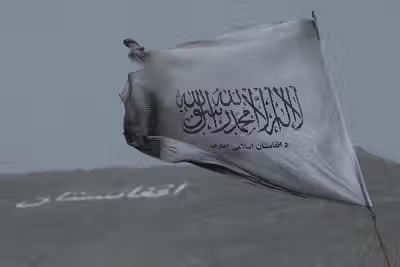

The National Resistance Council for Salvation of Afghanistan has said that essential consultations with political factions opposing the Taliban have not taken place, even as the Taliban has been invited to the Doha meeting.
The council emphasised that in accordance with the Security Council resolution, the United Nations should engage in consultations with all relevant parties before appointing a special representative.
The National Resistance Council in a statement on Tuesday wrote, "The concern of political factions at the national level and numerous meetings and conflicting movements at the international level about Afghanistan indicate the lack of national and international consensus and coherence about Afghanistan with the centrality of the United Nations."
This council had previously asked the United Nations to invite the representatives of the political factions opposed to the Taliban to the meeting in Qatar.
The statement of the council states that the UN Security Council is committed to electing a special representative with all parties involved in the Afghanistan issue.
This council has emphasised that neglecting any of the involved parties will result in the failure of current processes and the prolonged continuation of the Afghan crisis.
Earlier, the UN spokesperson announced that UN Secretary General Antonio Guterres will host a meeting on Afghanistan in Doha on 18 and 19 of February.
Recently, Taliban officials also claimed that they were invited to the meeting.
None of the parties were invited to the first UN meeting on Afghanistan in Doha hosted by Antonio Guterres.

During the regional summit in Kabul, Hassan Kazemi Qomi, Iran's Special Representative for Afghanistan, emphasised on the necessity of fair governance and fostering good relations with neighbouring countries.
Qomi suggested that demonstrating these two core principles in an official declaration would be positively received both regionally and internationally.
During his address at the "Afghanistan Regional Cooperation Initiative" in Kabul, Qomi expressed satisfaction that the summit was organised following Tehran's proposal at the Moscow Format meeting.
He highlighted the importance of establishing a secure platform for Afghanistan's global engagement, respecting its sovereignty and territorial integrity.
The Kabul summit, marking the first instance of the Taliban hosting a regional meeting with ambassadors and special representatives from neighbouring and regional countries, began on Monday afternoon at the Taliban-controlled Ministry of Foreign Affairs.
Despite being delayed due to bad weather as reported by Taliban-controlled media, the meeting eventually started around 4:30 PM Kabul time.
This meeting takes place against the backdrop of the upcoming UN Secretary-General-hosted summit on Afghanistan in Doha.
Amir Khan Muttaqi, the Taliban's Foreign Minister, urged regional representatives attending the Doha summit to accurately present the realities of Afghanistan to the global community. He reassured the participants that Afghanistan does not require a new UN coordinator, given the presence of the United Nations Assistance Mission in Afghanistan (UNAMA).
Muttaqi reiterated the Taliban's stance against the appointment of a new UN special representative, asserting the Taliban government's readiness to address shared concerns and issues. This statement comes in response to the UN Security Council's Resolution 2721 (2023), which recommends the appointment of a representative to facilitate intra-Afghan dialogues for an inclusive government.
In his meeting with representatives from 11 regional countries, Muttaqi emphasised on the Taliban's commitment to regional security, stating the group's intention to prevent instability and insecurity in neighbouring countries.

Amir Khan Muttaqi, the Taliban's Foreign Minister, during a Kabul meeting attended by delegates from 11 regional nations, emphasised on the group's commitment to regional security.
At the "Afghanistan Regional Cooperation Initiative," Muttaqi highlighted the Taliban's desire for regional stability and collaboration.
He declared, "The Islamic Emirate of Afghanistan is poised to engage with regional nations, founded on shared interests and mutual respect."
Muttaqi pointed out that in under two and a half years, the Taliban government's policy has showcased Afghanistan's focus on a mutually beneficial approach within the region.
Furthermore, he suggested that regional cooperation should concentrate on establishing avenues for interaction and collective efforts based on shared interests. This approach aims to develop a regional narrative facilitating positive and constructive engagement with the Taliban, addressing both current and future regional threats.
The meeting at the Taliban-controlled Ministry of Foreign Affairs in Kabul started on Monday afternoon, following a delay. Initially set for early afternoon, it commenced around 4:30 PM Kabul time.
The Taliban-run National Radio and Television attributed the postponement to adverse weather conditions.
Marking a first, the Taliban hosted this regional gathering in Kabul, welcoming ambassadors and special envoys from neighbouring and regional countries.
Reports indicate participation from diplomats and special representatives of adjacent and regional nations. This meeting precedes the upcoming UN Secretary-General-hosted second conference on Afghanistan in Doha, set for February.

Abdul Kabir, the Taliban's Deputy Prime Minister, declared on Sunday in Khost province that international pressure from Western and regional nations to alter the Taliban's conduct has been ineffective.
He called on countries to initiate dialogue and foster "positive and constructive relations" with the Taliban.
Simultaneously, he issued a stern warning, that any form of propaganda or military action against the Taliban would be firmly suppressed. He asserted that the reinstatement of the Taliban regime represented the desires of the Afghan populace, who actively supported the Taliban's jihad against Western forces.
Western and regional authorities have maintained that establishing official relations with the Taliban is contingent upon their adherence to human rights and disassociation from terrorist organisations.
Russia and the United States, despite their ongoing dispute over Ukraine, have jointly urged the Taliban to enter into talks with their political adversaries and strive towards forming an inclusive government.
The Russian Foreign Minister recently called on the Taliban to initiate dialogue with the National Resistance Front (NRF), an anti-Taliban armed group.
The Taliban, in turn, have perceived these requests from Russia and Western nations as undue meddling in their internal affairs and have consequently rejected them. Nevertheless, the Taliban have underlined their commitment to engaging in global dialogues to resolve existing issues in Afghanistan.
Speaking at a graduation ceremony for religious students at a jihadi seminary in Khost, Abdul Kabir emphasised that the Taliban remain open to dialogue for addressing the concerns of the international community and also highlighted that any external pressure on the group would be ineffective.

Ahmad Ariafar, the Director-General of Industry, Mining, and Trade in South Khorasan province of Iran, has stated that the limited exports from Pakistan to Afghanistan present an opportunity for Iran.
The Governor of South Khorasan too has expressed a desire to increase Iran's exports to Afghanistan, proposing to make the Mahirud border crossing operational around the clock.
The Mahirud border crossing, also known as the Mil 78 Point, is a major gateway between Iran and Afghanistan.
According to a report by IRNA on Sunday, Ariafar, speaking at an event in South Khorasan, described Afghanistan as a country with significant potential for Iranian services.
Officials of the Islamic Republic have indicated that construction materials and food products continue to be exported from Iran to Afghanistan.
Based on figures provided by Iranian authorities, the country has exported 67,000 tonnes of agricultural products to Afghanistan this year alone.