Taliban’s Defence Minister Claims Political Pressure Ineffective

Mohammad Yaqoob Mujahid, the Defence Minister for the Taliban, declared during a Kabul meeting that political pressures exerted on the group’s government remain ineffective.

Mohammad Yaqoob Mujahid, the Defence Minister for the Taliban, declared during a Kabul meeting that political pressures exerted on the group’s government remain ineffective.
Mujahid suggested that instead, such pressures fortify the bond between the populace and the Taliban.
This statement was made at a symposium organised by the Taliban's Ministry of Borders and Tribal Affairs, focused on "Strengthening the Islamic System and National Unity," held at the Loya Jirga Hall.
Mujahid criticised the opposition’s political leaders, accusing them of exploiting ethnic sentiments to the detriment of national interests.
He urged the Afghan population to reject any individual or group fostering sedition.
Taliban media outlets reported from the meeting and highlighted Mujahid's claim about past efforts to sow discord among Afghans, which he noted had achieved partial success, though specific projects were not mentioned.
Additionally, Mohammad Khalid Hanafi, the Minister of Vice and Virtue, reiterated the Taliban's stance against division, asserting the regime's commitment to unity across ethnic lines. Hanafi also boasted of the Taliban's achievements in eradicating poppy cultivation and addressing drug addiction issues within the country.
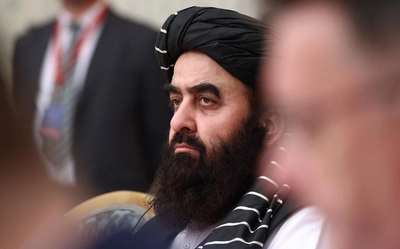
Hassan Kazemi Qomi, Iran's Special Representative for Afghanistan says that if necessary, "more than one army of suicide bomber forces" will be deployed from Afghanistan to support Gaza.
The Iranian envoy told state-controlled Ufogh TV that Afghanistan, although geographically distant from Gaza, is considered part of the "Axis of Resistance”.
Iranian government designates the groups it supports, along with others combating the Western coalition and Israel in the region, as the "Axis of Resistance.”
In response to whether he was referring to "the people of Afghanistan" or "Afghanistan under the rule of the Taliban," Qomi stated that Afghanistan has been engaged in a 40-year war against the "occupier”, emphasising that this war is not specific to one nation or group.
While Iran supports Hamas and other Palestinian groups against Israel, the Taliban regime has primarily limited itself to issuing statements against "Israel's crimes" and organising small rallies in support of the people of Gaza.

Quoting Feridun Sinirlioglu, UN Special Coordinator for Afghanistan, the Taliban has stated that there is no desire for the collapse of their government, and stakeholders want them to join the international community.
In a meeting with Abdul Kabir, the Taliban’s Deputy Prime Minister, Sinirlioglu said that the Taliban must be committed to international laws.
The Taliban has propagated this matter, while the UN stated that various armed factions, such as the National Resistance Front and the Afghanistan Freedom Front, are actively engaged in efforts to oust the Taliban government.
According to the Taliban's announcement, Sinirlioglu in the meeting said that significant decisions regarding Afghanistan will be made at the forthcoming Doha meeting.
The UN Special Coordinator for Afghanistan, as per the statement, emphasised that the international community, including the United States and European countries, expressed a keen interest in establishing relations with the Taliban.
Also, Sinirlioglu has said that the World Bank will hold a meeting regarding Afghanistan in the near future.
In this meeting, Abdul Kabir stressed about on the imperative for the Doha meeting to address crucial matters such as the reconstruction of Afghanistan, the provision of humanitarian aid, and the removal of banking sanctions.
Sinirlioglu had previously met with Amir Khan Muttaqi, the foreign minister of the Taliban, and discussed the Doha meeting.
Muttaqi stated that his decision to participate in the meeting would be contingent on receiving information about the agenda and composition of the gathering.
The Doha meeting about Afghanistan is scheduled to be held on 18 and 19 of February.

The Afghanistan Women's Political Network, in anticipation of the upcoming Doha meeting, has called for establishing a democratic and republican system reflecting the people's will.
The network asserts that the United Nations should convene the Doha meeting with the aim of dismantling the Taliban government.
This call comes as the second United Nations meeting on Afghanistan in Doha, Qatar, is set to occur in less than two weeks. The Afghanistan Women's Political Network, a prominent women's protest movement, has issued a statement highlighting the necessity of focusing on the rights of women and girls in Afghanistan during the meeting.
Since the Taliban regained power, the network's statement notes that over 52 written and numerous oral decrees have been issued against Afghan women. The network stresses that women and girls in Afghanistan have been stripped of all their rights.
The network's expectations from the Doha meeting include ensuring the safety of women and girls, enhancing education and health, promoting gender equality, and strengthening civil society institutions in Afghanistan.
To realize these goals, the Afghanistan Women's Political Network calls for increased international pressure on the Taliban and urges the global community to withdraw economic support from the regime.
Previously, Afghan women activists sent an open letter to the United Nations, requesting the inclusion of women's representatives in the Doha meeting. The meeting, hosted by the UN, will see the participation of special representatives from countries with envoys in Afghanistan. The Taliban have been invited to the meeting, but they will decide on their participation after further information on the meeting's agenda and attendees.

Local Taliban officials in Herat have stated that commercial goods transportation via the Herat-Khaf railway line will be launched in the next 15 days.
They mentioned that traders would benefit from tax discounts at key ports and borders, including Chabahar, Bandar Abbas, and Turkey.
Bakhtar News Agency, under Taliban control, reported on Tuesday that this railway route is anticipated to ferry around 100,000 tonnes of commercial goods and approximately 100,000 passengers in its inaugural year.
However, the Taliban forecasts suggest a significant increase in the route's capacity, potentially transporting over 500,000 tonnes of goods annually within five years.
Officials also stated the commencement of passenger services on the railway route in April. About 400 Taliban security forces will be deployed at four strategic posts along the route for security.
The officials also pointed to the ongoing expansion project of the Torgundi railway extending to Rabat Paryan, covering 113 kilometres.
The Herat-Khaf railway, inaugurated in October 2022 in a joint event by the Islamic Republic and the Taliban, measures 226 kilometres, links Afghanistan to Iran's railway network. The railway stretches 77 kilometres within Iran and 149 kilometres across Afghanistan.
Ya'qub Ali Nazari, Governor of Khorasan Razavi in Iran, highlighted the railway's substantial annual cargo capacity of approximately six million tonnes, which is pivotal for export and transit development with China and Central Asia.

Vedant Patel, a US State Department spokesperson, told Afghanistan International on Monday that the United States has no immediate intention to resume its diplomatic presence in Afghanistan.
He highlighted that the US engagement with the Taliban is primarily centered on human rights issues and the reinstatement of girls' education.
Responding to journalist Marzia Hosseini from Afghanistan International, Patel underscored that any normalisation of relations with the Taliban hinges on their respect for the rights of all Afghan citizens.
This statement coincides with the recent acceptance of the Taliban ambassador's credentials by the President of China. Concurrently, Voice of America's English section reported, while referring to an official document, that the US State Department is contemplating the reactivation of its consular services in Kabul.
Patel affirmed the US’ ongoing commitment to engaging with the Taliban and Afghans abroad while maintaining pressure on the Taliban to change their discriminatory policies.
The US government has notably abstained from official interactions and talks with major Afghan opposition groups, such as the National Resistance Front and the National Resistance Council for Salvation of Afghanistan, over the past two years. This stance persists even as these opposition factions seek international support, including from the US, for their political endeavours against the Taliban regime.
