Officials From China & Turkmenistan Discuss Afghanistan
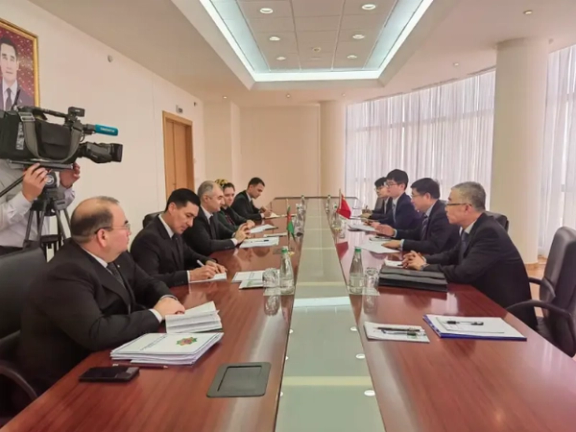
Yue Xiaoyong, China's special envoy for Afghanistan, announced that he met Turkmenistan's Deputy Foreign Minister, Ahmet Gurbanov, and discussed the situation in Afghanistan.
Yue Xiaoyong, China's special envoy for Afghanistan, announced that he met Turkmenistan's Deputy Foreign Minister, Ahmet Gurbanov, and discussed the situation in Afghanistan.
He said that China backs Turkmenistan’s claim to hold the fifth meeting of the foreign ministers of Afghanistan’s neighbouring countries in 2024.
The Chinese special envoy wrote on X social media platform on Friday that they are enhancing their joint effort to help the reconstruction of Afghanistan.
The fourth meeting of the foreign ministers of Afghanistan's neighbouring countries had been held in Uzbekistan. Foreign ministers and representatives from Iran, China, Russia, Pakistan, Uzbekistan, Tajikistan, and Turkmenistan attended the meeting.
One of the objectives of these meetings is to address and find solutions to Afghanistan's political challenges through diplomatic discussions among the neighbouring nations.

Jan Achakzai, the Information Minister of Balochistan, in an interview with Afghanistan International, pointed out that the Taliban is yet to convey its official viewpoint on the Durand Line to Pakistan.
Achakzai criticised the description of the Afghanistan-Pakistan border as an "imaginary line" as nonsensical.
During a discussion on Friday, he labeled the boundary between Afghanistan and Pakistan as a formally recognised and official international border.
He further clarified that Pakistan harbours no disputes with the Taliban on this issue, remarking, "If anyone harbours the foolish illusion that this border is imaginary, it remains merely a dream."
Sher Mohammad Abbas Stanikzai, the Taliban's Deputy Foreign Minister, had previously declared the absence of an official border between Afghanistan and Pakistan, instead referred to the Durand Line as an "imaginary line”.
Stanikzai firmly stated the group's refusal to acknowledge the "imaginary" Durand Line as the legitimate frontier between the two nations.
Responding to Stanikzai's comments, Achakzai dismissed them as manipulative and possibly influenced by external forces such as India.
"The Taliban has not formally presented their stance on this issue to Pakistan. If Taliban figures like Stanikzai have made such statements, I personally suspect they might be instigated by India or other entities," stated Achakzai.
The Balochistan Information Minister underscored the Taliban's attempts to deflect public attention from the challenges of unemployment, poverty, and migration.
Achakzai suggested that some government’s politicians, driven by internal necessities and aiming to shift public focus from pressing domestic issues, may seek a scapegoat, thereby straining ties with neighbours. Thus, he interpreted a senior Taliban official's populist claims as an effort to shift public scrutiny toward Pakistan and rally support.
The designation of the border as "imaginary" gained traction during Hamid Karzai's presidency when he instructed government bodies to refer to the Durand Line as such.
Afghanistan International's sources confirm that Elias Mohammadi, a young Afghan worker who was killed by being thrown from a bridge in Tehran, Iran, has been buried in Herat, Afghanistan, last Saturday.
A "supporter of the Islamic Republic" had thrown him off the bridge thinking he had insulted the Iranian flag.
Mohammadi's family members report that in the early hours of February 9, a member of the Basij threw Elias Mohammadi, who was cleaning the street, off the Niayesh bridge in Tehran. He lost his life due to the fall and vehicles crossing over him.
In the two weeks following the incident, the Iranian government has been silent about the killing of Mohammadi. However, Iranian social media users have launched a campaign for Mohammadi.
One of Mohammadi's relatives, who did not want to be named, told Afghanistan International that it took a week for the victim’s family to receive the body and transfer it to Herat.
According to the source, Mohammadi's body was buried on Saturday in his hometown in Obe district of Herat province.
Having arrived in Iran six years ago, Mohammadi was working at a fruit shop in Tehran's 5th district during the day. Additionally, he worked with a municipal contractor company, cleaning the streets of the Iranian capital during the night.
A colleague of Mohammadi told the Iranian media, "We were working with the municipal contractor, cleaning the walls of the overpass on the night of the accident. Unexpectedly, a car pulled up in front of us. He abruptly exited the vehicle and approached us. Without any warning, he engaged in a confrontation with our colleague (Elias) and subsequently threw him off the bridge. We rushed towards him to prevent his escape, but the assailant threatened us, warning that he would do the same to us if we followed him. He, then, fled in a car with his accomplices."
Witnesses have said that several cars passed over the body of victim, who was lying on the highway.
Iranian media said that the arrested killer is a 25-year-old young man with a bachelor's degree. According to some sources, he is a member of Basij, supporting the Islamic Republic of Iran.
He told the media, "I was passing that road when suddenly I saw the victim and his friends. I imagined that they were going to steal the flags that were raised on the side of the highway. The flags were raised on the occasion of Anniversary of the Iranian Revolution, and I thought that the victim intended to insult the flags and wanted to destroy them."
He confirmed that he had reported to the police before attacking Elias Mohammadi, however, he said, "I could not sit still, got out of the car, and after fighting with the victim, I pushed him, and he fell down and died.”
Despite announcing the identity and nationality of the victim, the Taliban and the Afghan embassy in Tehran, which is under the control of the group, have not reacted to the news.
The National Resistance Front (NRF) has said that the "one-sided approach" of the United Nations and countries towards Afghanistan is a matter of concern in the absence of political forces opposing the Taliban.
The NRF asked the United Nations to give the front an opportunity to present its concerns, suggestions and practical alternatives.
In its statement, the front emphasised that not listening to the majority of the oppressed Afghan people “will doom the United Nations plan to fail from the outset.”
The statement quoted Ahmad Massoud, the leader of NRF as saying, "All voices must be heard, not just those of the Taliban which comes with threats, intolerance, and violence.”
The Front stated that while it respects the right of the United Nations to discuss ways to help Afghanistan, the future of this country can only be decided by the people of Afghanistan, regardless of their ethnicity, gender, or religion.
NRF has welcomed the refusal of the United Nations to accept the "unreasonable" conditions of the Taliban to participate in the Doha meeting.
According to the front, until a framework of a level-playing field for fair political representation from Afghanistan is established in such meetings, the outcomes will continue to be questioned by the Afghan people.
NRF said that political forces are currently working on creating such a framework.
According to the statement, considering the views of all stakeholders, and prioritising the opinions of the political forces, women and the armed opposition of the Taliban, regarding establishing an inclusive government through democratic means, improving human rights, fighting against terrorism, and ending foreign geopolitical interventions in Afghanistan is necessary.
The front added that it welcomes the appointment of the United Nations Special Envoy for Afghanistan and at the same time, it expects that the process will be closely consulted with the opposition forces of the Taliban and other stakeholders.
A meeting convened by the Secretary General of the United Nations took place in Doha on February 18 and 19, where representatives from various countries were in attendance. The Taliban declined the invitation to participate, citing disagreement with the specified conditions. However, no invitations were extended to political opponents of the Taliban for this meeting.
Mawlawi Abdul Kabir, the Deputy Prime Minister of the Taliban, has expressed dissatisfaction with the United Nations for overlooking the Taliban's requests at the Doha meeting, calling the decision as “unfair”.
He contended that the Taliban's propositions, which he described as aligned with "national interests," were unjustly disregarded by the United Nations.
The office of the Taliban's Prime Minister announced that Mawlawi Abdul Kabir shared these concerns during discussions with members of the Youth Council from 22 districts of Kabul.
The second Doha meeting, aimed at addressing Afghanistan's situation and hosted by the UN Secretary-General, drew representatives from more than 25 countries.
Amir Khan Muttaqi, the Foreign Minister of the Taliban, was initially slated to attend the meeting. However, his participation was ultimately revoked following UN Secretary-General Antonio Guterres' refusal to meet with him, thus barring the Taliban's senior diplomat from the event.
Despite the Taliban's insistence that no individual or group represent Afghanistan at this assembly, the United Nations did not accommodate this request. Instead, the UN invited a delegation comprising three women and two men from the Afghan civil society to partake in the discussions in Doha.
Amnesty International has called on the Taliban to abolish the death penalty and stop all executions.
The organisation opposes all forms of execution as it violates the right to life. Amnesty International has described the Taliban's practice of public executions as a gross affront to human dignity.
The human rights organisation stated that the death penalty is a violation of international laws and standards and is intolerable.
Amnesty International has urged the Taliban to abolish the death penalty and other cruel, inhuman, and degrading punishments.
In a statement released on Friday, February 23, the organisation mentioned that public executions add to the inherent injustice of the death penalty and can only have an inhumane effect on the victim and a brutalising effect on those who witness the execution.
This statement was published a day after the Taliban's Supreme Court announced on Thursday, February 22, that two men were executed in a stadium in Ghazni province, with the approval of Hibatullah Akhundzada, the group's leader, on murder charges.
Eyewitnesses told Afghanistan International that the Taliban shot these two individuals at a stadium in the centre of Ghazni city.
Amnesty International supports the right to a fair trial for the accused and said that the violation of fair trial principles in Taliban courts is concerning.
The organisation stated that it is time for the international community and the United Nations to pressurise the Taliban for their blatant violation of human rights and ensure compliance with international laws in Afghanistan.
Previously, the United Nations had also opposed the death penalty and urged the Taliban to abolish execution sentences.