• العربية
  • پښتو
  • فارسی
Brand
  • Afghanistan
  • Sport
  • Markets
  • Afghanistan
  • Sport
  • Markets
  • Theme
  • Language
    • العربية
    • پښتو
    • فارسی
  • Afghanistan
  • Sport
  • Markets
All rights reserved for Volant Media UK Limited
volant media logo

UNSG Special Representative Announces Readiness For 3rd Doha Meeting
Mar 7, 2024, 10:12 GMT+0

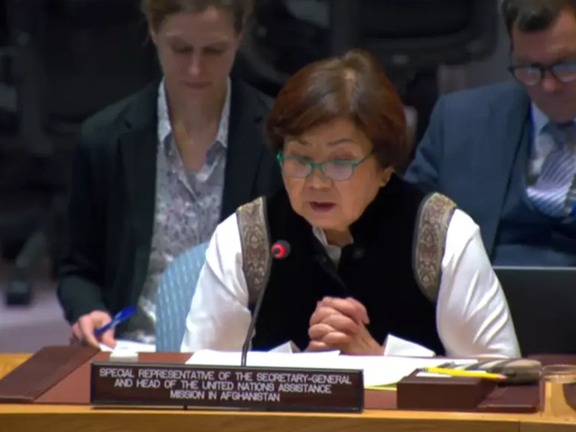
Roza Otunbayeva, the UN Secretary-General's Special Representative for Afghanistan, has announced preparations for the third Doha meeting on Afghanistan.

Otunbayeva expressed hope for the participation of the Taliban delegation and other relevant groups in the upcoming meeting, though she did not provide specific details regarding its date.

During a report to the UN Security Council on Wednesday, she emphasised on the need for the third Doha summit to have a practical agenda, with discussions aimed at achieving tangible outcomes aligned with the organisation’s objectives.

The third meeting is anticipated to differ from the previous two Doha meetings, with the discussions taking place at a different level and potentially without the presence of the UN Secretary-General, unlike the earlier gatherings.

The second Doha meeting was held on February 18 and 19 in the presence of UN Secretary General, Antonio Guterres and special representatives of 25 countries and international organisations for Afghanistan.

This meeting ended without a clear result due to the refusal of the Taliban to participate in it and also because the conditions of this group were not accepted.

Source of Instability In The Region And World

Otunbayeva called Afghanistan a challenge to the international community and a source of instability during the meeting of the Security Council on Wednesday and added that terrorism has been exported from the country to other parts of the world.

She also said that in the region and beyond, there are concerns about the presence of terrorist groups in Afghanistan.

She emphasised that the concerns extend beyond the presence of ISIS in Afghanistan. According to Otunbayeva, the presence of Tehreek-e-Taliban Pakistan (TTP) in Afghanistan is a significant worry for Pakistan, as the country has experienced terrorist acts in recent months.

During the meeting, the UNSG Special Representative stated that the organisation will maintain its engagement with the Taliban. She highlighted ongoing consultations with Afghans on human rights issues and the inclusion of people's representatives in the political decision-making process.

Otunbayeva also discussed international aid, noting that over the last three years, approximately eight billion dollars have been provided to the people of Afghanistan. She emphasised that the aid from the international community has played a crucial role in promoting economic stability and supporting the private sector in Afghanistan.

She appealed to the international community and donors to persist in their assistance to Afghanistan.

Most Viewed

Taliban Order Cut To Residential Fibre-Optic Internet In Kabul, Say Sources
1

Taliban Order Cut To Residential Fibre-Optic Internet In Kabul, Say Sources

2

Taliban Reject Pakistan Army Chief Remarks, Urge Islamabad To Tackle Militants

3

Taliban Treatment Of Women May Amount To Crime Against Humanity, Says UN Rapporteur

4

Taliban Beat Shia Cleric In Kabul After Marriage Dispute, Say Sources

5

Arrests & Killings Of Former Afghan Forces Continue, Says UN

•
•
•

More Stories

Taliban Shouldn’t Threaten Territorial Integrity of Neighbouring Countries, Says Pakistan

Mar 7, 2024, 08:53 GMT+0

Munir Akram, Pakistan's Permanent Representative to the United Nations, asked the Taliban not to threaten the national sovereignty and territorial integrity of neighbouring countries.

During the UN Security Council meeting on Wednesday, he said that threatening the territorial integrity of these countries in the short or long term is not beneficial to Afghanistan.

This is the first time that Pakistan, a long-time supporter of the Taliban, has accused the group of threatening the territorial integrity of other countries at an international meeting.

Earlier, Abbas Stanikzai, deputy foreign minister of the Taliban, had said that the Taliban does not recognise the border between Afghanistan and Pakistan, known as the Durand Line. He once again repeated the territorial claims of previous Afghan governments against Pakistan.

Unlike the past, Akram refrained from supporting the Taliban during the Security Council meeting, indicating Pakistan's dissatisfaction with the Afghan Taliban for failing to curb attacks by Pakistani militants from Afghan territory against Pakistani security forces.

Akram, who seemed aligned with nations critical of the Taliban in the Security Council, said that the group should fulfil all international obligations of Afghanistan and adhere to international laws. He urged the UN to conduct an inquiry into the financial and weapon resources of Tehreek-e-Taliban Pakistan.

Addressing the dire humanitarian situation in Afghanistan, the Pakistani diplomat emphasised that the UN lacks the necessary funds for humanitarian aid in the region. Consequently, he called on countries to contribute for the revitalisation of the Afghan economy and the release of frozen assets in Western nations.

Sharif, Unlike Kakar, Doesn’t Blame Taliban for Pak's Internal Issues, Says Group’s Media

Mar 6, 2024, 16:07 GMT+0

Bakhtar News Agency, under Taliban control, in an analytical article about the election of Shehbaz Sharif as the Prime Minister of Pakistan wrote that Pakistan no longer blames the Taliban for its internal problems.

The Taliban has not officially congratulated the new prime minister of Pakistan.

As per the article published on the Bakhtar News Agency website on Tuesday, the Taliban shows a willingness to collaborate with Pakistan in terms of cooperation and integration.

Referring to the problems in relations of the previous government of Pakistan with neighbouring countries, including Iran and India, Bakhatar news agency wrote, "These are all challenges that show that the new prime minister has a lot of work to do."

In this analytical article, Shehbaz Sharif, the new prime minister of Pakistan is mentioned as an experienced politician and it has been stated, "A number of Pakistani politicians and soldiers had an adventurous view of the current system of Afghanistan and have made many accusations and caused problems for the country."

As per the note, the previous government of Pakistan had linked its internal problems to the Taliban.

Bakhtar news agency wrote that the Taliban has a positive view toward its neighbour and expects the new government of Pakistan to follow a path for constructive cooperation with neighbouring countries and Afghanistan.

It added that the decision to deport Afghan refugees from Pakistan has been a "hasty decision".

Shehbaz Sharif became the 24th Prime Minister of Pakistan on Sunday winning the majority of the National Assembly's votes against Omar Ayub Khan from the Tehreek-e-Insaf party.

So far, China, India, Turkey and Iran have congratulated Shehbaz Sharif on the position of Prime Minister.

Taliban Publicly Punishes 11 Individuals in Maidan Wardak & Kabul

Mar 6, 2024, 14:26 GMT+0

The Taliban’s Supreme Court announced that it has punished 10 people, including two women and eight men, in Maidan Wardak province on charges of "adultery, sodomy and immorality"

Additionally, one man in Kabul was punished for public theft. The court added that Chak district court sentenced nine of these individuals, while Maidan Shahr court sentenced one of these individuals.

In a statement on Wednesday, Taliban’s Supreme Court wrote that these people who had completed their imprisonment and were punished in public.

In a separate statement on Wednesday, it stated that an individual was flogged 39 times on the charge of theft in Kabul.

The Taliban's statement did not explain the nature of the punishment, but it added that the Tazir sentence was implemented for these people. The group usually whips the accused in such cases.

According to the statement of the Taliban’s Supreme Court, these people were punished in the presence of the residents of Maidan Wardak province, court officials and other Taliban officials in this province.

It states, "Hudud and retribution are God's mercy, and the implementation of it, creates peace and happiness."

Although the Taliban have resumed corporal punishment following the takeover of power in Afghanistan, recently the authorities of the group have increased corporal punishment such as flogging, hand amputation and execution.

Recently, the group apprehended and penalised three individuals in Sar-e-Pul province, two in Kabul, eight in Herat, four in Laghman and Balkh, and 13 people in Bamiyan province. The charges against them included "adultery," "immorality," and "illicit relationships”.

Recently, the United Nations expressed concerns about the continuation of corporal punishment in Afghanistan, asked the Taliban to cease such punishments.

In response, the Taliban said that they adhere to Islamic Sharia law, emphasising that external organisations and countries should refrain from interfering in Afghanistan's internal affairs.

Helmand River Water Reaches Afghanistan-Iran Border Point

Mar 6, 2024, 12:55 GMT+0

Tasnim news agency has reported that the rise in rainfall within the Helmand River's catchment area, coupled with the filling of the Kamal Khan Dam, has led to the release of water into Iran.

According to the Iranian news agency, the water from the Helmand River has now reached "Jarikeh" dam situated at the Afghanistan-Iran border.

It also noted that the filling of the Kamal Khan Dam resulted in the release of some muddy floods into Iran.

The Taliban has not commented on the matter yet.

An official from Sistan and Baluchistan in Iran has confirmed the release of water towards Iran. The official clarified that it is not in accordance with the water treaty between Iran and Afghanistan. Instead, the agreement solely involves opening the gates of the Kamal Khan Dam, redirecting the flow towards Iran rather than the Godzare desert.

This release began on Wednesday night and is expected to continue in the upcoming days due to increase in rainfall in Afghanistan.

The Taliban has obstructed the Helmand River's passage to Iran by constructing multiple water dams.

AFF Carried Out 24 Verified Attacks On Taliban, Says UNSG

Mar 6, 2024, 11:35 GMT+0

Antonio Guterres, the Secretary-General of the United Nations, stated that the Afghanistan Freedom Front (AFF) conducted 24 verified attacks against Taliban forces between November 1, 2023, and January 10, 2024.

However, in his quarterly report, Guterres noted that the Taliban’s armed opposition has not given any territorial challenge to the group.

On Wednesday, March 6, the United Nations Assistance Mission in Afghanistan (UNAMA) released the quarterly report of the UN Secretary-General on the situation in Afghanistan. In this report, Guterres expressed the challenge of assessing the capabilities of the Taliban's armed opposition, citing difficulty in verifying many claims made on social networks regarding their attacks.

However, Guterres has confirmed that AFF has continued to carry out assassinations and "small-scale attacks" against Taliban forces. According to the report, AFF has shifted attacks from rural to urban areas.

The report provided specific instances of AFF activities, including four attacks in Pul-e-Khumri, Baghlan, four attacks in Kabul, one in Kandahar, one in the Aybak city of Samangan, and one in Mazar-e-Sharif.

It added that the National Resistance Front (NRF) has been most active in Parwan and has not carried out any attacks in its traditional stronghold of Panjshir.

Antonio Guterres said that some other armed opposition groups of the Taliban have also announced their existence and claimed to attack the Taliban forces, but none of these reports have been verified.

Request to Stop Corporal Punishment

The Secretary General of the United Nations wrote that the continuation of the introduction and implementation of Taliban policies that violate the rights of men and women in Afghanistan is alarming.

Antonio Guterres called on the Taliban to cease corporal punishment, which is contrary to Afghanistan's obligations under the Convention against Torture.

Taliban recently executed at least three people in Jowzjan and Ghazni provinces. In one of these cases, Afghanistan International sources said that the Taliban shot dead two individuals sentenced to death.

In addition, the Taliban has flogged dozens of people on various charges during their two-and-a-half-year rule.

Another Day of Grief for Afghan Girls

Guterres has once again called the deprivation of Afghan women and girls from education deeply concerning.

“As the ban on secondary schooling for girls remains, the start of the new school year in March will be another day of grief for Afghan girls and for the world,” he said.

Guterres asked the Taliban to immediately reverse the ban on girl’s education.

He stated that there is uncertainty about the Taliban’s ability to create an education system to address the challenges faced by Afghan youths in acquiring essential knowledge and skills.

The United Nations Secretary-General said that although there is little information about Taliban’s religious madrassas, he is concerned that the quality of education in these institutions doesn’t adequately prepare boys and girls for joining an effective workforce in the future.

Increase in Taliban Prisoners

Guterres’ report also states that the number of prisoners in Taliban prisons exceeded 19,000 in January, which has made it difficult for the group to handle and manage prisons.

As per the report, financial restrictions and the cessation of aid to Taliban prisons have failed to meet international standards. This includes inadequate access for prisoners to sufficient food, health services, and essential training.

The United Nations has indicated that discussions are underway among the Taliban leadership, the Supreme Court, and the Ministries of Economy and Justice regarding a plan for alternatives to imprisonment.