Pakistan’s Imports From Afghanistan Significantly Decreased, Says Pak Media

Pakistani media reported a 20 percent increase in Pakistan's exports to Afghanistan last month, while imports from Afghanistan decreased by nearly half.

Pakistani media reported a 20 percent increase in Pakistan's exports to Afghanistan last month, while imports from Afghanistan decreased by nearly half.
Pakistan exported goods valued at USD 117 million to Afghanistan in March of this year. According to reports from Pakistani media, the total value of Pakistan's exports to Afghanistan in February was USD 104 million.
However, Afghanistan's exports to Pakistan were worth USD 71 million in February, but this figure dropped to USD 36 million in March.
While the reason for the decline in Afghanistan's exports to Pakistan is not clear, it has been said that Pakistan has blocked the Torkham and Chaman border crossings for Afghan drivers citing passport issues.
The ongoing conflict between Taliban forces and Pakistanis at the border is another factor contributing to the reduction in Afghanistan's exports to Pakistan.
Recently, a Pakistani official from the Ministry of Commerce visited Kabul. According to the Taliban, an agreement was reached during this visit to separate politics from trade and facilitate transit, ensuring the interests of people of both the countries.
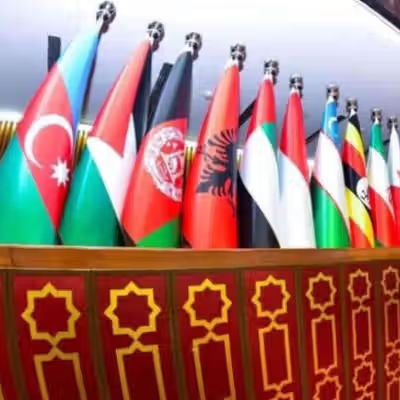

Hamdullah Fitrat, Deputy Spokesperson of the Taliban, responded to the remarks made by the UN Secretary-General spokesperson, stating that appointing a special representative for Afghanistan is an unnecessary step.
He emphasised that with the presence of UNAMA in Afghanistan, there is no need for the appointment of a new special representative.
The Taliban-controlled Radio Television Afghanistan (RTA) reported on Tuesday that Fitrat stated, "Now that there is peace and stability in Afghanistan and the era of war and bloodshed is over, there is no need for the appointment of another representative alongside UNAMA."
This Taliban official reacted to the appointment of a special representative for Afghanistan, while Stephane Dujarric, the spokesperson for the United Nations Secretary-General, stated on Monday that the process of appointing a special representative for Afghanistan by the organisation is ongoing.
Not long ago, Suhail Shaheen, the head of the Taliban's political office in Qatar, responded to statements made by the head of the UN Security Council, stating that the selection of a UN special representative for Afghanistan is "unacceptable”.
He stated, "We seek to engage with the international community and address issues based on our interests and principles."
The United Nations has been deliberating over the appointment of a special representative for Afghanistan for months, but the Taliban has consistently opposed such an appointment.
The group said that the Security Council resolution, which called for the appointment of a special representative for Afghanistan, was passed without consulting the Taliban.

The Taliban's Commission for Return and Communication with former Afghan officials announced that Narendra Singh Khalsa, the representative of Hindus and Sikhs in the former Afghan parliament, has returned to the country from Canada.
With the Taliban's takeover of power in Afghanistan and continued attacks on Hindu and Sikh citizens, majority of them fled the country.
After the Taliban's return in August 2021, several explosions occurred at Sikh temples.
Narendra Singh was the only representative of Hindus and Sikhs in the former Afghan parliament. He entered politics after his father was killed in a suicide attack in Nangarhar.
Five months after the Taliban entered Kabul, Singh had a meeting with the Taliban's deputy prime minister for political affairs in Kabul along with some Hindus and Sikhs.
In October 2021, Manjinder Singh Sirsa, National Secretary of the Bharatiya Janata Party of India, reported that a group of armed individuals, identifying themselves as Taliban officials, entered the Gurdwara in the Kart-e-Parwan area of Kabul and broke all CCTV cameras during their search operation.
Following the 2022 attack on the Sikh temple in Kabul, which was claimed by ISIS, a significant number of Afghan Hindu and Sikh citizens fled the country and sought refuge in India.
In response to these attacks, the UN Special Rapporteur for Afghanistan emphasised on the need for documenting, investigating, and holding accountable those responsible for systematic attacks against religious minorities in Afghanistan.
Hindu and Sikh representatives have engaged in numerous meetings with Taliban officials in Kabul over the past nearly three years. They have expressed concerns about the usurpation of their lands and have urged the Taliban to address the issue.

The George Bush Institute, in a report referring to the Taliban's ties with terrorist groups and continued violation of women's rights, has urged the United States and the international community to officially designate the Taliban as a Foreign Terrorist Organisation.
The institute stated that designating the Taliban as a foreign terrorist group would limit the group's ability to attract certain support and financial resources.
The request was made by citing reasons such as the Taliban’s relationships with several terrorist groups, including al-Qaeda and the Tehreek-e-Taliban Pakistan, both of which are considered as foreign terrorist organisation.
According to the report, the Taliban not only lacks the ability to prevent terrorism, but also continues to violate the rights of women and children, engaging in "criminal and corrupt activities" to consolidate its governance.
It emphasised that if a foreign organisation threatens US national security through premeditated violence with political motivations, it can be listed as "foreign terrorist organisations" under the country’s laws.
According to the report, listing the Taliban in this category would weaken any international efforts to legitimise the Taliban, halt support to the group, and restrict travel for its leaders. Furthermore, this would also deprive the Taliban of access to financial institutions.
Moreover, by designating the Taliban as a foreign terrorist organisation, countries would be obliged to recognise individuals associated with the group as terrorists and impose economic sanctions and visa restrictions against them.
The report states that it would also compel financial institutions to establish a specific mechanism for identifying individuals closely affiliated with the group to prevent the Taliban from accessing support and financial resources.
The report stated that the criminal activities of the Taliban and the suppression of vulnerable communities throughout Afghanistan have consistently been condemned by the international community, but these condemnations have not held the Taliban meaningfully accountable for human rights violations.
As per the report, the Taliban has bypassed existing accountability mechanisms through corruption and kleptocracy.
According to the George Bush Institute, "opportunistic" countries overlook the Taliban's exploitation of the government and view Afghanistan under the control of the group as a means to achieve their geopolitical goals.
This institute recommended that the US Special Inspector General for Afghanistan Reconstruction (SIGAR), the US Departments of State, Defence, and Treasury should harmonise information-sharing practices to enhance transparency and Washington's efforts towards Afghanistan.
It also suggested that the global community should take more definitive roles in confronting the Taliban's capabilities in corruption and human rights violations.

The Committee to Protect Journalists (CPJ) expressed concern on Monday regarding the Taliban's decision to limit or block Facebook in Afghanistan.
The committee urged Taliban authorities not to impede the free flow of information.
Najibullah Haqqani, the Taliban’s Minister of Telecommunications and Technology, announced on Sunday that the ministry has finalised plans to restrict or completely shut down certain social media networks, including Facebook.
He cited the reason for this action as "preventing young people from spending time and money" and being exposed to immoral issues.
In reaction to the Taliban’s decision, CPJ stated that the group has arrested journalists, shut down news websites and restricted access to foreign media outlets since the beginning of their takeover.
Beh Lih Yi, CPS’ Asia Programme Coordinator said, “The Taliban’s plan to restrict or block access to Facebook would be a further blow to freedom of information in Afghanistan.”
She added that social media platforms, including Facebook, have filled the void left by the decline of media industry in Afghanistan and the crackdown on press freedom, but the proposed ban would worsen the situation of media censorship by the Taliban.
Taliban spokesperson, Zabihullah Mujahid told CPJ that Facebook will not be banned, but restrictions will be imposed on it.

Stéphane Dujarric, spokesperson for the UN Secretary-General, disclosed that the United Nations is actively working towards appointing a Special Representative for Afghanistan.
Dujarric refrained from providing specific details, but assured that any developments in this regard would be communicated promptly.
This announcement came during a press conference in response to Mariam Rahmati, a journalist with Afghanistan International, who questioned whether a particular timeline had been established for nominating a Special Representative for Afghanistan.
Dujarric clarified that there is currently no definitive timeline for naming the United Nations Special Representative to Afghanistan.
The process of appointing a Special Representative for Afghanistan has been ongoing for several months. The appointment faces opposition from the Taliban, and countries with close ties to the group, including China, Russia, and Iran, who have indicated that their support for a UN representative's appointment hinges on the Taliban's approval.