
Pakistan’s defence minister has said the country may take action against militants in Afghanistan before the start of Ramadan, warning that delays in addressing security threats would carry serious consequences.
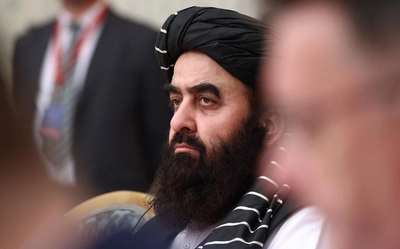
Khawaja Asif told ARY News that some level of contact with the Taliban in Afghanistan was continuing, but militant activity from Afghan territory had not subsided.
He said that if authorities on the other side of the border remained passive observers, responsibility for the consequences would lie with them.
Asif added that Pakistan still preferred dialogue but could not accept a situation in which attacks were carried out on its territory after negotiations.
The defence minister said Taliban officials had acknowledged they could not provide written guarantees on security matters and could only offer verbal assurances.
His remarks come amid a rise in militant attacks in Pakistan.
In one of the latest incidents, a suicide bombing targeted a Shia mosque in the Pakistani capital during Friday prayers, killing at least 31 people and wounding 169 others.
Following the attack, Asif said the attacker had travelled back and forth to Afghanistan.

The United Nations says 1,607 days have passed since the Taliban banned girls from attending secondary school in Afghanistan, warning that the continued restriction threatens the country’s future.
In a message marking the International Day of Women and Girls in Science on 11 February, the UN Assistance Mission in Afghanistan (UNAMA) said the exclusion of girls from education presents a troubling outlook for Afghanistan’s development.
UNAMA said in a statement that it was observing the day with deep sadness, noting that girls above the sixth grade have been unable to attend school for more than four years.
The mission said that it is more than four years of deprivation and lost opportunities that paint a painful picture of Afghanistan’s future , a future in which women and girls are absent from science and other vital fields.
The UN mission again called on the Taliban authorities to lift the ban on girls’ education, adding that millions of Afghan girls remain waiting to return to school.
Earlier this year, the United Nations reported that 2.2 million adolescent girls in Afghanistan are currently out of secondary school, warning that the prolonged restriction could seriously undermine both the future of girls and Afghanistan’s long-term development and stability.
The UN Educational, Scientific and Cultural Organisation (UNESCO) has warned that if restrictions continue until 2030, the number of girls deprived of education in Afghanistan could rise to more than four million.
The continued closure of girls’ schools has drawn widespread international criticism. Prominent public figures, political leaders and international organisations including Amnesty International and UNICEF have repeatedly called for the reopening of schools to girls.
Taliban officials, however, have consistently described the education ban as an internal matter, saying their policies are based on their interpretation of Islamic law.
The United Nations Development Programme (UNDP) says more than 75 precent of Afghanistan’s population is facing livelihood insecurity, with female-headed households among the most affected.
In a new report, the agency said only about 7 precent of women in Afghanistan are employed and that 88 precent of female-headed households lack access to basic needs.
Since returning to power, the Taliban have imposed policies restricting women’s access to education and employment. As poverty has spread across Afghanistan, the ban on women’s work has placed female-headed households under increasing economic strain.
Experts have repeatedly warned that Taliban restrictions on women’s education and employment threaten their future and undermine long-term economic stability.
In late 2025, the UN Security Council said Taliban policies affecting women cost Afghanistan’s economy more than $1 billion annually.
In its report, the council described the situation of women and girls in Afghanistan as “dire,” noting that eight out of ten Afghan women are deprived of education, employment and vocational training opportunities.
Afghanistan remains among the world’s most corrupt countries, according to Transparency International’s annual Corruption Perceptions Index (CPI), which shows the country’s ranking worsening slightly in 2025 under Taliban rule.
The report shows Afghanistan scored 16 out of 100, ranking 169th out of 182 countries. In 2024, the country scored 17 points, placing 165th out of 180 countries.
Transparency International measures perceived public-sector corruption on a scale from zero to 100, with zero representing the highest level of corruption and 100 indicating countries considered free of corruption.
Denmark, Finland, Singapore, New Zealand and Norway ranked as the least corrupt countries in the latest index. South Sudan, Somalia, Venezuela, Yemen and Libya were listed among the most corrupt.
Afghanistan’s score has declined over recent years. The country scored 20 points in 2023, ranking 162nd, and 24 points in 2022, ranking 150th.
For the first time in more than a decade, the global average CPI score fell to 42 out of 100, reflecting what Transparency International described as a broader decline in anti-corruption performance worldwide.
According to the report, 122 of 182 countries scored below 50, indicating widespread corruption in the public sector. Only five countries scored above 80, down from 12 countries a decade ago.
Transparency International said the decline in scores, including in some high-performing democracies, shows that corruption risks can increase even where institutions once appeared stable.
The report said countries that restrict civic space often struggle to control corruption. Among the 50 countries with the steepest CPI declines, 36 have imposed restrictions on civil liberties. It also noted that more than 90 precent of journalists killed while investigating corruption were in countries with low CPI scores.
Fragile states such as Afghanistan, under Taliban administration, remain near the bottom of the index. Transparency International said limited civic space, opaque political-financing systems, weak checks and balances, and the absence of independent judicial institutions leave such countries particularly vulnerable to corruption.
The organisation also highlighted declining corruption-perception scores in several democracies, including the United States (64), Canada (75), the United Kingdom (70), France (66), Sweden (80) and New Zealand (81).
Countries with strong democratic institutions generally perform better in the index, while authoritarian systems tend to rank among the worst performers. In countries such as Venezuela (10) and Azerbaijan (30), the report said corruption is structural and embedded across multiple levels of governance.
Transparency International called on governments worldwide to strengthen independent judicial systems and oversight institutions, improve transparency in political financing, protect media freedom and take stronger action against cross-border flows of illicit money.
The United Nations Assistance Mission in Afghanistan (UNAMA) held the third meeting of the private sector working group under the Doha Process in Kabul.
UNAMA said the meeting focused on supporting the private sector, creating employment opportunities, strengthening entrepreneurship, improving access to financial resources and reinforcing Afghanistan’s banking system.
Since the Taliban’s return to power, Afghanistan’s private sector has faced severe restrictions on access to banking services, money transfers and investment for more than four years, leading to a sharp decline in economic activity.
At the meeting, held on Tuesday, representatives of the Taliban presented information on what they described as “achievements and progress” since the group regained control of Afghanistan. UNAMA and several participants, however, emphasised ongoing challenges, the need for coordination and the importance of finding practical ways to support the private sector.
According to UNAMA, the Doha Process working groups were established after the third meeting of special envoys in Doha. Their purpose is to create a structured framework for engagement on specific issues, including the economy and the private sector.
Pakistan’s defence minister said the country’s involvement in the wars in Afghanistan was driven by political considerations rather than religion.
He added that the Soviet presence in Afghanistan should not be viewed solely as an “occupation”.
Speaking on Monday in Pakistan’s National Assembly, Defence Minister Khawaja Asif said Pakistan did not participate in the conflicts in Afghanistan out of religious commitment or in defence of Islam, but to secure political legitimacy and support from major global powers.
He said the Afghan government at the time had invited Soviet forces into the country and argued that describing their presence as an “occupation” reflected a narrative promoted by the United States.
Asif added that Pakistan even altered its national education curriculum during those years to align with wartime policies, saying the consequences of those changes remain unresolved. He said history had been rewritten to match the official narrative of the conflict.
“Pakistan Paid the Price and Was Abandoned”
According to Asif, Pakistan again entered conflict after 1999 in an effort to secure US support and was drawn into what he described as a rented war. He criticised the decisions of former Pakistani leaders General Zia-ul-Haq and General Pervez Musharraf to involve the country in Afghanistan’s wars.
He said that Pakistan paid the price and was ultimately abandoned, and was used like tissue paper and then discarded.
He said the decision turned Pakistan into a frontline state fighting wars on behalf of others.
During two decades of conflict against the Taliban and al-Qaeda in Afghanistan, Pakistan served as one of the main transit routes for international coalition forces and equipment. The use of Karachi port and land and air corridors for supplies to Afghanistan became a key strategic asset for Islamabad.
However, the United States repeatedly accused Pakistan both publicly and privately of sheltering insurgent networks, particularly the Haqqani network. Former US Joint Chiefs of Staff chairman Mike Mullen once described the Haqqani network as a veritable arm of Pakistan’s intelligence services.
Asif said Pakistan must acknowledge its past mistakes to overcome the consequences of those policies. He added that Pakistani society does not need to prove its religious identity and should instead focus on strengthening its ties to its own country and people.
Islamabad Mosque Attacker “Trained in Afghanistan”
At the same parliamentary session, Pakistan’s minister for parliamentary affairs, Tariq Fazal Chaudhry, said the attacker behind the recent suicide bombing in Islamabad was a resident of Peshawar who had received training in Afghanistan.
He alleged the training was carried out with Indian support and claimed New Delhi played a direct role in the operation.
Chaudhry said the attacker first opened fire on security guards before entering the imambargah, a Shia place of worship, and detonating explosives inside the mosque. According to him, 33 worshippers most of them young people were killed in the attack, and about 150 others were injured.
He identified the attacker as Yasir Khan and said four additional suspects had been arrested on suspicion of assisting him.