Over 2,500 Afghan Refugees Repatriated From Iran & Pakistan, Says Taliban
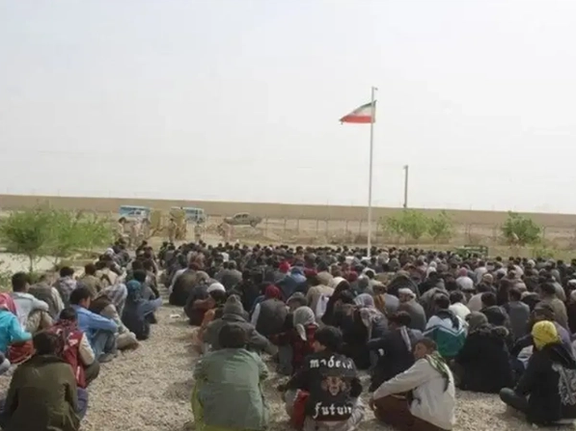
Taliban’s Ministry of Refugees and Repatriation announced that 2,628 Afghan migrants have returned from Iran and Pakistan in a single day, both "voluntarily and forcibly”.

Taliban’s Ministry of Refugees and Repatriation announced that 2,628 Afghan migrants have returned from Iran and Pakistan in a single day, both "voluntarily and forcibly”.
According to the ministry, 2,368 individuals returned from Iran, while another 260 returned from Pakistan.
On Tuesday, Taliban’s Ministry of Refugees posted on X social media platform that migrants residing in Iran and Pakistan entered Afghanistan from the Islam Qala and Torkham borders the previous day.
The Taliban did not disclose the number of migrants forcibly expelled from Iran, but stated that 260 individuals were forcibly expelled from Pakistan.
Taliban members stated that 10,000 Afs has been provided to 117 families returning from Iran.
The ministry added that migrants in need of assistance have been referred to the International Organisation for Migration and relief agencies.


Hassan Makfi, a commander in the Iranian army, announced that four engineering groups have been deployed to the region to implement the plan for border obstruction between Iran and Afghanistan.
He outlined that the border obstruction plan, which involves building a four-meter concrete wall, erecting barbed wire, and fencing, will be completed within three years.
According to reports from Iranian state media on Monday, Makfi declared the initiation of the project to obstruct Iran's eastern border with Afghanistan.
Makfi emphasised that the Iranian army has been responsible for guarding the border with Afghanistan since 2018, with Iranian forces stationed there.
Without further elaboration, this Iranian military official stated, "When politicians reduce their activities in the diplomatic arena, the army and armed forces take action."
Earlier, the President of Iran directed the allocation of three billion dollars to the General Staff of the Armed Forces of Iran for this purpose.
The Iranian Deputy Interior Minister stated that the objective behind obstruction of the eastern borders with Afghanistan is to bolster security and curb human and weapon trafficking.
In February, the commander of the Iranian army's ground forces announced that the first phase of the border obstruction project between Afghanistan and Iran, spanning 74 kilometres, is in progress.
Officials from the Iranian Ministry of Interior report that over USD 20 billion worth of smuggled goods enter or leave Iran annually.

The Iranian embassy, in response to the attack on worshippers in Herat, stated that they are ready to cooperate with the Taliban in "fighting terrorism”.
The Taliban has stated that an unidentified individual opened fire on worshippers at a mosque on Monday night in Guzara district, resulting in the death of six people.
This attack took place in the Hazara-inhabited area of Mohammadi town, and so far, no group has claimed responsibility for it.
Iran has condemned this terrorist attack on worshippers in Herat.
The embassy wrote on the X social media platform that Iran declares its readiness to strengthen cooperation with the Taliban government in the fight against terrorism.
Earlier, ISIS had claimed responsibility for attacks and bombings against Hazaras in Afghanistan.

The Afghanistan Green Trend (AGT), led by Amrullah Saleh, former Vice-President of Afghanistan, released a video on Monday showing a Pakistani preacher who, according to AGT, is delivering religious lectures at a school in Kabul.
In this video, one person speaks in Urdu about religious matters, while another person translates it into Pashto.
AGT stated that this video is from the "Hazrat Ibrahim Khalilullah High School," and the preacher is educating the directors and teachers of this school.
AGT claimed that most of these preachers are members of Lashkar-e-Taiba, an extremist anti-Shia and anti-India group recognised as a terrorist organisation by several countries.
It wrote that Pakistani preachers deliver religious lectures in Urdu to teachers and directors, which are then translated into Pashto or Persian by Afghan translators.
Saleh wrote on the X social media platform that the relationship between the Taliban and Lashkar-e-Taiba is strong and deep, and members of the group roam freely in Kabul.

Abdul Mateen Qani, spokesperson for the Taliban's Ministry of Interior, stated that in an attack on worshippers in the Guzara district of Herat province on Monday night, six civilians had been killed and one was wounded.
He stated, "An unidentified armed individual opened fire on worshippers with an AK-47."
Local witnesses informed Afghanistan International that the incident occurred in a mosque in Mohammadi town.
Witnesses described the assailants as "armed men on motorcycles”. They reported that several people, including women and children, were injured in this incident.
So far, no group has claimed responsibility for the attack.
Mohammadi town in the Guzara district is primarily inhabited by Hazaras, an ethnic and religious group that has been targeted multiple times by ISIS attacks.

The Taliban's Ministry of Refugees and Repatriations announced that 3,943 Afghan migrants returned to Afghanistan from Iran, both "voluntarily and forcibly”.
According to the ministry, these migrants entered Afghanistan on April 26 and 27 through the Islam Qala border crossing.
On Monday, in a note on the X social media platform, this Taliban ministry wrote that among the expelled migrants, 48 children without any guardian were also included who have been referred to the International Organisation for Migration for assistance in providing food and non-food aid as well as identifying their families.
The Taliban stated that 74 families have been provided with 10,000 Afghanis as assistance. According to the statement, health services have also been provided to an additional 487 individuals.