Taliban Meteorological Authority Warns Of Possible Flooding In 14 Provinces
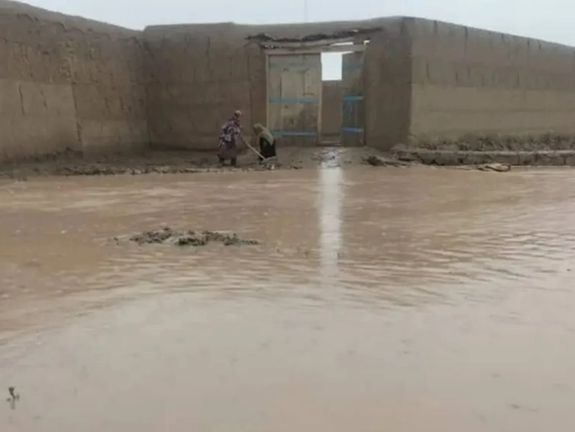
The Taliban's Meteorological Authority has reported the possibility of flooding in 14 provinces.
The Taliban's Meteorological Authority has reported the possibility of flooding in 14 provinces.
The department stated that on Thursday, heavy rainfall and flooding are expected in Badakhshan, Takhar, Nuristan, Kunar, Panjshir, Laghman, Nangarhar, Logar, Paktia, Khost, Paktika, Ghazni, Maidan Wardak, and Bamiyan provinces.
The Taliban's Meteorological Authority has forecast rainfall between 15 to 35 millimetres in various areas.
According to reports, more than 300 people have died in Baghlan, at least 50 in Ghor, and nearly 60 in Faryab province due to recent flooding.
In the most recent incident, 21 people lost their lives due to flooding in seven provinces.

A group of anti-Taliban political factions and figures will hold a meeting on June 24 in Vienna with the aim of achieving "political unity and creating a clear and shared outlook among free Afghans”.
According to received information, members of the National Resistance Front, the Afghanistan Freedom Front, and the Jamiat, Junbish, and Wahdat parties will participate in this meeting.
Based on information obtained by Afghanistan International, the organisers expect close to 70 participants in this two-day meeting.
Like previous meetings, in addition to political and military factions, former government members, university professors, civil activists, and media representatives have also been invited.
The initial list of participants includes names such as Ahmad Massoud, leader of the National Resistance Front; Rangin Dadfar Spanta, former Foreign Minister; Rahmatullah Nabil, former head of the National Directorate of Security of Afghanistan, and Sima Samar, former head of the Afghanistan Independent Human Rights Commission.
It is unclear who else from other Afghan political parties and military factions will attend this meeting.
The last Vienna meeting was held in December 2023 in the Austrian capital.
Zabihullah Mujahid, the Taliban spokesperson, stated that some UN members, particularly the Special Rapporteur for Afghanistan, are attempting to divert attention from the third Doha meeting.
Mujahid said that those in the UN always try to present a "bad" image of Afghanistan.
On Wednesday, in response to the 56th session of the Human Rights Council in Geneva, the Taliban spokesperson wrote on X that some UN member countries are overshadowing significant developments by portraying a negative image of Afghanistan.
Mujahid added that the Taliban appreciates the supportive stance of some countries in the UN Human Rights Council.
He emphasised, "It is a reality that positive and constructive engagement with the Islamic Emirate must be carried out."
On Tuesday, Richard Bennett, the UN Special Rapporteur for Afghanistan, presented his report, stating that the systematic and institutionalised discrimination in Afghanistan and the exclusion of women by the Taliban should shock the conscience of humanity.
Bennett described the exclusion of women from public life and their deprivation of education and work as "crimes against humanity" and called on the international community to recognise gender apartheid in Afghanistan.
Bennett also urged the international community to stop legitimising and normalising relations with the Taliban. He stated that the international community should not treat the Taliban as a legitimate government in the upcoming third Doha meeting.
Representatives of most countries at this meeting condemned the Taliban's policies towards women and called on the group to lift restrictions on women.
The Taliban's Ministry of Transport and Civil Aviation reported that 100-120 airplanes pass through Afghan airspace daily.
The ministry stated that it charges a transit fee of USD 700 per airplane.
This is in contrast to the last years of the previous government, when around 400 airplanes passed through Afghan airspace daily.
On Wednesday, June 19, Imamuddin Ahmadi, Taliban’s spokesperson for the Ministry of Transport, told Taliban controlled Radio Television Afghanistan (RTA) that international flights are conducted daily from the country's five international airports with "international standards”.
This Taliban official also mentioned that Nangarhar Airport, which was used as a military airport during the previous government, is now open for international flights.
The Taliban claim that there are 27 active airports across Afghanistan, including five international airports.
In August 2023, the group announced that over 25,000 transit flights had been conducted through Afghan airspace in the past year, generating 8 billion Afghanis in revenue.
Qasim Wafaeezada, the head of the Civil Aviation Authority during the previous government, said in 2020 that around 400 airplanes pass through Afghan airspace daily. This office had stated that over 95,000 airplanes passed through Afghan airspace annually.
Following the Taliban’s takeover of power in Afghanistan, most international airlines changed their routes and halted flights to Afghanistan.
Nearly three years later, some regional airlines have resumed their flights from Afghanistan.
The United Nations has announced that the Security Council will hold a meeting on Afghanistan on Friday, June 21.
Roza Otunbayeva, the head of United Nations Assistance Mission in Afghanistan (UNAMA), will explain the situation in Afghanistan at this meeting.
The Security Council is reviewing the situation in Afghanistan following a recent report by Richard Bennett, the UN Special Rapporteur on Afghanistan, which stated that violence against Afghan women is strong and widespread.
Bennett emphasised that the exclusion of women from public life and the deprivation of Afghan women and girls from work and education, should’ve be classified as crimes against humanity and gender apartheid.
Simultaneously, the third Doha meeting, hosted by the United Nations and attended by special representatives of countries for Afghanistan, is scheduled for June 30 and July 1.
The Taliban have been invited to the Doha meeting and have announced that they will send a delegation to Qatar. However, according to reports, the UN has not invited representatives of Afghan civil society.
Political groups and women have called for the inclusion of diverse Afghan groups, including women, in the Doha meeting and have questioned the "legitimacy" of the Doha meeting in the absence of women.
Evgeny Viktorov, Russia's representative at the UN, Human Rights Council on Tuesday said that achieving lasting peace and stability in Afghanistan is not possible without engaging with the Taliban, particularly on human rights issues.
Viktorov emphasised on the formation of an inclusive government with the participation of ethnic representatives in Afghanistan.
At the 56th session of the UN Human Rights Council, the Russian representative said, that Moscow is closely monitoring the economic and human rights situation, including the status of Afghan women and girls in education and employment.
Viktorov reiterated the importance of forming an inclusive government in Afghanistan and said, "A very important issue is the formation of a fully inclusive government in Afghanistan with the participation of representatives from all ethnic groups and minorities in the country."
He attributed the current situation in Afghanistan to the "irresponsible withdrawal" of international forces from the country, stating that the Taliban inherited Afghanistan with a multitude of problems.
Viktorov added that Afghanistan's complete dependency on international aid over the past twenty years has worsened the country's economic situation.
He also said that international sanctions against the Taliban have brought Afghanistan very close to a humanitarian disaster.