5.8-Magnitude Quake Shakes Kabul, Northern Provinces
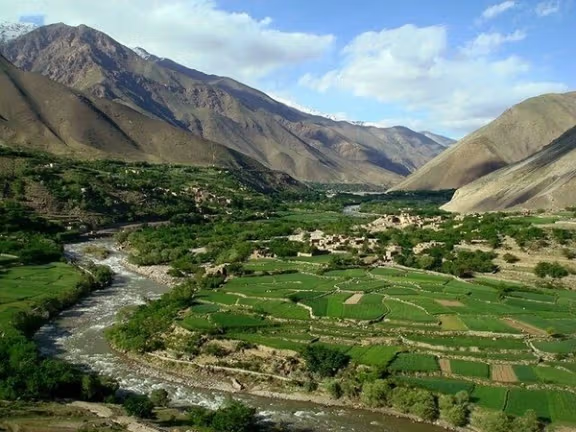
A strong earthquake struck parts of Afghanistan on Friday, shaking Panjshir, Badakhshan, Takhar, Samangan, Parwan, Baghlan, Kabul and several other provinces.
A strong earthquake struck parts of Afghanistan on Friday, shaking Panjshir, Badakhshan, Takhar, Samangan, Parwan, Baghlan, Kabul and several other provinces.
Residents in these areas told Afghanistan International that they felt powerful tremors and rushed out of their homes.
The United States Geological Survey said the earthquake measured 5.8 in magnitude and was centred in Bazarak district, the capital of Panjshir province.
Audiences also reported feeling the tremor in Kunduz and Kapisa provinces. According to the US Geological Survey, the quake occurred at around 5:40pm local time.
There have been no immediate reports of casualties or damage. The Taliban authorities have not yet commented on the earthquake.

Richard Bennett, UN special rapporteur on human rights in Afghanistan, is set to present his report on the right to health of women and girls in Afghanistan at the 61st session of the UN Human Rights Council in Geneva on Thursday, 26 February.
The council is also expected to review the broader human rights situation in the country.
In a post on X, Bennett said he would deliver an oral update on recent human rights developments. He recently visited Pakistan and, speaking at a conference in Lahore, warned that the deportation of Afghan migrants could expose them to serious human rights risks.
The 61st session of the Human Rights Council is being held in Geneva from Monday, 23 February, to Tuesday, 1 April. The agenda includes panel discussions on global human rights issues, women’s rights, the rights of persons with disabilities and children’s rights.
Afghanistan is among the key items on the agenda. The council is expected to receive an oral update from the UN secretary-general on progress towards establishing an independent investigative mechanism into alleged human rights violations in Afghanistan.
A resolution to create such a mechanism was adopted by the Human Rights Council in October.
Member states will also consider a one-year extension of Bennett’s mandate as special rapporteur on Afghanistan.
In addition, a report by the Office of the UN High Commissioner for Human Rights on the situation in Afghanistan is due to be presented during the session.
Residents of Kabul say they have seen an unidentified drone flying over the Afghan capital.
A resident of District 17 told Afghanistan International on Thursday, 19 February, that an unmanned aerial vehicle was observed flying at a visible altitude above the city.
The resident shared a video with the broadcaster showing what appeared to be a drone circling in the sky over Kabul. According to the resident, the aircraft remained over the capital for several hours.
It is not clear which country the drone may belong to. The Taliban have not issued an official statement regarding the reported flight.
Since returning to power in August 2021, the Taliban has not had full control over Afghanistan’s airspace. Taliban officials have previously acknowledged that the country’s skies remain under what they describe as “occupation”.
Over more than four years of Taliban rule, residents in several provinces have repeatedly reported sightings of unidentified drones.
According to various reports, US surveillance drones and military aircraft have flown over parts of Afghanistan during this period. Pakistan has also operated fighter jets and drones in Afghan airspace with US approval and coordination, according to reports.
The United Nations Assistance Mission in Afghanistan (UNAMA) marked the World Day of Social Justice by calling for equal access to education and inclusive participation in decision-making across Afghanistan.
In a message released on Friday, 19 February, UNAMA said that no country can achieve social justice when half of its population is deprived of secondary education.
At the same time, Afghan activists launched a campaign titled the “National Campaign for Girls’ Education”, urging the immediate reopening of girls’ secondary schools.
The United Nations designated 20 February as the World Day of Social Justice at a 1995 summit in Copenhagen. The day aims to promote equal rights for all and to combat discrimination, inequality and social exclusion.
Over the past four years, the Taliban have imposed sweeping restrictions on citizens, particularly women and girls, intensifying discrimination, poverty and marginalisation, according to critics.
In its statement, UNAMA said social justice in Afghanistan requires non-discriminatory access to employment and sustained humanitarian support for families in need.
The mission stressed that lasting peace can only be achieved through the meaningful participation of women, young people, diverse ethnic groups and persons with disabilities in decision-making processes.
Since the Taliban returned to power in 2021, the international community has repeatedly called on the group to establish an inclusive government. The Taliban have largely dismissed those appeals.
Afghan activists supporting girls’ education said no society can claim to uphold social justice while denying equal access to education.
In a statement, they said: “A government that deprives half of society of the right to education, the right to choose and the right to dignity can neither expect obedience from its people nor their support.”
The activists also urged the Taliban to end what they described as hostility towards justice, knowledge and national interests, and called on families and civil society institutions to join the campaign in support of girls’ education.
The World Day of Social Justice comes as, during more than four years of Taliban rule, many social groups, especially women and ethnic and religious minorities, have faced discrimination and harassment.
Over that period, the Taliban have issued dozens of decrees restricting the rights of women and girls in education, employment and public life. Human rights experts and activists have described these policies as amounting to “gender apartheid” and have called for their recognition and criminalisation under international law.
Afghan applicants say Pakistani visas are being sold on the black market in Kabul for between $1,000 and $1,500, despite an official fee of just around $ 25.
Several applicants told Afghanistan International on Thursday that without paying bribes to travel agencies approved by Pakistan’s embassy and consulates, obtaining a visa is either impossible or can take months.
Some Afghans said they had paid large sums through travel agencies in exchange for expedited and guaranteed visa processing at Pakistan’s embassy and consulates in Kabul, Nangarhar, Kandahar and Balkh.
Applicants seeking medical treatment said they were compelled to pay the inflated prices. According to information obtained, medical visas are sold on the black market for between $1,300 and $1,500, while tourist visas reportedly cost between $1,500 and $2,000.
Several applicants said they were effectively required to deal with travel agencies registered with Pakistan’s diplomatic missions in order to secure a visa.
One applicant in Kabul said: “I applied for a medical visa and paid 1,500 afghanis, but after four months I had not received it. I then paid $1,300 to a company in Kabul and was invited to the embassy for an interview the same day. I received the visa that day.”
He added: “During the interview they asked how much I had paid for the visa. I said 1,500 afghanis. If I had said I paid $1,300, my visa would have been rejected.”
Pakistan’s embassy in Kabul has not responded to the allegations.
Officials at several travel agencies in Kabul and Nangarhar confirmed that Pakistani visas are being sold on the black market. They said applicants who follow standard procedures often wait for months and may ultimately have their applications rejected.
Some Afghans have urged the Taliban authorities to raise the issue with Pakistani officials to curb the illegal sale of visas.
Complaints about Pakistan’s visa process have increased since the collapse of the former Afghan government. Nearly five years into Taliban rule, the issue remains unresolved.
Tajikistan’s State Committee for National Security says it has seized 58 kilograms of narcotics smuggled from Afghanistan in the border district of Shamsiddin Shohin and arrested two Tajik nationals in connection with the case.
State television reported on Wednesday, 18 February, citing the security committee, that the confiscated drugs included 30 kilograms of opium, 19 kilograms of hashish and 9 kilograms of heroin.
The two suspects, aged 57 and 55, were detained during the operation. Authorities said the narcotics had been smuggled into Tajikistan by Afghan traffickers through an official border crossing.
According to the committee, the suspects planned to transport the drugs to the capital, Dushanbe, and then onward to other countries through their associates.
Officials said the detainees have been referred to court for prosecution and face up to 20 years in prison under Tajik law.
Last week, Tajik border forces also reported the arrest of an Afghan national accused of drug trafficking. Authorities said he was detained in border areas of Tajikistan with 46 packages of narcotics.
The head of Tajikistan’s Drug Control Agency said that about 2 tonnes and 742 kilograms of narcotics were seized along the country’s border with Afghanistan last year.
Tajik authorities added that drug trafficking originating from Afghanistan increased by nearly 50 percent last year compared with 2024.