Taliban Publicly Flogs Two Individuals In Maidan Wardak Province
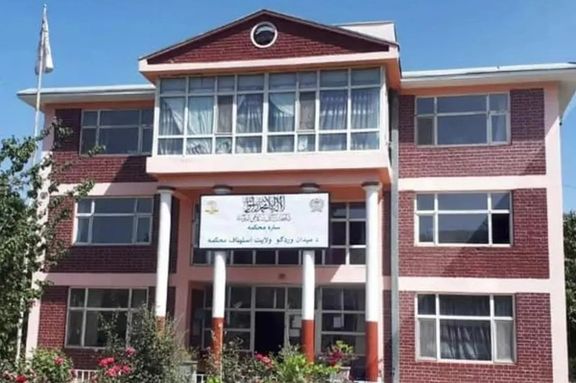
The Taliban’s Supreme Court announced that on Wednesday, its judicial authorities in Maidan Wardak province publicly flogged two individuals accused of theft.

The Taliban’s Supreme Court announced that on Wednesday, its judicial authorities in Maidan Wardak province publicly flogged two individuals accused of theft.
The Taliban's court in Maidan Wardak sentenced each of the accused to 39 lashes and three years in prison.
Abdullah Furqani, the head of the local Taliban court, claimed that floggings have significantly reduced crime rates in the country.
Previously, on Wednesday, the Taliban’s Supreme Court had also announced that a man and a woman were flogged in Kabul for having sexual relations outside of marriage. The court stated that the woman received 32 lashes and the man received 39 lashes.
Over the past three years, international human rights organisations have consistently urged the Taliban to halt corporal punishments. However, the Taliban has said that it will continue to impose punishments according to Islamic "Sharia" law.
Human rights organisations have reported that principles of fair trial are not upheld in Taliban prisons and courts.
A human rights organisation called Rawadari stated in a research report that the Taliban courts exhibit discriminatory decisions, torture, coerced confessions, and lack of independence and impartiality, with the presumption of innocence being violated.


Fox News reported that US Secretary of State Antony Blinken has been urged to suspend American aid to Afghanistan.
According to the report, this request followed revelations that nearly $300 million in US aid may have ended up in the hands of the Taliban.
Previously, the Special Inspector General for Afghanistan Reconstruction (SIGAR) reported that two State Department bureaus failed to prove their compliance with counterterrorism vetting.
Two days ago, Senator Mike Braun sent a letter to Blinken calling the report "deeply alarming" and requested that US aid to Afghanistan be halted until the issue is addressed.
Braun added that the State Department's failure to adhere to anti-terrorism inspection standards "has strengthened and enriched the Taliban and its terrorist affiliates”.
He also emphasised that when funds intended for humanitarian and developmental purposes end up supporting terrorism and perpetuating violence and instability, it undermines US national security.
"It is imperative that the State take immediate remedial and comprehensive action to rectify these issues to prevent similar occurrences in the future”, said Braun.
This request to halt US aid to Afghanistan comes amid a SIGAR report stating that the US has provided approximately $21 billion in aid to Afghanistan over the past three years.
SIGAR noted that this aid was allocated for humanitarian assistance, development projects, the transfer and resettlement of refugees from Afghanistan to the US, and the repayment of Afghanistan's foreign assets.

The Taliban's Ministry of Interior rejected a recent Special Inspector General for Afghanistan Reconstruction (SIGAR) report on Wednesday, calling it baseless.
The SIGAR report claimed that the Taliban has not acted against opium reserves in Afghanistan, leading to a doubling of the drug's price.
The Taliban claimed that since their return to power, drug cultivation, sale, and trafficking have been eliminated for the first time in decades.
The group’s Ministry of Interior stated, "The latest SIGAR report is baseless. For the first time in several decades, the phenomenon of drugs has been eradicated across the country."
The Taliban's Ministry of Interior also emphasised that no one would be permitted to cultivate poppy.
The United Nations Office on Drugs and Crime confirmed in its latest report that while poppy cultivation has decreased, the production and sale of synthetic drugs like methamphetamine have increased.
SIGAR accused the Taliban of failing to address existing opium reserves in Afghanistan. The organisation reported that traders and farmers are involved in storing opium and inflating its price. SIGAR noted that while poppy cultivation has decreased, the value of opium has doubled since the ban on poppy cultivation was enacted.
The Daily Telegraph previously reported that Afghan farmers are covertly cultivating poppies in response to rising narcotic prices. According to the Telegraph, the price of opium has surged from £30 per kilo to £800-£1,000 since the Taliban's takeover, with some senior Taliban officials reportedly benefiting from this increase.
Taliban officials, speaking anonymously to the British newspaper, suggested that the ban on poppy cultivation might be aimed at raising opium prices, thereby enabling officials with hidden opium reserves and secret poppy fields to "accumulate more wealth”.
SIGAR, which does not have an office in Afghanistan, compiled its report based on findings from other organisations, including the United Nations.

The Tehreek-e-Taliban Pakistan (TTP) has accused Pakistani security forces of "burying alive" two of its fighters.
The group released a video alleging that the fighters survived this gruesome incident and reached a "safe place”.
Security sources informed Afghanistan International that the fighters have fled to Afghanistan. The TTP has consistently denied its presence in Afghanistan, though Pakistani officials have accused the Afghan Taliban of harbouring Pakistani militants who then launch attacks on Pakistani security forces from Afghan soil.
In its statement, the TTP claimed that Pakistan's anti-terrorism forces had "buried alive" these fighters in Mohmand district, Peshawar. Security sources added that the police had "imprisoned them in a cave”.
A video posted on social media by pro-Taliban influencer Muneer Sherzad shows him meeting and praising the two TTP fighters. Reports suggest Sherzad met them in Afghanistan and expressed support for the TTP’s struggle against the Pakistani government.
The Afghan Taliban has repeatedly denied the presence of Pakistani militants in Afghanistan, a claim that Pakistan and other countries have contested.

The US Commission on International Religious Freedom stated that the situation of religious minorities in Afghanistan is deteriorating.
Accusing the Taliban of consistently violating religious freedoms, the commission called for sanctions against responsible officials of the group.
In its annual report released on Wednesday, the commission urged Washington to designate Taliban-controlled Afghanistan as a "Country of Particular Concern”.
The report noted that in 2023, the Taliban severely restricted the individual and religious freedoms of all Afghans, particularly women and religious minorities such as Shia Muslims, Ahmadiyya Muslims, Sikhs, Hindus, and Christians, and continues to do so.
During Muharram, Taliban officials stated that for the safety of mourners, Ashura ceremonies should be limited and held at specific locations. The US Commission on International Religious Freedom said that the Taliban has restricted the religious freedom of Shias.
ISIS has attacked Shia Muslims religious sites in the capital on several occasions. The Taliban has failed to prevent ISIS attacks on this community.
According to the report, ISIS-Khorasan has continued its attacks on the Shia minority in Afghanistan. In October 2023, ISIS attacked the Imam Zaman Mosque in Pol-e-Khumri city of Baghlan province.
The Taliban stated that seven people were killed in the incident, but sources told Afghanistan International that the death toll was over 20.
The US Commission on International Religious Freedom highlighted the role of the Taliban's Ministry for the Propagation of Virtue and the Prevention of Vice in enforcing discriminatory Taliban decrees. Additionally, the Taliban publicly administer punishments such as flogging for alleged moral crimes.
The commission called on the US government to sanction and freeze the assets of Taliban officials responsible for severe religious freedom violations.
The US Commission on International Religious Freedom reported that the Taliban arrested several journalists, women's rights activists, and religious minorities last year.
The group has also restricted the activities of aid organisations by banning women from working. In another move, the Taliban arrested 18 local employees of an NGO in September 2023, accusing them of promoting Christianity.
The commission recommended that the US government place Afghanistan on the list of countries with serious concerns about the freedoms of its citizens.
Additionally, the commission urged the US government to prioritise asylum requests from at-risk religious minorities.
The commission stated that US diplomats should raise the issue of religious freedoms in Afghanistan in their interactions and meetings with Taliban representatives.
The US Commission on International Religious Freedom is an independent, bipartisan federal entity established in 1998.

The Afghanistan Freedom Front (AFF) announced on Wednesday that it had conducted an attack on a Taliban checkpoint near Baraki Square in Kabul.
According to the group's statement, three Taliban fighters were killed in the incident.
AFF has shared a video of the attack on its social media platform.
The group also mentioned in their statement that one Taliban member was injured during the attack.
Afghanistan International has not independently confirmed the occurrence of this attack or the reported casualties.
In recent months, this anti-Taliban armed group has frequently claimed responsibility for guerrilla attacks on Taliban checkpoints and posts in Kabul and other provinces.