Taliban Publicly Flogs 2 Individuals In Maidan Wardak
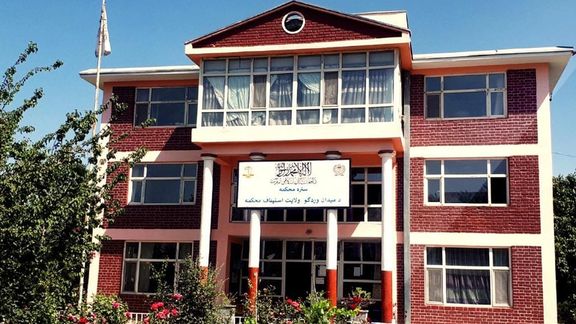
The Taliban's Supreme Court announced that judicial authorities in Maidan Wardak province publicly flogged two individuals on Monday, August 12, for engaging in sexual relations.
The Taliban's Supreme Court announced that judicial authorities in Maidan Wardak province publicly flogged two individuals on Monday, August 12, for engaging in sexual relations.
According to the court's statement, each person received 39 lashes and was sentenced to 13 years of imprisonment.
The statement also mentioned that several Taliban officials and people were present during the punishment.
The Supreme Court did not disclose the identities of the individuals.
The Taliban frequently report public floggings, sometimes several times a week or even daily. In the past week, nearly 10 people have been flogged for various charges in Kandahar, Kabul, and other provinces.
Human rights organisations and the United Nations have repeatedly called on the Taliban to cease public corporal punishment. However, such practices continue under the group's rule in Afghanistan.

A group of women’s rights activists in Takhar took to the streets on Monday, August 12, to protest against the Taliban’s policies.
During the march, the protestors chanted slogans denouncing "gender apartheid," declaring that the Taliban cannot silence women’s voices through the use of force.
This demonstration was held close on the heels of the third anniversary of the Taliban’s takeover of Kabul.
Identifying themselves as members of the "New Thought Movement," the women’s rights activists marched through the streets of Taloqan, the provincial capital, under the banner of "Women, Life, Freedom”.
The protestors accused the Taliban of enforcing gender apartheid in Afghanistan and called on other women to stand up for their rights against the group.
Meanwhile, Taliban officials are preparing to commemorate August 15 as the day of their "victory over the US occupation and its allies”.
Women’s rights movements, both within Afghanistan and internationally, have issued statements ahead of August 15, marking the third anniversary of the Taliban’s return to power, describing it as the "darkest day in Afghanistan’s modern history”.
Rawadari, a human rights organisation, has reported that in the first half of this year, 239 individuals were killed in targeted suicide and explosive attacks or through deliberate and extrajudicial executions.
The report, published on Monday, indicates that the victims included former government employees, women, children, tribal elders, and Taliban opponents. Additionally, at least 128 others were injured across 30 provinces in Afghanistan.
The report reveals that among those killed, 178 were men, 44 were children, and 17 were women.
Rawadari noted a 28.8% decrease in such incidents compared to the same period last year, which saw 516 cases. However, the organisation attributes this decline to severe restrictions on information access and the Taliban's efforts to conceal targeted, suspicious, and extrajudicial killings.
The report suggests that the ruling group employs force, intimidation, and fear to suppress information about these incidents.
Civilian Casualties in Explosive and Suicide Attacks
The report highlights that in the first half of 2024, targeted explosive and suicide attacks resulted in the deaths of at least 34 civilians and injuries to 35 others in Kabul, Kandahar, Nimroz, and Bamiyan provinces. This represents a 73.8% decrease from the 111 civilian deaths recorded during the same period last year.
However, landmine explosions and leftover war explosives killed 49 civilians and injured 56 others in the first half of this year, marking a 66.6% increase from the previous year.
Targeted, Mysterious, and Extrajudicial Killings
Rawadari reported that in the first six months of this year, at least 193 individuals, including 181 men, nine women, and three children, were deliberately and extrajudicially killed or injured by the Taliban or unknown assailants. This represents a 43.5% decrease from the previous year.
The report identifies the perpetrators as "the Taliban and unknown armed individuals" but notes that the Taliban often attributes these killings to "unknown armed individuals”.
Over the past three years, the Taliban has not provided any information on legal actions taken against those responsible. Additionally, the Taliban has used force, intimidation, and threats to prevent the dissemination of information about these extrajudicial killings.
The report also reveals that at least 51 former government employees and their family members were targeted in extrajudicial killings or injuries in the first half of this year, a slight decrease from 55 cases last year.
Rawadari criticised the Taliban for failing to adhere to its "general amnesty" decree, instead using it to target former government personnel. The organisation also reported that four civilians were killed this year on charges of collaborating with opposing groups.
Increase in Arbitrary Detentions
In the first six months of this year, Rawadari reported that at least 614 people, including 33 women, were arbitrarily and illegally detained, more than doubling the 222 cases recorded during the same period last year.
The organisation condemned the Taliban for disregarding international human rights standards and legal procedures in its widespread practice of arbitrary detention. The detained include former government employees, Taliban opponents, civil activists, and journalists.
Violations of Human Dignity
Rawadari noted that the Taliban has extensively violated human dignity, including acts of torture and mistreatment of prisoners.
The report emphasises the lack of access for human rights organisations to Taliban prisons, which restricts the ability to obtain specific statistics.
Released prisoners have been threatened against disclosing details about their treatment in detention.
In the first half of this year, 12 people reportedly died in Taliban-controlled prisons due to severe torture, with at least 10 others hospitalised for similar reasons—a 20% increase from the previous year.
The report highlights the absence of independent oversight and mechanisms for addressing the human rights of prisoners in Taliban-controlled facilities.
Increased Restrictions on Women and Girls
The report details that the Taliban has not only banned girls above the sixth grade from attending school and universities but has also engaged in broader discrimination and repression against women and girls.
At least 13 educational centres, including online schools, providing opportunities for girls above the sixth grade were closed in the first half of the year. Additionally, 82 managers and students from these centres were detained.
Rawadari noted that the Taliban's policies have resulted in widespread human rights violations, including the exclusion of vulnerable ethnic and religious groups from equal access to government services and national resources.
The organisation called for active and effective involvement from the international community to address the deteriorating human rights situation in Afghanistan.
Rawadari urged the Taliban to adhere to international agreements and cease further violations of Afghan citizens' fundamental rights.
Munir Akram, Pakistan's representative to the United Nations, announced that his country is working to influence the Taliban's policy towards the Tehreek-e-Taliban Pakistan (TTP).
Akram noted that internal divisions within the Taliban has hindered the group from taking significant action against the TTP.
As reported by The Express Tribune on Monday, he explained that Pakistan is leveraging diplomacy at bilateral, regional, and global levels to shift the Taliban's approach to the TTP.
"It is your assumption that we cannot change their [Taliban] policy; it is not our assumption. Whether it is the Taliban or someone else, any government will try to change their policy through diplomacy, and this effort is ongoing", he said.
Islamabad regards the TTP as a terrorist organisation , and for the past three years, its primary demand from the Taliban government has been to curb the TTP's activities, an action that has yet to be taken by the Taliban.
Akram emphasised that despite Islamabad's efforts, internal conflicts within the Taliban government have prevented any serious measures against the Pakistani Taliban. He noted that Pakistan is trying to persuade the Taliban that the presence of the TTP in Afghanistan is detrimental not only to Pakistan and the region but also to the Taliban themselves.
He also called for an international consensus to prioritise counterterrorism in Afghanistan. Akram further stated that any future recognition of the Taliban and the lifting of sanctions would be contingent on the group's actions against terrorism.
Nearly three years ago, on August 15, Pakistan celebrated the Taliban's victory in Afghanistan, expecting the rise of a government aligned with Islamabad in Kabul. However, in the years since, this has not materialised, and according to Pakistani officials, relations between Kabul and Islamabad have reached their lowest point.
Human Rights Watch (HRW) announced on Sunday that the Taliban has created the most serious women’s rights crisis globally over the past three years.
The organisation urged governments worldwide to hold the Taliban leadership accountable for all the serious crimes in Afghanistan.
Fereshta Abbasi, Afghanistan researcher at Human Rights Watch stated, "Under the Taliban’s abusive rule, Afghan women and girls are living their worst nightmares."
The organisation highlighted a report by Richard Bennett, the United Nations special rapporteur for Afghanistan, which characterises the current situation as "an institutionalised system of discrimination, segregation, disrespect for human dignity, and exclusion of women and girls”.
HRW also reported that, over the past three years, the Taliban has consistently violated freedom of expression and the rights of journalists and media. Additionally, women have been arbitrarily detained for their attire, and those protesting against Taliban directives have been subjected to torture.
The organisation emphasised that Afghanistan is currently facing one of worst humanitarian crisis worldwide. Taliban-imposed restrictions have severely impacted women's and girls' access to healthcare, jeopardising their health.
Abbasi further stressed that governments engaging with the Taliban must consistently remind them that their repression of women, girls, and all Afghan citizens violates Afghanistan’s obligations under international law.
The Taliban's Ministry of Energy and Water has announced that Iranian investors have shown interest in developing water supply and electricity generation projects in Afghanistan.
As per the Taliban-controlled Bakhtar News Agency, the interested investors are affiliated with Mobarakeh Steel Company and its subsidiaries. The news agency, citing the Ministry's media office, detailed that officials from these companies discussed their investment interests during a meeting with Abdul Latif Mansoor, the Taliban's Minister of Energy and Water.
While specific projects were not disclosed, the Taliban's media office conveyed that Mansur welcomed the Iranian investors' interest, highlighting that the investment environment in Afghanistan is currently favourable.
Bakhtar also reported that Abdul Latif Mansur emphasised on the need for "coordination and the swift initiation of practical work" by these investors in the sectors of water supply and electricity generation.
Afghanistan has long been dependent on imported electricity, with the majority of its power currently sourced from Iran and Central Asian countries.