Russia Invites Taliban To Moscow Format Meeting

The Taliban has claimed that Dmitry Zhirnov, the Russian ambassador to Kabul, invited the group to participate in the upcoming meeting of the Moscow format.

The Taliban has claimed that Dmitry Zhirnov, the Russian ambassador to Kabul, invited the group to participate in the upcoming meeting of the Moscow format.
During a meeting with Taliban’s Foreign Minister Amir Khan Muttaqi on Wednesday, Zhirnov said that Russia cares about its relations with the group.
"Moscow attaches special importance to relations with the Taliban and has always invited the Afghan delegation to all regional and international meetings hosted by Russia," Zhirnov said as per the Taliban's Foreign Ministry.
Amir Khan Muttaqi said that the Taliban has participated in all the meetings of the "Moscow format" and considers this format positive. He said that the upcoming meeting is an opportunity to discuss bilateral issues with high-ranking Russian officials and representatives of countries in the region.
The Moscow Format meetings, which have been initiated by Russia since 2017, aim to create a platform for regional and international cooperation in order to find a comprehensive and peaceful solution to the Afghan crisis, as well as to counter the spread of terrorism and drug trafficking.
For the first time, Taliban leaders appeared in front of the media at the Moscow Format conference. Observers believe that the Moscow format elevated the Taliban from an insurgent and armed group to a political group.
These meetings are usually attended by representatives from Afghanistan's neighbouring countries, including Iran, Pakistan, China, India, and Central Asian countries (Tajikistan, Uzbekistan, and Turkmenistan).
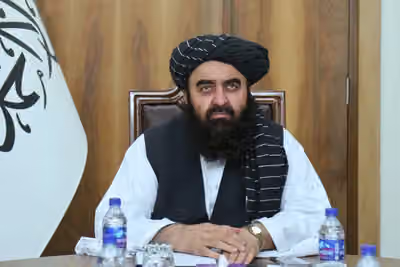
Mohammad Nabi Omari, the Taliban's Deputy Interior Minister, acknowledged in Khost province that the group's government is grappling with several challenges and requires the input and support of the population to address these issues.
"There are some problems," Omari stated. "We are neither saints nor prophets. We need the people's consultation, their opinions, and their votes."
As discontent among the Afghan populace grows, largely due to the restrictions imposed by the Taliban, Omari's remarks highlight the group's call for public consultation and participation in resolving governmental challenges. He underscored the importance of the people's votes and advice to find solutions to ongoing difficulties.
Omari also urged residents of Khost to adhere to the rules and regulations established by the Taliban government. His appeal for public consultation comes despite the group's historical opposition to democratic elections and the concept of elected governance.
The Taliban's emphasis on voting and public consultation stands in stark contrast to their continued enforcement of controversial policies, including the prohibition of girls' education and restrictions on women's employment, which have persisted for at least three years.

The US State Department spokesperson said that Antony Blinken will not be able to appear before the US Congress on the date set by the House Foreign Relations Committee to discuss the withdrawal from Afghanistan.
Matthew Miller said that Blinken has other important things to do, such as a ceasefire in Gaza.
The US House Foreign Relations Committee recently subpoenaed Antony Blinken to testify about the country's withdrawal from Afghanistan.
The committee's chairman, Michael McCaul, warned Blinken that if he did not appear before the committee on September 19, he would face a charge of contempt of Congress.
A State Department spokesperson said at a press briefing on Tuesday, that Antony Blinken "has testified 14 times in Congress about Afghanistan, including four times directly before the House Foreign Affairs Committee”.
Matthew Miller added that the State Department has cooperated with the US House Foreign Relations Committee's investigation into Afghanistan and has handed over the documents to the committee.
In a letter to the US State Department on Tuesday, Michael McCaul wrote that former and current US officials have confirmed that Antony Blinken was the "final decision-maker" on the withdrawal of US forces from Afghanistan.
McCaul asked Blinken to appear before the Foreign Relations Committee to answer about his role.
However, Matthew Miller said at the press briefing, "The secretary is travelling and trying to push forward the ceasefire."
US media reported that Antony Blinken will travel to Egypt on Wednesday, September 19, with the aim of advancing the Gaza ceasefire agreement.
Referring to Blinken's visit, Matthew Miller said, "The secretary of state cannot be in Congress for the time being, because he has other important things to do.
Miller added that the secretary of state could appear before the Congress at a later date, but for now, his deputy is available.
Asked when Antony Blinken could appear before the Congress, the State Department spokesperson said, "We are in discussions with the committee on this issue and we have proposed a time when Blinken is not travelling to do important US foreign policy matters."
At the same time, Matthew Miller called Antony Blinken's testimony before the Foreign Relations Committee "unnecessary”.
Recently, with the heat of the election contests in the United States, Republicans, especially Donald Trump, the party's presidential candidate, have accused Joe Biden and Kamala Harris of "mismanagement" in the withdrawal of US troops from Afghanistan.
Trump blames the Biden administration and his vice-president for failing to prevent the deaths of 13 US troops during the evacuation from Afghanistan.

The United Nations Children's Fund (UNICEF) expressed concern over the continued ban on girls' education beyond the sixth grade in Afghanistan and said that UNICEF would continue to work to return girls to school.
UNICEF added that this year, 38,000 girls have been deprived of continuing education in grades above six.
September 18 marks the third anniversary of the Taliban's official ban on girls' education.
UNICEF said that education allows girls and boys to acquire the cognitive skills they need to survive, thrive, make the right decisions and maintain better opportunities for the future.
The United Nations Children's Fund (UNICEF) has emphasised that 2.3 million girls are currently enrolled in primary schools in Afghanistan.
According to UNICEF, more than one million girls are enrolled in primary school this year, and nearly 1.5 million girls, including 38,000 girls who completed sixth grade this year, have been affected by the education ban.
"UNICEF will not fail to support the 2.3 million girls currently enrolled in primary schools in Afghanistan," the UN agency said, stressing on the right to education for all children.
UNICEF said that it will not stop trying to get Afghan girls back to school.
Three years ago, on September 18, the Taliban's Ministry of Education issued a notice inviting male students and teachers in Afghanistan to return to schools.
In this announcement, the Taliban's Ministry of Education did not mention the return of female students and teachers to schools.
In the past three years, women and girls in Afghanistan have repeatedly protested across the country in response to the ban on education.
This decision of the Taliban was also accompanied by protests from various countries and international organisations.
However, the Taliban has not yet taken any steps to reopen schools above the sixth grade.

The President of the European Parliament Roberta Metsola addressed the women of Afghanistan on Tuesday during a meeting of the organisation, which was also attended by some Afghan women's activists.
She stressed on the continued support for women's efforts to secure their rights.
She said, "Your struggle will not be ignored." On Tuesday, the European Parliament invited a number of Afghan women activists to its meeting.
In this meeting, figures such as Shukria Barakzai, Parwana Ebrahimkhel Nejrabi, Parastoo Yaari, Farahleqa Onchizadeh, Farzana Kouchi, and Tahmina Salek were present.
During more than three years of their rule, the Taliban has imposed extensive restrictions on Afghan women and girls in the private and public spheres.
The Taliban have banned girls above the sixth grade from going to school and female students from attending university.
In the latest move, the group has signed a law known as "Propagation of Virtue and Prevention of Vice", the provisions of which target women more than before.
The Taliban's new law prohibits women from talking to stranger men and calls their voices "awrah" even when reciting the Quran.

With girls above the sixth grade being banned from attending school, Human Rights Watch has said that the international community has not taken meaningful action to lift the Taliban's restrictions.
The organisation called on the world to exert more pressure on the Taliban to lift the ban on girls' education.
On September 17, 2021, more than a month after the group came to power, the Taliban's Ministry of Education announced in a statement the reopening of schools in Afghanistan, but called only male students and male teachers to schools.
Zabihullah Mujahid, the spokesman for the Taliban government, announced that the closure of schools above the sixth grade for girls is "temporary" and will be reopened when suitable conditions are provided.
Since then, about 1,096 days have passed and girls above the sixth grade have not gone to school.
In a statement on Tuesday, Human Rights Watch said that the Taliban, like the first term of their rule, when they deprived girls of education for five years, this time are wasting "precious time" of girls in the most critical years of their personal and academic growth, learning, and development.
"Girls who dropped out of school during those years [the first round of Taliban rule] mostly never fully recovered, and girls who dropped out of school today will also face lifelong and intergenerational consequences," the organisation said in a statement.
The human rights organisation also said that despite the ban on girls' education above the sixth grade in Afghanistan, there is still a need for governments and international institutions to take meaningful steps to lift the ban.
Human Rights Watch has called on the Taliban to provide safe and quality education to all girls.
"Donor countries should support communities that seek to protect girls' right to education and fund online and underground education initiatives implemented by women," the organisation's statement said.
