US Weapons Left Behind In Afghanistan Have Reached J&K Militants, Indian Media Report

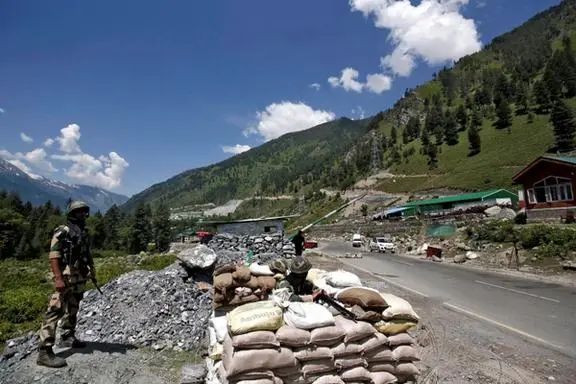
The Indian media outlet India Today has reported that the remaining US M4 rifles in Afghanistan have fallen into the hands of militants in Jammu and Kashmir.

The Indian media outlet India Today has reported that the remaining US M4 rifles in Afghanistan have fallen into the hands of militants in Jammu and Kashmir.
The newspaper quoted sources as saying that Pakistan's intelligence agency (ISI) has been supplying the weapons to militants entering India from the border.
The discovery of M4 weapons from three militants in clashes in Akhnoor, Jammu and Kashmir, has sparked a wave of concern among security forces, India Today reported on Tuesday, November 12. "Almost all the terrorists who cross the border carry AK-47 and M4 rifles," sources told the outlet.
Indian security forces are now investigating how US weapons left in Afghanistan ended up in the hands of militants in Jammu and Kashmir.
Experts also told India Today that the continued use of the assault rifle by militants in Jammu and Kashmir is a serious concern and may be a result of the withdrawal of US forces from Afghanistan in 2021.
The Indian media outlet stressed in the report that these weapons are capable of penetrating bulletproof vehicles and damaging solid infrastructure.
So far, Pakistan has not commented on the allegations.
Earlier, Pakistani officials had expressed concern about the threat of US equipment remaining in Afghanistan to the countries of the region.
According to a Pentagon report, the US Department of Defence provided $18.6 billion worth of military equipment to the Afghan National Army and Security Forces between 2005 and August 2021. The US Department of Defence has announced the value of the remaining US equipment in Afghanistan at $7.12 billion.

Diplomatic sources told Afghanistan International that UNAMA has facilitated the Taliban's participation in the annual United Nations climate change summit in Baku.
After the fall of the previous government, the United Nations Climate Change Convention suspended Afghanistan's participation.
Afghanistan's mission in Geneva had nominated Nasir Ahmad Andisha, the head of the mission, to participate in the 29th United Nations Climate Summit, COP29.
"Given the current difficult situation in Afghanistan and our commitment to participate in international environmental dialogues, Nasir Andisha, as Afghanistan's official representative, is a very suitable choice to participate in the COP29 summit to be held in Baku, Azerbaijan," said a letter written by Afghanistan's mission in Geneva to the Permanent Mission of the Republic of Azerbaijan on October 16.
The letter expressed the hope that Azerbaijan's mission to the United Nations would convey the letter to the relevant authorities in Baku.
It seems that the request of the Afghan representative in Geneva has not been accepted by Azerbaijan, and the Taliban has sent its representative to this international meeting instead.
Diplomatic sources told Afghanistan International that Afghanistan was absent from the previous three UN summits in Cairo, Abu Dhabi and Scotland, but "this year Baku took a different approach, and we are sure that UNAMA played a role (in Baku's decision to invite the Taliban)".
The United Nations Mission in Afghanistan has not yet responded to a question from Afghanistan International about UNAMA's role in introducing the Taliban delegation to the Baku meeting.
‘UNAMA Chief Meets Taliban Official’
According to a note from the Taliban's Environment Department published on November 4 on the agency's page on social media platform X, Roza Otunbayeva, the head of UNAMA, met with Matiul Haq Khalis, the head of the National Environmental Protection Agency in Afghanistan.
"There was a comprehensive discussion on the nature and scope of the United Nations Climate Change Summit (COP29)," the note said.
The Taliban did not say that Otunbayeva had invited the Taliban to attend the meeting. However, a diplomatic source told Reuters that Azerbaijan invited officials from the Taliban's Environment Department as observers to enable them to "potentially participate in peripheral discussions and have the opportunity to have bilateral meetings".
According to the source, since the Taliban government is not officially recognised by the United Nations, the group's officials cannot receive accreditation to participate in the proceedings of the member states.
AFP also reported on Tuesday that the Taliban delegation that attended the meeting was not involved in the main talks.
A three-member Taliban delegation led by Matiul Haq Khalis, travelled to Azerbaijan on Monday, November 12, to attend the international meeting.
The UN's annual climate summit kicked off on Monday, November 11. Fundraising for developing countries is the main topic of discussion at the conference so that they can adapt to these changes.
Afghanistan is one of the countries which has suffered the worst due to climate change. This year's flash floods claimed hundreds of lives. Meanwhile, the heavily dependent country is suffering from one of the worst droughts in decades.
With the fall of the previous Afghan government, the United Nations Framework Convention on Climate Change postponed Afghanistan's participation after 2021, effectively pulling the country out of the negotiations.
After three years, the Taliban delegation has participated in this important international meeting, which was hosted by the United Nations, for the first time.
Taliban officials have so far participated in United Nations meetings on Afghanistan in Doha, as well as in meetings in China and Central Asia.
The United Nations has refused to hand over Afghanistan's seat in the General Assembly to the Taliban, and the Taliban government has not been recognized by any country so far, mainly due to the restrictions it has imposed on women's education and work.
US President-elect Donald Trump has chosen Republican Senator Marco Rubio as his administration's secretary of state, Reuters reported.
In 2021, Rubio and 21 other senators proposed a bill to designate the Taliban as a terrorist organisation.
This Florida-born politician is on track to be the first Latino to serve as America's top diplomat once the Republican president-elect takes office in January. In recent years, his views have been more aligned with Donald Trump.
As Secretary of State in the Trump administration, Rubio will face further challenges stemming from the ongoing instability in the Middle East and Ukraine.
Reuters wrote that the war between Ukraine and Russia will be at the top of Rubio's agenda.
The US senator recently said in interviews that instead of focusing on retaking territories seized by Russia over the past decade, Ukraine should seek a negotiated solution with Moscow.
He was also among 15 senators who opposed sending $95 billion in military aid to Ukraine in April of this year.
‘Marco Rubio's Stance On Taliban’
Trump's choice for the US Secretary of State has held a tough stance against the Taliban over the years.
In February, Marco Rubio introduced a bill titled "Stop Terrorist Financing" to make the distribution of UN aid in Afghanistan more transparent. He said that the US government should halt humanitarian aid to Afghanistan until it stops the Taliban's misuse of foreign aid.
Rubio told Fox News, "Terrorist organisations like the Taliban should not benefit from American taxpayer money. Unfortunately, this is a scenario that is actually happening before our eyes. Until we make sure, the said aid to the UN will be suspended."
In July 2022, Rubio and some other senators proposed another bill to Congress that would have prevented the transfer of Guantanamo detainees to Afghanistan.
The bill was proposed after the Taliban announced that a member of the group had been released from Guantanamo Bay as a result of "positive engagement" with the United States.
Also in October 2021, Marco Rubio and 21 other Republican senators introduced a bill calling on the US State Department to designate the Taliban as a terrorist organisation. The bill, titled the "Preventing Terrorist States Designation Act," also called for sanctions on countries that aid the Taliban.

US President-elect Donald Trump has appointed Mike Waltz, a member of Congress and a retired Army colonel who served as a Green Beret, as his national security adviser, media reported.
Waltz has served in the US Army and National Guard for 27 years and has a history of fighting the Taliban.
He currently represents Florida in the US House of Representatives and is a prominent supporter of Donald Trump.
Mike Waltz, 50, has published his military and political experiences in a book titled "The Warrior Diplomat: The Battles of a Green Helmet: From Washington to Afghanistan."
Waltz has been a critic of the Biden administration's handling of the US withdrawal from Afghanistan, describing the process as "shameful”.
He also told a congressional hearing in October last year that the Taliban had continued to kill and harass former Afghan soldiers.
In February last year, during a congressional hearing called by Zalmay Khalilzad, the US soldier criticised the former US envoy for Afghanistan peace who had said that the Taliban had succeeded in containing al-Qaeda and ISIS.
Waltz said that "relying on one terrorist group to destroy another terrorist group is dangerous and a big mistake".
Referring to the Taliban's punishment of Afghan citizens, Waltz said in December 2022 that women in Afghanistan have been oppressed, children have been radicalised, and another generation of terrorists is being recruited to attack the United States.
The US official told Fox News in September last year that al-Qaeda in Afghanistan, with the help of the Taliban government and US equipment, is once again reviving and realising bin Laden's "dream". Mike Waltz added that US troops will have to return to Afghanistan in the future and fight terrorism. "But not a single official in Joe Biden's administration resigned or was fired," he sarcastically wrote in a note on social media platform X.
Waltz is also a vocal critic of China and Beijing's activities in the Asia-Pacific region. In addition, following Russia's invasion of Ukraine, he called on Joe Biden to provide Ukraine with more weapons.
The US National Security Adviser is a powerful official in the US government who, unlike many senior government positions in the United States, does not require Senate confirmation.

Zablon Simintov, the last Jew from Afghanistan, arrived in Israel on Monday with the help of a Jewish Agency.
According to Israel's Kan network, Simintov went to Türkiye after the Taliban came to power, and after living there for three years, he finally arrived in Israel on Monday.
Simintov, who was forced to leave Afghanistan after the fall of Kabul, in an exclusive interview with Kan 11, said that he was in danger every day and had taken care of the only synagogue in Kabul for a long time, but after the Taliban takeover, he had no choice but to leave Afghanistan.
Simintov was shifted to Türkiye with the support of an American Jewish man named Mordechai Kahana, where he remained for three years. During this time, he continued to look for an opportunity to immigrate to the United States, but encountered administrative problems.
In the interview, he also spoke of his desire to go to Israel to visit his friends.
The Jewish Agency, which facilitated Simintov's immigration to Israel, declined to comment on the details of the case, saying that it could not comment on his specific situation.

Abdullah Khanjani, the political head of the National Resistance Front (NRF) of Afghanistan, has begun a series of meetings with key leaders of groups opposing the Taliban.
Khanjani met a number of politicians, including Abdul Rashid Dostum, Mohammad Mohaqiq, Rasul Sayyaf, and Atta Mohammad Noor, in Türkiye.
Khanjani is called the second in command of the National Resistance Front of Afghanistan, whose responsibility is to coordinate the political leaders opposed to the Taliban.
He said that during these meetings, he emphasised on the formation of a single front to fight the Taliban and shared a "first-hand assessment" of the situation in Afghanistan with these leaders.
According to the assessment of the political head of the National Resistance Front of Afghanistan, the rift between the Taliban and the people is increasing day by day, and the attacks of opposition groups are increasing and the ground for change is gradually being prepared.
In these meetings, Khanjani stressed on the need to bring together Afghan leaders.
