Taliban Publicly Flogs Woman & Man In Khost
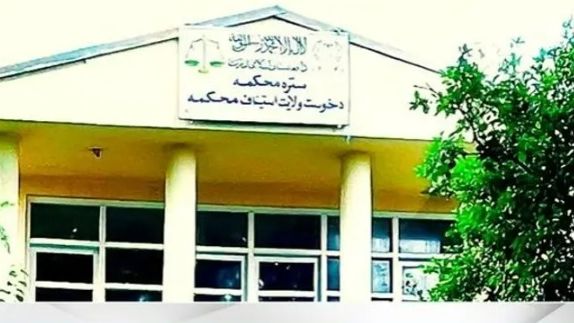
The Taliban's Supreme Court announced that the group's primary court in Nadir Shah Kot district of Khost province had flogged a woman and a man on charges of "moral corruption".
The Taliban's Supreme Court announced that the group's primary court in Nadir Shah Kot district of Khost province had flogged a woman and a man on charges of "moral corruption".
According to the Law of Promotion of Virtue, the Taliban also considers it "immoral" for men and women to speak to each other.
According to the court, each of the defendants was sentenced to 39 lashes in public.
The Taliban's Supreme Court wrote in a statement on Thursday, November 21, that the flogging sentences were carried out by local authorities in the courtyard of the primary court of Nadir Shah Kot district in the presence of clients, local officials, and the general public.
Despite the objections of international human rights organisations, the Taliban has continued to torture and give out corporal punishment in Afghanistan. This comes as many humanitarian organisations have expressed concern about the lack of access to a fair trial for the accused in Afghanistan.

The Taliban's Supreme Court announced on November 21 that the group had flogged three people 39 times for alleged extramarital affairs at a stadium in Khulm district of Samangan province.
According to the court's statement, the three men were flogged in public in the presence of local Taliban officials.
According to a statement issued by the Taliban's Supreme Court, the flogging sentence was carried out based on the decision of the Taliban's primary court in Khulm district of Samangan province.
Despite international condemnation, the Taliban's Supreme Court announces implementation of corporal punishment almost daily.
The international community and human rights defenders have repeatedly called for an end to the Taliban's corporal punishment of defendants, but the group has continued to implement "Islamic law" at will.
The United Nations has repeatedly stated that the Taliban violates the laws and human dignity by punishing flogging.
The Afghanistan Journalists' Support Organisation (AJSO) said that without support for Afghan media, the future of freedom of expression in the country is in serious danger.
On the occasion of World Television Day, the organisation said that a serious crisis threatens media and television in Afghanistan.
A statement issued by the AJSO on Thursday (November 21) read that in the past three years, Afghanistan's visual media have faced widespread restrictions and severe pressures.
The organisation said that the Taliban has severely restricted freedom of expression and the free flow of information by imposing censorship, shutting down the media, and creating an atmosphere of fear and threats against journalists.
The statement also noted that many TV channels have been forced to stop operating or broadcasting content in accordance with the Taliban's ideology. The pressures have had a particularly significant impact on female journalists. Since the Taliban came to power, many female journalists have been deprived of their jobs and some have been forced to leave the country.
The Afghanistan Journalists’ Support Organisation has emphasised that these conditions have endangered not only the freedom of the media, but also the right of the Afghan people to access information.
The organisation called on the international community, human rights organisations, and media organisations to take immediate and practical action to support Afghan media and journalists.
World Television Day, which is celebrated annually on November 21, honours the role of television in promoting culture, information and education. This day reminds us of the impact of television as one of the main communication tools in spreading public awareness and promoting freedom of expression in democratic societies.
This day was introduced by the United Nations in 1996 as an opportunity to inform people about the vital role of television in modern societies.
Sources from the Taliban's Prisons Regulatory Authority confirmed to Afghanistan International that 150 foreign nationals are currently being held in the group's prisons in Afghanistan.
According to these sources, at least 10 of these prisoners are Iranian.
Sources from the Taliban's Prisons Regulatory Authority confirmed on Thursday, November 21, that about 8,000 Afghan prisoners are being held in Iranian prisons.
According to statistics provided by the agency, a total of nearly 12,000 prisoners are held in Taliban-controlled prisons in Afghanistan.
The Taliban has not yet provided details about the identities and reasons for not releasing these foreign prisoners in Afghanistan.
Earlier, US officials had confirmed that three US citizens had been imprisoned by the Taliban. Last week, the Taliban had arrested a Canadian veteran.
On November 14, the Taliban announced that a delegation from Iran's Ministry of Justice had travelled to Kabul to discuss the transfer of Afghan prisoners. According to the Taliban, these talks were held in order to transfer Afghan prisoners from Iran to Afghanistan to serve their sentences.
On November 18, Esmail Baghaei, a spokesman for the Iranian Foreign Ministry, also announced that the number of Afghan prisoners in Iran is significant, and that this has cost the Islamic Republic a lot of money. He also said that Iran has redoubled its efforts to transfer these prisoners.
Iran's Deputy Minister for International Affairs and Human Rights has emphasised that the agreement for the transfer of Afghan convicts was signed in 2006 and that the Taliban is committed to this agreement.
Jabbar Ali Zakeri, Deputy Minister for Roads and Urban Development of Iran, Chair of Board and President of Railways of Islamic Republic, given the proximity of Iran, Afghanistan, and China, called for connecting the railways of the three countries.
Zakeri said that since this proximity reduces the cost of transit and shortens the route, Iran is proposing a trilateral meeting.
In a meeting with Mohammad Ishaq Sahibzada, Deputy Minister of Public Works and head of the Taliban's Railway Authority, Zakeri referred to the determination of the Islamic Republic of Iran Railways to help Afghanistan's railways, saying, "The existence of the railway in the northwest of Afghanistan and its proximity to the common border with Iran is a great opportunity for transit between the two countries."
Emphasising on the importance of completing the Herat rail axis based on a specific timeline, Zakeri said, "This line can shorten the transit route and reduce its cost."
Regarding the transportation of goods through the railway between Iran and Afghanistan, he said that many of the problems faced by the Iran-Afghanistan railway consortium have now been solved and currently three trains are running on the designated route per week.
The Taliban's deputy minister of public works also said that according to assessments, there is a good load capacity on the China-Afghanistan-Iran route and Afghanistan is fully prepared to take the necessary steps along with Iran in this direction.
Training of Afghan Railway Staff
Referring to the training courses held for Afghan railway employees in the past years, Iran's Deputy Minister of Roads and Urban Development said that due to the Taliban's request, a third training course for railway employees will be held in person soon.
The head of the Taliban's Railway Authority also thanked the training programmes for 96 Afghan railway employees and called for a third round of training for Afghan railway employees.
According to IRNA, the Taliban official also announced engineering studies for the construction of the Zaranj-Kandahar railway route, which will open a new chapter of cooperation and trade exchanges between the two countries by connecting this railway line to Zabul.
Local sources told Afghanistan International on Wednesday that the Taliban in Kunar Province has banned the broadcast of images of living creatures.
In a meeting with local officials, the governor of Kunar stressed that from now on, no interviews will be conducted with the visual media.
In addition to national television, there is a private channel called Zala in Kunar, which has also been ordered to refrain from publishing images of living creatures.
Previously, the Taliban had banned the publication of images in Nangarhar, Kandahar, Takhar, Badghis and Helmand provinces.
The Taliban's media restrictions over the past three years have led to the closure of dozens of media outlets and the loss of hundreds of journalists. Concerns have also been raised that these restrictions will be extended to Kabul and other provinces.
Visual media officials travelled to Kandahar earlier this month to resolve the issue and shared their concerns with Taliban leaders.
However, these meetings ended inconclusively.
The Taliban has announced that these actions are carried out in accordance with Article 17 of the Law on the Promotion of Virtue and in accordance with Islamic Sharia. This article prohibits the photography of living beings.