• العربية
  • پښتو
  • فارسی
Brand
  • Afghanistan
  • Sport
  • Markets
  • Afghanistan
  • Sport
  • Markets
  • Theme
  • Language
    • العربية
    • پښتو
    • فارسی
  • Afghanistan
  • Sport
  • Markets
All rights reserved for Volant Media UK Limited
volant media logo

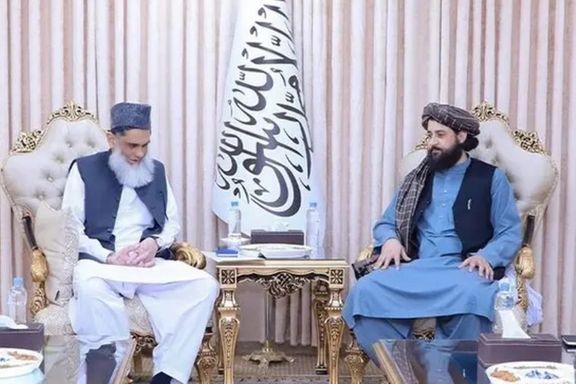
Taliban’s Defence Minister, Pakistani Embassy Chargé d'Affaires Meet After Border Tensions

Nov 27, 2024, 16:31 GMT+0

In the wake of border tensions and rising insecurity in Pakistan, Obaidur Rehman Nizamani, the chargé d'affaires of the Pakistani embassy in Kabul, met with Taliban’s Defence Minister Mullah Yaqoob.

The Taliban's Ministry of Defence wrote in a statement that Nizamani emphasised on the expansion of joint cooperation and strengthening bilateral relations during the meeting.

Mullah Yaqoob also called the relations between Afghanistan and Pakistan "stable" and said that the Taliban’s administration is ready to cooperate with Islamabad in the economic field, trade sector and other fields.

The meeting took place on Wednesday, November 27.

Pakistani officials and the Pakistani embassy in Kabul have not yet provided details about the meeting.

The meeting took place after clashes between Taliban forces and Pakistani border guards in Khost. At the same time, due to the increase in insecurity in Pakistan, relations between the Taliban and Islamabad have become strained.

Pakistan has accused the Taliban of harboring TTP militants and that the group is carrying out attacks in Pakistan from inside Afghanistan. The Pakistani army has called on the Taliban to fulfil its commitments and ensure the security of Afghanistan's borders.

"It is expected that the interim government of Afghanistan will not allow the territory of this country to be used by the TTP to carry out terrorist acts against Pakistan," the Pakistani military statement said.

Pakistan claims that the Afghan Taliban supports members of the Tehreek-e-Taliban Pakistan (TTP) and that Afghan soil is being used to carry out terrorist acts against the country.

Most Viewed

Pakistan Hosts Regional Meet On Afghanistan Without Taliban
1

Pakistan Hosts Regional Meet On Afghanistan Without Taliban

2

Taliban Delegation Travels To Russia To Facilitate Medicine Imports

3

Taliban Ignore Afghanistan’s Interests By Backing Militants, Says Pakistan Army Chief

4

Germany’s Interior Minister Defends Deportations To Afghanistan

5

United Nations Delivers Education Kits To Four Million Afghan Children

•
•
•

More Stories

Russian Security Council Secretary Tells Taliban to Start National Reconciliation Process

Nov 27, 2024, 15:15 GMT+0

Russian Security Council Secretary, Sergei Shoigu, in a meeting with Taliban officials in Kabul, called for the start of a process for reconciliation among Afghans.

He said that Russia wants a lasting peace in Afghanistan and that Moscow is ready to help the reconciliation process among Afghans.

Sergei Shoigu, who was previously Russia's defence minister, headed a high-level delegation to Kabul on Monday and met separately with Taliban officials, including Mullah Abdul Ghani Baradar, deputy prime minister for economic affairs, Mawlawi Abdul Kabir, deputy prime minister for political affairs, Mullah Yaqoob, defence minister, and Sirajuddin Haqqani, the Taliban's interior minister.

According to Russian news agencies, Shoigu said in a meeting with Taliban officials, "We confirm our readiness to establish a constructive political dialogue between our countries, including the reconciliation process among Afghans."

The intra-Afghan dialogue is part of the Doha agreement signed between the Taliban and the United States. However, the Taliban refused to talk to the negotiating team of the former government. With the withdrawal of international forces led by the United States from Afghanistan, the Afghan government collapsed and the Taliban seized power in the country.

Over the past three years, political movements opposed to the Taliban have repeatedly emphasised on dialogue and negotiations with the Taliban, but the Taliban has rejected such talks.

Feridun Sinirlioğlu, the UN Special Coordinator for Afghanistan, presented his assessment of the situation in Afghanistan to the UN Security Council last year. The report proposed a roadmap for engagement with the Taliban, and the start of a political process for the participation of Afghan political forces was part of the proposal. He had said that this process could lead to the normalisation of relations between governments and the Taliban government.

The Taliban has opposed "intra-Afghan dialogue" and the return of former government figures.
Taliban officials have said that they discussed economic cooperation and the expansion of relations with the Russian delegation. The Taliban has made no mention of the delegation's request for intra-Afghan reconciliation.

Abdul Ghani Baradar, the Taliban's deputy prime minister for economic affairs, told Shoigu that the Taliban administration needs Moscow's help to ease the burden of Western sanctions.

According to Russian media, Abdul Ghani Baradar said, "We have tried to create conditions for the growth of Afghanistan's exports and the growth of foreign investment."

The Taliban official said that the United States and the West have increased the pressure on the Taliban after the Taliban came to power by freezing Afghanistan's assets and imposing a travel ban on the group's leaders.
"Therefore, we are waiting for the Russian Federation to help us neutralise this pressure," Baradar added.

Removing Taliban From List Of Terrorist Groups Is "Only Talk For Now", Says Putin's Aide

Nov 27, 2024, 13:56 GMT+0

Yuri Ushakov, an aide to Russian President Vladimir Putin, said that the idea of cooperating with the Taliban has not been translated into action.

Regarding the possibility of temporarily removing the Taliban from Russia's list of terrorist groups, Ushakov said that this issue is "only a matter of words, for now”.

Russian media reported on Tuesday that a bill to "temporarily remove" the Taliban from Russia's list of terrorist groups has been submitted to the country's parliament.

Regarding the possibility of temporarily removing the Taliban from the list of terrorist groups, Yuri Ushakov said, "There are certain reasons for cooperating with the Taliban, but so far this is just talk."

According to the bill submitted to the Russian parliament, "the activities of certain organisations prohibited by Russian law can be suspended for a limited period of time at the request of the prosecutor general or his deputy and by a court order”.

After Russian Security Council Secretary Sergei Shoigu visited Kabul and met with Taliban officials, the group claimed that the process of removing the Taliban from Russia's list of terrorist groups has reached the final stages.

However, Russian President Vladimir Putin's spokesman, Dmitry Peskov, has also announced that Moscow has not yet made a decision on removing the Taliban from the list of terrorist groups.

Peskov said that after Russia's decision to remove the Taliban from the list of terrorist groups, details will be announced.

A high-level Russian delegation led by Russian Security Council Secretary Sergei Shoigu and Deputy Prime Minister Alexey Overchuk visited Kabul on Monday and met with Taliban officials.

Speaking about Russia's relationship with the Taliban, Vladimir Putin had said, "We take into account the views of each of our partners and friends and will coordinate on this issue."

UN Reports 30% Increase In Opium Production In Afghanistan

Nov 27, 2024, 12:25 GMT+0

The United Nations Office on Drugs and Crime (UNODC) announced that opium production in Afghanistan has increased by 30% in 2024 as compared to the previous year.

According to the statistics of this office, contrary to the orders of the Taliban leader, 433 tons of opium had been produced in Afghanistan this year.

The United Nations Office on Drugs and Crime (UNODC) on Wednesday (November 27) published a report saying that the value of the opium crop in 2024 is approximately $260 million, an increase of 130% as compared to the previous year.

The office said that despite a 30 percent increase in opium production in 2024, it showed a 93 percent decrease when compared to 2022, before the issuance of a decree banning the cultivation and production of narcotics by Taliban leader Mullah Hibatullah.

The report states that poppy production and cultivation have been transferred from the southwestern provinces of Afghanistan to the northeastern provinces of the country. The office said that two-thirds of opium production took place in the northeastern provinces.

"International efforts must be coordinated to ensure that this reduction is not replaced by the production of dangerous synthetic drugs such as methamphetamine in Afghanistan or the region," said Ghada Waly, executive director of UNODC.

Waly called for help for poppy-dependent rural communities to turn to cost-effective legal and economic alternatives.

The office had reported last month that poppy cultivation in 2024 increased by 19% compared to the previous year. The United Nations had said that the area of poppy cultivation last year was 10,800 hectares, and this figure has reached 12,800 hectares this year.

Last month's report by the United Nations Office on Drugs and Crime (UNODC) also stated that poppy cultivation has grown in the northeastern regions of Afghanistan, and the price of dry opium has reached about $730 per kilogram.

Despite Attacks By Resistance Fronts, Taliban Retains Military Dominance, Claims SIGAR

Nov 27, 2024, 10:12 GMT+0

The Special Inspector General for Afghanistan Reconstruction (SIGAR) wrote in a report that attacks by opposition fronts do not pose a serious threat to the Taliban, and that the group has been able to maintain its military dominance in Afghanistan.

He predicted that the Taliban would likely be able to maintain this advantage for at least the next 12 months.

In a report to the US Congress, the US inspector general assessed the situation in Afghanistan during the months of July to September. The report was published on Monday, November 26.

The report also emphasised that the Afghanistan Freedom Front and the National Resistance Front, despite their attacks, have not yet posed a serious threat to the Taliban.

‘Doubts About Taliban's Ability To Confront ISIS’

According to the inspector general's report, ISIS-K has been able to increase its cross-border threats and become a regional and global threat. The report expressed doubts about the Taliban's ability to confront ISIS-K.

According to the US inspector general's report, ISIS-K has about 2,000 members, and despite pressure from the Taliban, the group is expanding its influence and strength.

‘ISIS-K Attacks On The Rise In Europe’

ISIS-K is using facilitation networks in Afghanistan and Turkiye to transport troops to Europe, the US inspector general said. The group's simpler, but more frequent attacks are expected to increase in Europe over the next year.

The report explains that one of the main factors behind ISIS-K's success in carrying out transnational attacks is access to weapons, level of military training, ability to evade counterterrorism measures, and identification of effective targets.

ISIS-K targets Afghans and citizens of Central Asian countries who have migrated to Europe or are planning to travel to Europe for asylum.

The US inspector general's report indicates that the group derives part of its financial resources from the main branch of ISIS and has recently switched to using international aid and cryptocurrencies.

‘Al-Qaeda's Strategic Patience’

The US inspector general also reported that al-Qaeda in Afghanistan continues to operate without attracting attention. According to the report, after the US withdrawal in 2021, Taliban leaders may have decided to follow the peace agreement with the US in Doha in 2020 and not allow al-Qaeda to carry out cross-border attacks.

However, the report suggests that some prominent al-Qaeda figures have recently traveled to Afghanistan, which may be a sign of training, recruitment, and reorganisation activities.

The report also raised concerns about cooperation between al-Qaeda and the TTP. According to the report, this cooperation could pose a threat beyond the region. The US inspector general's report states that al-Qaeda has exercised "strategic patience" in its relations with the Taliban.

According to the report, the United States continues to pressure the Taliban to secure the rights of women and girls and will not normalise its relations with the Taliban until these rights are restored.

The US State Department stressed that the Taliban have not fulfilled their promises in August 2021 to respect the rights of women and girls and have returned to the repressive policies they pursued in the 1990s.

"Although the Taliban is sensitive to international criticism, there is no sign of a willingness to change its domestic policies under international pressure," the report shows.

‘Regional Concerns’

According to the report, the countries of the region are concerned about the situation in Afghanistan. Despite maintaining diplomatic relations with the Taliban, these countries are concerned about the expansion of terrorist groups in Afghanistan. The countries of the region have called on the Taliban to fight terrorist groups in a tangible way.

Pakistan accuses the Taliban of supporting the Tehreek-e-Taliban Pakistan (TTP). Islamabad says that Afghan soil is being used against the country. The Islamic Republic is afraid of the activities of ISIS and Jaish al-Adl on its borders. However, the Taliban has stressed that Afghanistan's soil will not be used against the countries of the region and the world.

The US Inspector General serves as the coordinator of surveillance reports and assessments related to the country's security and defence operations.
OIC, UK Special Envoys Call For 'Enhanced Engagement With Taliban'

Nov 27, 2024, 09:15 GMT+0

Tarig Ali Bakheet, the Special Representative of the Organisation of Islamic Cooperation (OIC) for Afghanistan discussed Afghanistan in a meeting with his British counterpart.

In order to address the economic, humanitarian and human rights challenges in Afghanistan, there is an "urgent need to increase the level of engagement with the Taliban", they said.

The Organisation of Islamic Cooperation (OIC) said in a statement that the OIC's Special Representative met with British Special Representative for Afghanistan Andy McCoubrey on Monday at the OIC headquarters in Jeddah.

The two officials discussed the situation in Afghanistan and key issues at the last Doha meeting.

The third Doha meeting, which was held on June 30 and July 1 of this year, was attended by representatives of international community, as well as a delegation from the Taliban group in Qatar, and discussed supporting the private sector and more cooperation of the world to fight drugs in Afghanistan.

Representatives of the Organisation of Islamic Cooperation (OIC) and the United Kingdom called for increased engagement with the Taliban to resolve economic and humanitarian problems in Afghanistan.