Taliban Ban Overnight Stay Of Guests In Kabul's Green Zone Inns, Claim Sources
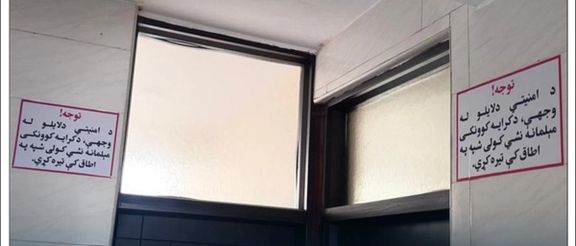
Local sources said that the Taliban's intelligence agency has banned guests from staying overnight in hotels and inns near Kabul's "Green Zone".
Local sources said that the Taliban's intelligence agency has banned guests from staying overnight in hotels and inns near Kabul's "Green Zone".
According to sources, the Taliban's intelligence agency has announced that the ban was carried out for security reasons.
According to local sources, Taliban officials in the group's intelligence department have not provided further explanations about the reasons for the ban.
Bilal Sarwari, a journalist, also announced the ban in Kabul's Green Zone on his X social platform account.
In a photo he posted on his social media page, there is a sign in the corridor of one of the inns, "For security reasons, guests cannot spend the night in rented rooms."
Before the Taliban's takeover of Afghanistan, the Kabul Protected Area, known as the "Green Zone", was home to embassies of foreign countries, including the US embassy, and the offices of international institutions and organisations.
The Presidential Palace, Ministries of Defence, Interior, and Foreign Affairs were also located in this area.

Médecins Sans Frontières (MSF) or Doctors Without Borders has said that the Taliban's decision to ban women's education in medical institutions threatens Afghanistan's health system and will have serious consequences for women's health.
The Taliban's move is another step to exclude women from public and professional life, the organisation said.
The organisation added that the small number of female health workers in Afghanistan has currently affected access to healthcare in the country, especially due to the separation of male and female hospital wards. The Taliban's new ban has further restricted access to quality healthcare.
"There is no health system without educated female medical staff," said Médecins Sans Frontières (MSF) representative in Afghanistan, Mickael Le Paih, on Friday, December 6.
He added that more than 41 percent of the organisation's medical staff in Afghanistan are women.
Le Paih also stressed that the Taliban's new decision deprives women of access to education and the provision of impartial health services.
The organisation said that the medical needs in Afghanistan are enormous and that more women need to be trained to take care of them.
Restrictions imposed by the Taliban in Afghanistan over the past three years have significantly reduced access to medical education for women, Médecins Sans Frontières (MSF) said in the statement.
At the maternity centre in Khost province, which is one of the busiest maternity centres in the world, it is challenging to fill essential positions such as nurses and obstetricians and gynecologists, the statement added. The organisation reported that from January to June 2024, it helped 22,300 deliveries.
The World Health Organisation (WHO) has emphasised that in order to provide essential health services to all people, these services must be provided by all genders.
Médecins Sans Frontières (MSF) has said it will continue to defend women's right to access medical education and education in general in Afghanistan.
The medical needs in Afghanistan are enormous, and to meet them, more training of women's medical staff is necessary.
Médecins Sans Frontières (MSF) is an international non-profit organisation that provides medical and humanitarian services in crisis areas.
Karim Khan, the chief prosecutor of the International Criminal Court (ICC), met with a number of members of the Afghan Women's Coalition.
The International Criminal Court (ICC) said that the Office of the Prosecutor, in cooperation with victims and civil society, has prioritised action on "gender-based crimes in Afghanistan”.
The ICC on Friday, December 6, released a video of Karim Khan's meeting with members of the Afghan Women's Coalition on social media platform X.
The statement said that Prosecutor Karim Khan, along with the victims and civil society, has prioritised action on gender-based crimes in Afghanistan.
Khan expressed hope that the decisions of the Hague court would "alleviate some of the pain of Afghan women".
Referring to human rights violations in Afghanistan this week, Karim Khan said that he would soon apply for an arrest warrant for those involved in human rights violations.
Recently, Chile, Costa Rica, Spain, France, Luxembourg, and Mexico referred the case of Afghanistan, especially the violation of women's rights in this country, to the International Criminal Court in The Hague. The International Criminal Court also confirmed that it had received the case.
The court is also expected to issue arrest warrants for some Taliban leaders involved in "systematic violence" against women and "the prevailing gender apartheid in Afghanistan".
In a meeting with Afghan women activists in The Hague, Karim Khan once again referred to the countries' requests, saying, "Soon you will hear news about your country”.
Human rights activist Horia Musadiq was quoted as saying that the chief prosecutor of the Hague court said, "He hopes that the court's decisions can alleviate some of the pain and suffering of the Afghan people, especially Afghan women, and that those responsible for the crimes will be brought to justice."
The Hague prosecutor has refused to name the Taliban, but the group has a case that Karim Khan and his team are handling because of its policies that have completely deprived Afghan women of their rights.
Past Crimes
On Thursday, a number of Afghan activists met with Karim Khan. Horia Musadiq, one of the participants, told Afghanistan International that during the meeting, she called for an investigation into the crimes and violence of the past 20 years.
She said that in order to investigate the crimes committed over the past 20 years, whether by the Taliban or by NATO and US forces in Afghanistan, a special tribunal should be established similar to the war crimes tribunal in the former Yugoslavia.
Fereshta Abbasi, Afghanistan researcher at Human Rights Watch, also posted a photo of Afghan women activists meeting with Karim Khan at the International Criminal Court (ICC) headquarters in The Hague on Thursday, and wrote, "The prosecutor announced that he would soon request an arrest warrant."
Afghan women's activists are in the corridors of the criminal court seeking to hold the perpetrators of serious crimes in Afghanistan accountable, she said.
Despite repeated calls by the international community, human rights organizations, and especially Afghan women to lift restrictions imposed on women in Afghanistan, the Taliban has increased these restrictions over the past three years.
After banning girls from studying above the sixth grade, the Taliban banned the education of girls and women in higher education centres and universities, and in the latest move, closed the only remaining educational institution, namely medical institutes, to girls.
The Afghanistan-Pakistan Joint Chamber of Commerce announced that the level of trade exchange between Afghanistan and Pakistan has decreased from $2.5 billion to $700 million. The organisation blamed Islamabad for the decline in trade with Afghanistan.
In a statement on Wednesday, December 4, Zia-ul-Haq Sarhadi, the deputy head of the chamber, cited various factors as the main reasons for the decline.
He said that the Pakistani government had imposed restrictions such as a temporary acceptance document, the requirement of a bank guarantee equal to the value of goods, adding 14 items to the negative list, imposing a 10 percent tariff on Afghanistan's transit goods, and stopping more than 300 Afghan commercial containers at Karachi port, which led to a decline in trade relations between the two countries.
Sarhadi added that these policies have caused a large part of Afghanistan's trade to be transferred to Iran's Chabahar port instead of Karachi port, as a result of which thousands of people have lost their jobs in Pakistani customs.
He also criticised the Khyber Pakhtunkhwa province's decision to impose an additional two percent tariff on export goods sent to Afghanistan through the Torkham border. The tariff, which is aimed at developing the state's infrastructure, has put more pressure on traders.
The Afghanistan-Pakistan Joint Chamber of Commerce has called for an immediate review of these policies to prevent further damage to trade and economic cooperation between the two countries.
In the past few decades, Afghan governments have had not very warm relations with Pakistan due to their proximity to India. Strained relations and hostility between Islamabad and Kabul have hurt land trade between Afghanistan and Pakistan.
Although the Afghan Taliban enjoyed broad support from Pakistan in the war against the previous government for the past 20 years, after the fall of the government, the Taliban's relationship with Islamabad deteriorated due to its support for Pakistani militants.
Pakistan has ignored the Taliban's repeated calls to improve economic relations and solve the problem of Afghan businessmen in the field of trade.
Rina Amiri, the US special representative for Afghan women's affairs, said on Thursday that the Taliban's policies and actions show complete disregard for Afghanistan's international obligations.
Engagement with the group without prioritising human rights is counterproductive, she said.
"In the past three years, the Taliban has deprived women of their most basic rights, such as the right to education, decision-making, travel, and even to speak in public," Amiri wrote on social media platform X on Thursday in response to the Taliban's new decree banning women from attending medical institutes.
She stated that these policies are a clear example of gender discrimination and an attempt to exclude women from society.
Amiri added that the Taliban's closure of health institutes would eliminate access to vital health services, including maternal care. She called the decision inhumane and a threat to the lives of Afghan women and children, warning that these actions endanger the future of the country.
The US Special Representative clarified that preventing the training of female doctors and prohibiting the treatment of women and girls by male doctors is inhumane and illogical.
The Taliban's new decree has sparked a wave of international condemnation. In addition to the United States, countries such as Germany and France, the European Union, the Organisation of Islamic Cooperation and human rights organisations have described the decision as "unacceptable" and "destructive”.
Pakistan's Foreign Ministry has said that it is holding talks with the Afghan Taliban on combating the threat of terrorism from Afghan soil.
Mumtaz Zahra Baloch, the spokesperson of the ministry, expressed concern about the unification of terrorist groups on Afghan soil and its transformation into a regional threat.
In her weekly press briefing on Thursday, December 5, Pakistan's Foreign Ministry spokesperson said that issues related to terrorism are important in the talks between Afghanistan and Pakistan. "Pakistan and Afghanistan discussed the dimensions of the fight against the threat posed by Pakistan from terrorist elements who have found hideouts and sanctuaries inside Afghanistan," she said.
Mumtaz Zahra Baloch also expressed concern about the unification of terrorist groups on Afghan soil and their transformation into a regional threat.
In that case, she said, Pakistan would like to take immediate and effective action against these terrorist groups.