French MP Calls Taliban's Restrictions 'Exclusion Of Women'
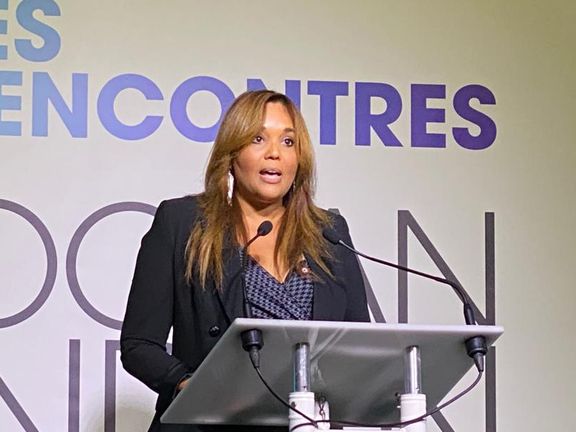
French MP Maud Petit strongly criticised the Taliban's restrictions on Afghan women.

French MP Maud Petit strongly criticised the Taliban's restrictions on Afghan women.
In a post on social media platform X on Monday, December 30, Petit called these restrictions "the elimination of women" and said, "How is this possible in the world of the 21st century?"
The French parliamentarian's remarks are in response to the new decree attributed to Taliban leader Hibatullah Akhundzada. He issued the decree on Saturday, December 28, regarding windows through which neighbouring women can be seen.
According to the decree, it is forbidden to make windows through which women can be seen in a neighbour's kitchen or yard.
The decree states that "because women are usually cooking in the kitchen, or there is a well of water there, or women sit there because of custom and habit," they should not be seen from a window facing the neighbour's house.
Afghan women protesters have called the Taliban's decree a clear example of the continued "oppression and humiliation of Afghan women".


Hamdullah Fitrat, the Taliban's deputy spokesman, said that any decision on Afghanistan at UN Security Council meetings without the presence of the group's representative is "one-sided and inconclusive".
Earlier, the Security Council had once again called for a review of the Taliban's misogynistic policies.
He made the remarks in an interview with the Taliban-controlled National Radio and Television on Sunday, December 29, in response to a recent statement by the United Nations Security Council.
The United Nations Security Council announced on Friday, December 27, that its members reiterated their support for UNAMA in their meeting about 20 days ago. The statement said that the members of the Security Council are deeply concerned about the negative impact of the Taliban's actions towards women.
Members of the council called on the Taliban to repeal restrictive policies, especially on the rights of women and girls. According to the statement, women's and girls' access to education and their full participation in Afghanistan's development is vital to building trust between the international community and Afghanistan.
Currently, Afghanistan's seat at the United Nations is held by Nasir Ahmad Faiq, a diplomat of the former Afghan government.
The Taliban's Ministry of Foreign Affairs has nominated Suhail Shaheen as its representative to the United Nations, which has not been accepted.

Taliban’s Ministry of Economy, marking the second year since banning women from employment in non-governmental organisations (NGOs), has issued a renewed warning to domestic and international organisations to strictly adhere to this directive.
In a statement dated Thursday, 26 December, Mohammad Alam, Deputy Minister of Finance and Administration for the Ministry of Economy, emphasised that women are prohibited from working in NGOs. He warned that any organisation found violating this ban would face suspension of its activities and revocation of its licence.
The ministry urged all domestic and international organisations to comply with the order and to refrain from employing women in any capacity.
The Taliban first issued this ban in December 2022, instructing NGOs to “suspend” all female employees. The decision sparked widespread global condemnation, with some organisations halting their operations in Afghanistan in protest.
Humanitarian groups have reported that the exclusion of women from their workforce has severely disrupted relief efforts, further exacerbating the ongoing humanitarian crisis in the country.
Despite international criticism, the Taliban continues to enforce policies that exclude women from public life and impose further restrictions on their participation in Afghan society.

Afghanistan’s Central Bank, under Taliban control, has announced that the Participation Banks Association of Turkiye conducted a three-day training programme for its employees.
According to a statement from the Taliban, the training focused on the principles of Islamic banking and Sharia-compliant financial products.
In a statement released on Saturday, the Taliban-controlled Central Bank explained that the programme aimed to enhance employee capabilities and facilitate the full implementation of Islamic banking in Afghanistan.
Sediqullah Khalid, deputy head of the bank, stated: “The Central Bank of Afghanistan has terminated interest-based transactions in the banking sector and is committed to establishing a complete Islamic banking system.”
He further added that all current banking transactions in Afghanistan are conducted in accordance with “Hanafi jurisprudence and without interest.”
The head of Afghanistan’s Central Bank has repeatedly appealed to international Islamic organisations and institutions to support the implementation of a fully Sharia-compliant banking system.
A defining feature of Islamic banking is the prohibition of “bank interest,” viewed as “usury” and deemed religiously illegitimate by the Taliban. Instead, financial activities are structured around profit-sharing and ethical investment principles.
This initiative comes at a time when Afghanistan’s banking system remains in disarray following the Taliban’s return to power. The country’s financial institutions continue to face significant challenges in restoring normal operations and facilitating international transactions.

The World Food Programme (WFP) has announced its support for Afghan saffron farmers by providing seeds and expert consultation to assist in cultivating and processing this highly valuable spice.
The initiative, according to the United Nations’ WFP, aims to ensure families have improved access to nutrition while fostering sustainable livelihoods.
In a statement on Sunday, the WFP highlighted saffron—often referred to as the “red gold” of the world—as a promising opportunity for economic stability in Afghanistan.
Abdul Wahid Sadat, deputy head of the Afghan Saffron Union, stated in November that 85% of saffron processing in the country is carried out by women. He further noted that between 50,000 to 60,000 women in Herat province are currently involved in saffron processing, demonstrating the sector’s significant contribution to empowering women.
The Taliban previously announced that, following the ban on poppy cultivation, saffron farming has expanded to 26 provinces across Afghanistan, marking a notable shift towards alternative agriculture in the region.

Maria Zakharova, spokesperson for Russia’s Foreign Ministry, has expressed concern over escalating tensions along the Pakistan-Afghanistan border. Zakharova urged both Pakistan and the Taliban to “show restraint” and resolve their disputes through dialogue.
In a statement published on Saturday on the Russian Foreign Ministry’s website, Zakharova noted, “Moscow is concerned over the escalation of tensions on the Pakistani-Afghan border, where not only the military but also civilians perish in shootouts.”
The Russian Foreign Ministry has called for a “constructive dialogue” between the Taliban and Pakistan to address their differences peacefully.
The statement coincides with the Taliban Ministry of Defence’s announcement of retaliatory attacks, conducted three days after Pakistani airstrikes targeted areas in Afghanistan’s Paktika province.
While the Taliban did not explicitly name Pakistan, their Ministry of Defence claimed that the retaliatory strikes occurred “beyond the Durand Line,” the term commonly used by Taliban officials to describe the Afghanistan-Pakistan border.
The Taliban’s retaliation follows Pakistan’s airstrikes on Tuesday evening in Barmal district, Paktika province. According to Zabihullah Mujahid, the Taliban’s spokesperson, at least 46 people, including women and children, were killed in the bombings, which targeted four locations.
After the airstrikes, the Taliban Ministry of Defence had pledged that the attacks would not go unanswered.