• العربية
  • پښتو
  • فارسی
Brand
  • Afghanistan
  • Sport
  • Markets
  • Afghanistan
  • Sport
  • Markets
  • Theme
  • Language
    • العربية
    • پښتو
    • فارسی
  • Afghanistan
  • Sport
  • Markets
All rights reserved for Volant Media UK Limited
volant media logo

Pakistan Begins Two-Year Term As Member Of Security Council
Jan 3, 2025, 09:40 GMT+0

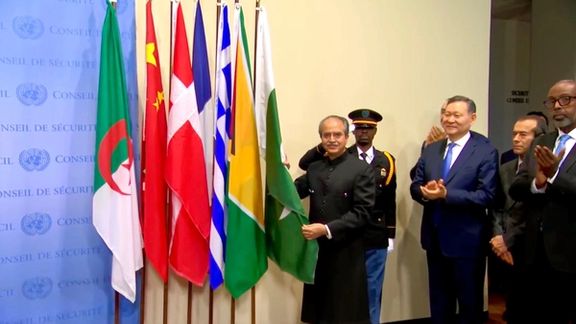
Pakistan has begun its two-year term as a non-permanent member of the United Nations Security Council.

Islamabad was elected to replace Japan as one of the representatives of the Asia-Pacific region on the Security Council in June last year and officially began its work on January 1 this year.

On Wednesday, January 2, the United Nations Security Council raised the flags of Pakistan, Denmark, Greece, Somalia, and Panama as non-permanent members of the Council.

The ceremony was attended by Asim Iftikhar Ahmed, Additional Permanent Representative of Pakistan to the United Nations.

Pakistan's Dawn newspaper reported that this is the eighth time that Pakistan has gained membership in the council.

The newspaper also wrote that by becoming a member of the Security Council, Pakistan will also gain a seat on the Islamic State (IS) and Al-Qaeda Sanctions Committee, which is responsible for identifying individuals and groups associated with IS and Al-Qaeda as terrorists and imposing sanctions on them.

"This will be a valuable opportunity for Pakistan to highlight cross-border terrorist attacks from Afghanistan by groups linked to the Islamic State militant group and al-Qaeda," the Dawn newspaper wrote.

Pakistan will have more influence in setting the agenda and presenting proposals by becoming a member of the UN Security Council. It is likely that Pakistan will use this position to highlight the threat of terrorism from Afghan soil against Pakistan, especially the threat of the Tehreek-e-Taliban Pakistan, and to illegitimately portray India's sovereignty over Jammu and Kashmir.

Islamabad may also try to exert pressure on the Afghan Taliban from this area.

Pakistan's two-year term as a member of the United Nations Security Council ends on December 31, 2026.

Most Viewed

Taliban Ignore Afghanistan’s Interests By Backing Militants, Says Pakistan Army Chief
1

Taliban Ignore Afghanistan’s Interests By Backing Militants, Says Pakistan Army Chief

2

Female Ismaili Entrepreneur Shot Dead In Badakhshan

3

Afghanistan May Not Remain Intact In Future, Says Pakistani Analyst

4

French Parliament Hosts Two-Day Meeting On Afghanistan

5

Taliban Renews Call For China To Launch Aynak Copper Mine

•
•
•

More Stories

Islamic Republic Of Iran Has Executed Nine Afghan Prisoners In One Month

Jan 2, 2025, 15:33 GMT+0

The Islamic Republic of Iran executed at least 138 prisoners, including nine Afghans, in December 2024, the human rights organisation Hengaw reported.

The organisation wrote that the number of executions in Iran in December increased by 9.5 percent compared to the previous month.

The Hengaw Human Rights Organisation reported on Thursday, January 2, that the Islamic Republic's judiciary has executed at least 28 Kurdish prisoners, 22 Baluch prisoners, 15 Turkish prisoners, 12 Lur prisoners, and six Gilak prisoners in December 2024.

The organisation said that this month, six women were executed by the Islamic Republic of Iran's judiciary in prisons in Isfahan, Zanjan, Yazd, and Sari.
In a separate report, Iran Human Rights also reported that the Islamic Republic executed five prisoners, including three Afghans, in Bandar Abbas Central Prison on Wednesday, January 1.

The Hengaw Human Rights Organisation, which operates outside Iran, said that of a total of 138 executions this month, three were announced by official sources of the Islamic Republic. The organisation noted that six of these prisoners were executed in secret without the knowledge of their families and the right to a last visit with their families.

Hengaw added that 75 prisoners were executed on drug-related charges, 61 for murder, and 10 for armed robbery.

The human rights organisation Hengaw has previously announced that the Islamic Republic of Iran has executed at least 74 Afghan prisoners in 2024.

The Islamic Republic has continued to carry out executions despite the objections of international organisations. Human rights organisations operating outside Iran have acknowledged that the Islamic Republic has increased the execution of Afghan prisoners after the Taliban came to power in Afghanistan.

Did Not Ask Pakistan For Money To Keep TTP Away From Border Areas, Says Taliban

Jan 2, 2025, 14:16 GMT+0

The Taliban's deputy spokesman denied the Pakistani Defence Minister's claim that the Taliban had demanded 10 billion rupees in exchange for the removal of Tehreek-e-Taliban Pakistan (TTP) fighters from the border areas.

The Pakistani Defence Minister had said that the Taliban had demanded 10 billion rupees to remove TTP fighters from the border areas.

Hamdullah Fitrat, deputy spokesman for the Taliban, said on Thursday in response to the claim, "It is regrettable that high-ranking Pakistani officials are making such false statements."

Earlier, Pakistani Defence Minister Khawaja Muhammad Asif had claimed that during his visit to Afghanistan in 2022, Taliban’s Defence Minister Mohammad Yaqoob Mujahid had demanded 10 billion Pakistani rupees to move the TTP from areas near the Durand Line to western Afghanistan.

Pakistani officials have repeatedly asked the Taliban to not allow Pakistani militants to operate in border areas and attack Pakistani security forces.

Pakistan has always accused the Afghan Taliban of supporting armed groups opposed to its government, especially the Tehreek-e-Taliban Pakistan.

In recent months, there have been reports that the Taliban is planning to move TTP members to northern Afghanistan.

Islamic Republic of Iran Executes Three Afghan Prisoners In Bandar Abbas

Jan 2, 2025, 12:18 GMT+0

The Iranian Human Rights Organisation reported that the Islamic Republic executed five prisoners, including three Afghans, in the central prison of Bandar Abbas.

The organisation said that the Islamic Republic's judiciary had previously sentenced the prisoners to death on drug-related charges.

The Iranian Human Rights Organisation wrote in a statement that authorities at Bandar Abbas Central Prison carried out the death sentences of these prisoners on Wednesday morning, January 1. The organisation identified one of the executed prisoners as Ramzi Yigsavar, 25, from the Baburiyan tribe of Afghanistan.

The Iranian Human Rights Organisation has identified the two executed Iranian prisoners as Hedayat Ghasemi and Shahrokh Sabahpour. The organisation said that the identities of the other two Afghan prisoners who were executed are still unknown.

Earlier, the Iranian Human Rights Organisation announced on Monday, the execution of an Afghan prisoner named Jalal Stanikzai in Aligudarz prison in Lorestan. The organisation wrote that Jalal Stanikzai had been arrested four years ago on charges of premeditated murder and sentenced to death.

The Islamic Republic has continued to carry out this sentence, despite opposition from international organisations to the execution of the defendants.

According to the Human Rights Organisation Hengaw, the Islamic Republic of Iran executed at least 74 Afghan prisoners in 2024.

Khalil Haqqani Had Continuous Contact With NRF, Says Fazl Ahmad Manawi

Jan 2, 2025, 11:07 GMT+0

Fazl Ahmad Manawi, a former justice minister and a member of the National Resistance Front (NRF), said that Khalil Haqqani, the former Taliban refugee minister, had indirect and continuous contacts with the NRF.

He added that these contacts continued since the war in Panjshir until the suicide attack on Haqqani's life.

However, he emphasised that Ahmad Massoud, the leader of the National Resistance Front, had no direct contact with Khalil Haqqani.

Manawi said in an interview with Afghanistan International on Wednesday that Khalil Haqqani was not a supporter of war and that they received repeated calls from him when the war was underway in Panjshir.

He clarified that Haqqani's efforts to prevent war and stand his ground continued until the last moment.

Earlier, Michael Semple, former deputy EU envoy for Afghanistan, had said in an interview with Afghanistan International that Haqqani was assassinated because of covert internal and external connections. He said that the Taliban leader was suspicious of Haqqani's contacts. Semple had described Haqqani's assassination as a result of internal Taliban conflicts.

Fazl Ahmadi Manawi, a senior member of the National Resistance Front, also attributes the assassination of Khalil Haqqani to internal Taliban disputes.

Khalil Haqqani was killed last month in a suicide attack at the headquarters of the Taliban’s Ministry of Refugees in Kabul.

Manawi mentioned the increasing dissatisfaction within the Taliban ranks, saying that the Kandahar group had monopolised power, and this had caused dissatisfaction among other factions within the group.

Manawi predicted that with the coming to power of the new US government, aid to the Taliban will be cut off and they will not be able to finance the huge expenses of their jihadi schools and security institutions through taxes and underground resources.

Manawi stated that the coming year will not be a good year for the Taliban, predicting that signs of the Taliban's collapse will become more visible in 2025. This member of the National Resistance Front stated that in a meeting with representatives of regional countries, they realised that these countries were also disappointed with the Taliban.

Migration of Afghan Elites From Iran Harmful For Country, Says University Prof. In Tehran

Jan 2, 2025, 10:06 GMT+0

An assistant professor at Allameh Tabataba’i University said at a conference in Tehran on Wednesday that many elites from Afghanistan migrated to Iran after the Taliban came to power.

Mandana Tishehyar called them human capital and considered their migration to Western countries to be detrimental for Iran.

In the talk "Immigration of Scientific Elites in Iran Today, Challenges and Solutions," this university professor said that Afghan immigration to Iran began in the 1970s and now their second and third generations are present in Iran, those who, according to Tishehyar, were educated and raised in Iran.

According to IRNA, Tishehyar said that after the Taliban came to power in Afghanistan, a wave of people left the country, "including educated people such as university professors, students, doctors, engineers, lawyers, economists, sociologists, journalists, writers, and athletes who brought financial capital to Iran in addition to human capital”.

Tishehyar, pointing out that these people leave Iran for Western countries, America, and Australia after a while for various reasons, said, "No effort was made to ensure their continued existence. The migration of this group of Afghans from Iran is not in the country's interest and will end up being detrimental to Iran in the long run."

The university professor went on to say that as Afghan immigrants leave Iran, “their next generation will become alienated from the Persian language”. She said, “Elite Afghan immigrants could have helped Iran solve some issues such as smuggling, security, counter-terrorism, the environment, climate change, and the water issue.”

The assistant professor at Allameh Tabataba‘i University also pointed out the issue of preventing women and girls from getting an education in Afghanistan, saying that preventing women from getting an education by the Taliban "will result in their children not being educated properly in the future, which will have consequences for Iran as well”.

This university professor in Tehran criticises the lack of efforts to retain elite Afghan immigrants, even though in recent months the Islamic Republic has launched a massive campaign to collect and deport Afghan immigrants from their country.

In addition, restrictions on the education of children of immigrant families have increased, and employment and even settlement of Afghans have been banned in many Iranian cities.

The harsh treatment and inappropriate treatment of Afghan immigrants by law enforcement officials and, in some cases, by Iranian citizens has made it difficult for families to consider staying in Iran. In recent years, many Afghans have tried to move to European countries, the United States, and Australia.