Pakistani Army Claims Killing Of Afghan ‘Terrorist’ In North Waziristan

The Pakistan Army has announced the killing of an Afghan national, identified as Luqman Khan alias Nusrat, during a counter-terrorism operation in North Waziristan.

The Pakistan Army has announced the killing of an Afghan national, identified as Luqman Khan alias Nusrat, during a counter-terrorism operation in North Waziristan.
In a statement released on Saturday, the Pakistani military alleged that the deceased was involved in terrorist activities and cited his death as “irrefutable evidence of Afghan nationals’ involvement in terrorism within Pakistan.”
According to the statement, Nusrat was killed on 6 February in an operation conducted by security forces in the Datta Khel area of North Waziristan.
The statement further revealed that the Taliban had contacted Pakistan to retrieve the body of the slain Afghan national. Authorities confirmed that Nusrat was a resident of Khost province of Afghanistan.
The Pakistan Army reiterated its expectation that the Taliban administration upholds its commitments and prevents terrorists from using Afghan soil to launch attacks on Pakistan.
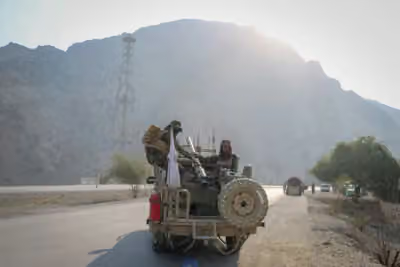

The second round of the National Dialogue Process, aimed at outlining a political roadmap to address Afghanistan’s ongoing crisis, is set to take place in Istanbul on Saturday and Sunday, 8-9 February.
According to sources shared with Afghanistan International, the event will bring together representatives from the Taliban, political parties, civil society, and women. Expected attendees include the sons of Hazara leaders Karim Khalili and Mohammad Mohaqiq, a representative of Jamiat e Islami party leader Salahuddin Rabbani, a delegate from the Islamic Movement Council, the son of Hizbe Islami leader Gulbuddin Hekmatyar, as well as former member of parliament Farkhunda Zahra Naderi.
Although some journalists have been invited, the forum has imposed restrictions on media coverage, barring any reporting on the discussions. Like the first round of the process, this meeting will be conducted behind closed doors.
Uncertainty Over Taliban Participation
The first round of the National Dialogue Process, held in November 2023, gathered 70 representatives from diverse political and ethnic groups, ethnic, and factions. However, several Taliban representatives and key political figures declined to participate. It remains unclear whether the Taliban will attend this second round of the process.
Participants of the inaugural round of the process had emphasised the necessity of a transparent intra-Afghan dialogue process to pave the way for meaningful political engagement.
Objectives of the National Dialogue Process
The National Dialogue Process consists of 35 permanent members and convenes every three months to foster a culture of dialogue. Its primary objective is to provide a platform for constructive discussions between Afghans inside and outside the country, promoting national trust and addressing Afghanistan’s political, social, economic, and cultural challenges.
Established in 2022 as a collective initiative of Afghan political, social, and economic leaders, the assembly operates with a council-based structure and a rotating leadership.
Prominent figures leading the forum include Uzbek young leader Babar Farahmand, former minister Mustafa Mastoor, former deputy ministers Hikmat Khalil Karzai, and Idris Zaman.

John Sopko, the former U.S. Special Inspector General for Afghanistan Reconstruction (SIGAR), has alleged that a substantial portion of U.S. financial aid has ended up in the hands of the Taliban.
Speaking in an interview with Fox Business on Thursday, Sopko stated that U.S. aid has been channelled into Afghanistan through organisations such as the United Nations and the World Food Programme (WFP), but oversight of its allocation and expenditure has been inadequate.
Previously, Sopko called on Congress to terminate SIGAR after 30 September 2025, citing the significant reduction in U.S. aid to Afghanistan. He underscored that the issue transcends any single institution or individual, attributing it to systemic failures within U.S. agencies to manage financial resources transparently and effectively in Afghanistan over the past two decades.
Earlier this year, Sopko had warned that U.S. funds were being siphoned into the Taliban’s coffers. He also disclosed that certain employees of the U.S. Agency for International Development (USAID) had attempted to report on financial mismanagement in Afghanistan but were ignored in Washington.
Taliban Rejects Allegations
In response to Sopko’s remarks, the Taliban dismissed the claims as baseless. Abdul Latif Nazari, the Taliban’s Deputy Minister of Economy, stated that the group merely facilitates international aid efforts and does not interfere in the distribution of humanitarian assistance.
Sopko has previously warned that terrorist groups could exploit U.S. humanitarian aid, particularly funds sent via the UN to assist impoverished Afghans. He reiterated that a significant share of American taxpayer money, allocated through UN channels for Afghanistan, fails to reach those in need.
Financial Impact and U.S. Policy Shift
According to SIGAR’s latest report, published on 2 February 2025, the U.S. has spent approximately $3.71 billion in Afghanistan since its military withdrawal in 2021, with the majority of funds directed to UN agencies.
Meanwhile, U.S. President Donald Trump has announced a temporary suspension of all foreign aid, including assistance to Afghanistan, for at least three months. This decision has heightened concerns over the future of humanitarian efforts in Afghanistan, where millions remain dependent on international support.
Critics of the Taliban contend that the group exploits and interferes with humanitarian aid, diverting resources for its own benefit. Many analysts believe that cutting or suspending U.S. aid could exacerbate Afghanistan’s economic crisis, placing additional strain on the Taliban administration.

The Taliban’s Office of the Prime Minister has instructed the Ministry of Interior to issue weapons and armoured vehicles to employees and ombudsmen of the Ministry for the Propagation of Virtue and the Prevention of Vice, according to leaked documents.
The documents, published on the TalibLeaks website, reveal that the Taliban’s morality police in the capital and provinces will be granted permits to carry weapons and operate black-tinted armoured vehicles. The Ministry for the Propagation of Virtue and the Prevention of Vice initially submitted the proposal to the Prime Minister’s Office on 2 May 2024, which was approved on 27 August and subsequently forwarded to the Ministry of Interior for implementation.
Following the directive, the Ministry of Propagation of Virtue instructed its departments in Kabul to compile and submit lists of their employees to the Ministry of Interior for weapon permit applications. Provincial offices were directed to liaise with local police headquarters to facilitate the issuance of permits for carrying weapons and black-tinted armoured vehicles.
A day after receiving the directive, the Ministry of Interior confirmed the request and instructed the General Directorate of Criminal Investigation to process the permits. According to the leaked documents, the Public Services Directorate of ministry of interior will distribute application forms and permits, and upon completion of legal procedures, weapons and vehicle permits will be officially issued.
Purpose of Arming Ombudsmen Remains Unclear
The Taliban government has not provided a clear explanation for why its morality police, who are considered civil agents, require access to weapons and armoured vehicles. However, the move suggests that these officials may require such equipment for self-protection or to enforce their directives.
Previously, Taliban officials had maintained that the morality police’s role was to implement the orders of the Taliban leader through “advice and persuasion.” The recent directive granting them access to weapons signals a shift towards a more forceful approach.
Issuing weapon and vehicle permits is among several new privileges granted to the enforcers of virtue, who serve as the ideological arm of the Taliban. In a separate directive, the Taliban’s Administrative Office instructed the Ministry of Public Health to provide medical treatment for ombudsmen at both civilian and military hospitals.
Conditions for Carrying Weapons in the Taliban’s Interior Ministry
A leaked document from the Ministry for the Propagation of Virtue and the Prevention of Vice outlines the conditions for obtaining weapon permits. According to the document, senior and mid-level Taliban officials will receive weapon permits free of charge. Officials and employees of other ministries may apply for weapon permits at a cost of 15,000 Afghanis for a three-year period, provided they undergo biometric registration and provide a guarantor. Official Taliban fighters, referred to as “mujahideen,” are entitled to obtain two weapons free of charge, provided they submit a departmental letter, complete biometric registration, and provide a guarantor.
Regarding black-tinted armoured vehicles, biometric registration and a guarantor are required for the responsible individual. However, Taliban officials are exempt from these requirements. Black-tinted vehicles will only be allocated to high-ranking officials within the group.
The Taliban leader has tightened oversight over the distribution of weapons, consolidating control over the process and removing it from the Ministries of Interior and Defence. As a result, the allocation of weapons among loyal Taliban personnel is expected to expand under the new directive.

Iran’s Interior Minister, Eskander Momeni, has announced the enforcement of stricter regulations on the employment of Afghan migrants, stating that hiring “foreign nationals” without residency permits deprives Iranian citizens of job opportunities.
He added that the Iranian Ministry of Labour is holding employers accountable for violations of these laws.
Speaking on Thursday during the inauguration of housing projects in Semnan province, Momeni revealed that approximately 1.1 million Afghan migrants have been deported from Iran since the beginning of this year, according to the Solar Hijri calendar.
Addressing concerns about the continued influx of Afghan migrants, Momeni emphasised that securing Iran’s borders remains a priority, stating, “Projects to physically and electronically secure the border are a priority to minimise their return.”
According to the United Nations, approximately 1.6 million Afghans have migrated to neighbouring countries, including Iran, following the Taliban’s return to power.
Simultaneously, both Iran and Pakistan have intensified measures against Afghan migrants. In addition to accelerating deportations, the Iranian government has imposed restrictions on their presence in certain cities and criminalised the employment of undocumented migrants.

The Taliban’s Administrative Office has issued a directive instructing officials not to visit the grave of Mullah Omar, the group’s founder, without prior notice and coordination with Taliban authorities in Zabul, according to documents published by “TalibLeaks.”
In 2024, the Taliban’s Administrative Office had previously sent a letter to the Ministry for the Propagation of Virtue and the Prevention of Vice, warning against uncoordinated visits to Mullah Omar’s resting place. The letter cited “security concerns” as the reason for mandating prior approval before visiting the site in Zabul.
This directive comes despite repeated claims by Taliban officials over the past year that the group has ensured “nationwide security” across Afghanistan, allowing citizens to travel freely between provinces without fear.
The Taliban officially unveiled Mullah Omar’s grave in November 2022. However, the previous Afghan government had asserted that he had passed away in April 2013 in Pakistan.
The order surfaced following a major data breach within the Taliban’s government systems. On Wednesday, a hacker group claimed responsibility for infiltrating Taliban ministries and released internal documents on a platform called “TalibLeaks.”
The Taliban’s Ministry of Communications has acknowledged the leak, confirming that documents from multiple government offices have been exposed. On Thursday, the ministry stated that initial assessments suggest the breach may have originated from individual computers with inadequate security measures.
However, Taliban officials have denied that the central government database was compromised.