Taliban Lacks Full Control Over Afghanistan, Says U.S. Secretary Of State

Marco Rubio, the U.S. Secretary of State, has raised concerns over terrorist activity in Afghanistan, stating that the Taliban does not have full control over the country.

Marco Rubio, the U.S. Secretary of State, has raised concerns over terrorist activity in Afghanistan, stating that the Taliban does not have full control over the country.
In an exclusive interview with Canadian-American journalist Catherine Herridge, Rubio warned that contested governance in Afghanistan creates opportunities for terrorist groups such as Al-Qaeda and ISIS to operate.
Addressing concerns about the presence of these groups, Rubio stated: “Anytime you have governing spaces that are contested, where there isn’t full control over every part of the territory, it creates an opportunity for these groups.”
He noted that the key difference between the current situation and a decade ago is the absence of U.S. forces in the region to conduct counterterrorism operations.
The Secretary of State acknowledged that in some instances, the Taliban has cooperated with requests to pursue ISIS and Al-Qaeda but stressed that this cooperation has been inconsistent. He further emphasised that while the situation is not identical to the pre-9/11 period, the current level of uncertainty poses serious risks.
Rubio also pointed out that concerns about terrorist resurgence extend beyond Afghanistan, citing Syria as another area of instability. He highlighted that while many are pleased that Bashar al-Assad is no longer in power, around 8,000 ISIS members are currently held in Syrian prisons. He warned that any further regional instability could lead to their release, exacerbating security threats.
Michael McCaul, a U.S. congressman, has voiced concern over the potential shutdown of the Afghan refugee resettlement programme, urging the U.S. Secretary of State to uphold promises made to Afghans who worked alongside the U.S. government.
On Tuesday, Reuters, citing informed sources, reported that officials in the office responsible for coordinating Afghan resettlement efforts had been instructed to prepare for its closure by April. If implemented, the directive would prevent approximately 200,000 eligible Afghan refugees from entering the United States.
McCaul, a Republican member of the House of Representatives and a supporter of former President Donald Trump, posted on X on Thursday that while he backs efforts to reduce federal government spending, the Afghan refugee resettlement office should not be included in these budget cuts.
“During its chaotic and deadly withdrawal from Afghanistan, the Biden administration abandoned tens of thousands of our Afghan allies who fought and bled alongside our military,” McCaul stated.
He urged the U.S. Secretary of State to prioritise honouring commitments made to Afghan allies who had risked their lives supporting U.S. operations in Afghanistan.

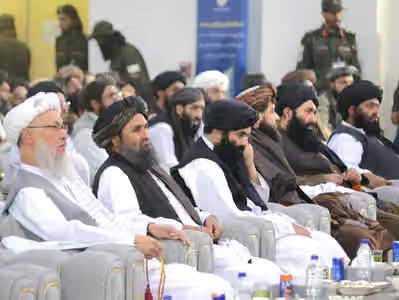
Amid growing reports of internal tensions within the Taliban leadership and the overseas travel of key officials, several senior Taliban figures attended an event in Kabul on Thursday, ostensibly for the inauguration of a healthcare centre.
Fasihuddin Fitrat, the Taliban army chief, denied any divisions among the group’s leadership, while Mullah Abdul Ghani Baradar, the Taliban’s deputy prime minister, urged the public to disregard media reports about internal discord. The high-profile attendance at the event appeared to be a serious effort to project unity and downplay growing concerns over internal rifts.
Following Mullah Baradar’s trip to Doha, the United Nations Security Council confirmed that he had travelled to Qatar for a one-month medical treatment, with a temporary travel exemption granted from 9 February to 3 March 2025.
Although the Taliban has not disclosed details about his illness or treatment, Baradar attended Thursday’s healthcare centre inauguration at Daoud Khan Hospital in Kabul. His presence suggests he may have cut short his medical trip to Doha and returned to Afghanistan.
Without directly addressing reports of internal disputes, Baradar stated: “Obedience and respect are fundamental principles in the Islamic Emirate and will continue under any circumstances. The Emirate remains focused on implementing Sharia, rebuilding the country, and ensuring the nation’s well-being.”
He also urged the international community to engage with the Taliban, arguing that political and economic pressure would benefit no one.
Mullah Yaqub, the Taliban’s defence minister, had not been seen in public since 25 January, when he met with Iran’s foreign minister in Kabul. Nearly a month later, he reappeared at the healthcare centre inauguration, where he reiterated the Taliban’s commitment to engaging with the international community while adhering to Islamic values.
“We do not want Afghans to be forced into migration again; we must stand against these challenges,” he said, adding that the country’s problems should be resolved “without making things worse.”
Fasihuddin Fitrat, the Taliban army chief, who had reportedly avoided his office in recent weeks due to security threats, also attended the event. He dismissed reports of internal rifts, saying, “There are no divisions among the Islamic Emirate’s leadership. These are merely rumours spread by our opponents.”
He further rejected claims of ethnic bias within the Taliban, asserting that positions are assigned based on merit.
Referring to the recent opposition gathering in Vienna, Fitrat declared: “There is no Afghanistan after the Taliban,” and insisted that any notion of a post-Taliban Afghanistan was a “delusion.” He accused opposition figures at the Vienna meeting of lacking genuine public support and urged Taliban critics to return to Afghanistan, claiming that the group had established security and eliminated discrimination.
Analysts believe the public appearance of key Taliban figures at the healthcare centre was a calculated move to counter growing reports of internal discord and defection within the group.
Reports of deepening divisions within the Taliban leadership have intensified, particularly following the escape of Abbas Stanekzai, the deputy foreign minister, who had openly criticised Taliban leader Hibatullah Akhundzada over policies oppressing Afghan women.
Sources indicate that the Taliban leader initially barred Stanekzai from leaving the country and issued an arrest warrant, but with the help of senior Taliban figures, he managed to flee Kabul.
Meanwhile, Sirajuddin Haqqani, the Taliban’s interior minister, was last seen 37 days ago during a meeting with Saudi Arabia’s ambassador in Kabul. On 21 January, the Taliban announced that Haqqani, along with Abdul Haq Wasiq, the group’s intelligence chief, had travelled to the UAE. The UN Security Council later confirmed that he had received permission to perform Hajj. Unverified reports suggest that Haqqani has since returned to Khost on a private flight from the UAE.
Afghanistan International recently obtained an audio recording of Abdul Hakim Sharei, the Taliban’s justice minister, in which he criticised widespread corruption within the group and claimed to have submitted his resignation, though it was not accepted.
Sources confirmed that Sharei has since travelled to Dubai. Following these reports, the Taliban’s justice ministry stated that he had left for medical treatment under orders from the group’s leader.
International media have widely reported that tensions within the Taliban are escalating due to Hibatullah Akhundzada’s hardline policies. The UK-based Telegraph recently reported that Akhundzada is at odds with key figures such as Sirajuddin Haqqani, Mullah Yaqub, and Abbas Stanekzai over the Taliban’s bans on women’s education and employment. The newspaper suggested that these disagreements could lead to further fractures within the group’s leadership.

The Taliban Supreme Court has announced that four individuals, including two women, were publicly flogged in Shakar Dara district of Kabul on charges of sexual relations, fleeing home, and extramarital affairs.
In addition to receiving lashes, the individuals were sentenced to prison terms ranging from six months to one and a half years.
In a statement issued on Thursday, the Taliban Supreme Court stated that two individuals were sentenced to 39 lashes each and one and a half years in prison, while the other two received 38 lashes and were sentenced to six months and one year in prison.
The statement confirmed that the public punishment was carried out at the group’s primary court in Shakar Dara district, Kabul, in the presence of local officials, residents, and court attendees.
Earlier this week, the Taliban Supreme Court also reported the flogging of nine individuals in Ghazni and Takhar provinces.
The United Nations and human rights organisations have repeatedly called for an end to corporal and public punishments by the Taliban. However, the group has continued to disregard these appeals.

A research institute investigating ISIS’s financial operations has reported that the group, particularly its Khorasan branch (ISIS-K), receives funding from across the globe.
The study highlights that ISIS-K’s primary financial network is directed from an undisclosed location in Afghanistan.
Adam Russell, a researcher at the Global Network on Extremism and Technology, stated in a report released on Tuesday that ISIS-K is leveraging extensive global financial support to plan future attacks.
According to the study, Maktab al-Sadiq, a key financial network of ISIS, has managed to resume operations despite ongoing counterterrorism measures. The report identifies Tamim al-Kurdi as the individual overseeing this network from an unknown location in Afghanistan since 2020, though little information is available about him.
Despite international pressure, ISIS’s financial networks have expanded their reach from South Asia to North Africa and Western countries. Maktab al-Sadiq is responsible for funding major ISIS operations in Asia, with the U.S. State Department confirming that this office utilises unregistered financial service companies, hawala networks, cash couriers, and cryptocurrency transactions to finance ISIS-affiliated groups in Afghanistan, Pakistan, India, Bangladesh, the Maldives, and the Philippines.
Findings from the study indicate that ISIS-funded attacks in Iran and Russia were also facilitated through this financial network. For instance, ISIS-K reportedly transferred at least $2,000 in digital assets to a group in Moscow that later carried out an attack on a concert hall in the city’s suburbs.
Previously, ISIS-K profited from underground resources and the extraction of precious stones in Afghanistan, particularly in Nangarhar province. However, since the Taliban took control of these mines, ISIS-K’s income from this source has significantly declined. Despite this, competition between the two groups over mineral resources continues. Reports suggest that ISIS has attempted to target the Taliban’s Chinese business partners. China has signed several mining contracts with the Taliban, making mining, oil, gas, and tax collection the group’s primary sources of revenue, though they remain dependent on international aid.
The report states, “Even with the arrests and deaths of key operatives and facilitators from Afghanistan, Pakistan, Somalia, Syria, and Türkiye in 2023 and early 2024, the office has reportedly recovered.” Researchers believe that the resilience of this network is due to its global financial reach and continuous cash inflows from various sources worldwide.
According to U.S. officials cited in the report, Türkiye has been a significant hub for ISIS’s financial transactions. Operatives have used local cryptocurrency exchanges, hawala networks, and money transfer services such as PayPal and Western Union to move funds into the country and distribute them among affiliates. However, Turkish authorities have intensified their efforts to dismantle these networks and arrest those involved.
Official data reveals that since June 2023, more than 36,000 ISIS-linked suspects have been arrested in Türkiye. Additionally, Turkish authorities, in cooperation with Tajikistan—another key financial hub for ISIS—have identified and detained several of ISIS’s financiers between 2022 and 2023, seizing $2 million in cryptocurrency in the process. Binance, a major cryptocurrency exchange, has also announced its collaboration with the National Bank of Tajikistan and other government agencies to counter terrorist financing.
The report also highlights suspicious ISIS-related financial activities in the Maldives, Spain, Germany, and the United States, where investigations are ongoing.
With global crackdowns on ISIS intensifying, the organisation is expected to adapt its financial strategies, just as it has done in the past.
The study emphasises that hawala networks remain a major challenge for international authorities combating ISIS. While regulating informal money transfer systems primarily falls under local law enforcement, banks and international payment service providers such as Western Union, PayPal, and Wise must enhance their oversight of suspicious transactions, as hawala networks often rely on these systems to maintain liquidity.

The European Union Delegation in Afghanistan, marking World Day of Social Justice, reiterated its steadfast support for all Afghans in their pursuit of justice. The delegation emphasised that social justice is the cornerstone of peace and stability in human societies.
In a statement on Thursday, the EU Delegation declared: “We especially support Afghan women’s just and equal rights to education and employment.” It called on people to work collectively to achieve social justice in Afghanistan.
Earlier, on January 24, in recognition of International Day of Education, the EU Delegation in Afghanistan had stressed that quality, gender-inclusive education is vital for Afghanistan’s prosperity and self-sufficiency. The EU reaffirmed that education is a fundamental right for all and expressed its commitment to ensuring access to education for Afghans.
The delegation reiterated its solidarity with the Afghan people and its support for their efforts to secure fundamental educational rights and build a prosperous future for the country.
In 1995, during the Copenhagen Summit, the United Nations designated February 20 as World Day of Social Justice to promote the rights of all citizens. The UN established this day to combat discrimination, inequality, and the marginalisation of social groups.
Since the Taliban assumed control of Afghanistan over three years ago, many social groups—particularly women, ethnic minorities, and religious communities—have faced widespread injustice and persecution. Girls’ schools beyond the sixth grade remain closed, and women are banned from attending universities, further exacerbating social inequality.
