Torkham Border Remains Closed For Seventh Day, Stranding Thousands Of Trucks
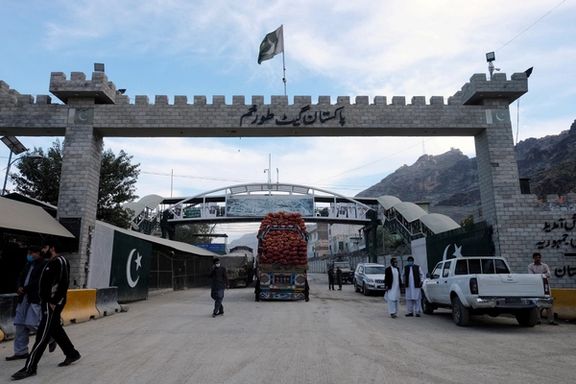
The Torkham border crossing has remained shut for the seventh consecutive day, halting all movement of goods and people.
The Torkham border crossing has remained shut for the seventh consecutive day, halting all movement of goods and people.
The Associated Press reported that over 5,000 trucks carrying perishable goods, including fruits and vegetables, are stranded, awaiting the reopening of the crossing.
Pakistani officials estimate that the prolonged closure has resulted in approximately $12 million in losses for traders. The disruption has severely impacted transportation networks, leaving both traders and travellers in limbo.
Pakistan closed the Torkham crossing last Friday following a dispute over the installation of a signboard by Pakistani authorities and the subsequent construction of a Taliban security checkpoint.
Despite multiple rounds of negotiations between Taliban and Pakistani border officials, no agreement has been reached, and the crossing remains closed.

The Economist Intelligence Unit (EIU), in its annual Democracy Index 2024 report, has ranked Afghanistan as the most authoritarian country in the world, placing it last among 167 nations.
The report, published by the research division of The Economist magazine, awarded Afghanistan a score of just 0.25 out of 10, highlighting the extreme repression under Taliban rule.
According to the report, Afghanistan is now more oppressive than Myanmar and North Korea, which follow closely in the rankings. The Taliban administration is classified in the “authoritarian” category, with no electoral governance, political participation, or civil liberties.
The EIU, a research institution with over 75 years of experience, provides political and economic analysis to governments, corporations, and financial institutions. With a network of 400 analysts, it assesses complex geopolitical and economic situations worldwide.
Afghanistan Ranks Last in the 2024 Democracy Index
Afghanistan’s position at the bottom of the rankings reflects its status as the most closed and repressive regime in the world. Unlike North Korea and Myanmar, which have structured governance systems, the Taliban rule without a constitution, relying solely on rigid religious decrees. Under their rule, freedoms of speech, political participation, and women’s rights have been completely eliminated. Girls’ education, women’s employment, and minority rights are also strictly banned.
Breakdown of Afghanistan’s Democracy Index Score
Electoral Process and Pluralism
Afghanistan, along with Sudan, Syria, the Central African Republic, Turkmenistan, and Laos, scored zero in this category, indicating a complete absence of credible electoral processes.
Government Functioning
Afghanistan, Sudan, Syria, and Myanmar also scored zero in terms of governance efficiency, transparency, and accountability. Laos (2.86) and North Korea (2.50) scored slightly higher, as their authoritarian systems operate in a more structured manner.
Political Participation
Afghanistan is the only country in the report to receive a 0.00 in political participation, reflecting a complete lack of citizen engagement in governance, even among elites or groups close to the Taliban.
Political Culture
In the political culture index, which assesses public support for democratic values, Afghanistan scored 1.25. This highlights the Taliban’s rigid ideological control. In contrast, Turkmenistan (5.00) and Sudan (5.63) scored higher, indicating that some segments of their populations still lean towards democratic ideals, despite authoritarian rule.
Civil Liberties
The civil liberties index, which evaluates freedom of speech, assembly, and the rights of women and minorities, awarded Afghanistan a score of zero, placing it alongside Syria, Myanmar, and North Korea. This confirms the absolute suppression of social and civil freedoms under Taliban rule.
The Democracy Index 2024 serves as yet another warning about the severe restrictions imposed by the Taliban, reinforcing their status as the most repressive regime in the world today.
The BBC has reported that the Taliban is monitoring Kabul’s residents using 90,000 CCTV cameras, marking a significant expansion of its surveillance network. The BBC stated that it is the first international media outlet allowed access to the Taliban’s control centre.
Khalid Zadran, the Taliban’s police spokesperson in Kabul, confirmed the scale of surveillance, stating: “We monitor the entire city of Kabul from here.”
The BBC report, published on Thursday, noted that Taliban officials claim the CCTV system is designed to combat crime. However, critics warn that the surveillance network may be used to suppress dissent and enforce the Taliban’s strict laws.
Inside the control centre, Taliban officers sit in rows, monitoring live footage from thousands of cameras across Kabul, a city of six million people. The system tracks everything from vehicle licence plates to individuals’ facial expressions.
Zadran explained: “In certain neighbourhoods, when we notice groups of people and suspect they might be involved in drug use, criminal activities, or something suspicious, we quickly reach out to the local police.” He added that the Taliban police act swiftly to investigate such gatherings.
The BBC described the rapid expansion of CCTV cameras in Kabul as a sign of the Taliban’s evolving approach to law enforcement. Under the previous government, the city had only 850 cameras. Since the Taliban took power, that number has surged to 90,000.
Concerns Over BBC’s Relationship with the Taliban
The report comes amid allegations by UnHerd, a UK-based investigative media outlet, that the BBC and its charity arm, BBC Media Action, have made substantial payments to the Taliban.
According to UnHerd, the BBC has avoided broadcasting news that might anger the Taliban and has allegedly pressured its journalists to comply with Taliban directives. The BBC’s press office denied the claims, calling the UnHerd report inaccurate.
UnHerd also found that while the Taliban banned other media outlets, such as Voice of America and Radio Free Europe (Radio Azadi), the BBC has been allowed to operate freely in Afghanistan.
Surveillance and Facial Recognition Technology
The BBC report revealed that the Taliban’s surveillance network includes advanced facial recognition technology.
One of the control room monitors categorises individuals based on age, gender, beard length, and whether they are wearing a face covering. Zadran told the BBC: “On clear days, we can zoom in on individuals who are kilometres away.”
The Taliban even use the system to monitor their own forces. At one checkpoint, officers used surveillance cameras to zoom in on a car’s boot, inspecting its contents remotely.
The Taliban’s Interior Ministry claims that the CCTV system has significantly improved security, reduced crime, and helped police apprehend criminals more efficiently.
However, human rights organisations have raised serious concerns about who is being monitored and for how long.
Human Rights Groups Raise Alarms
Amnesty International warned that the Taliban’s mass surveillance, justified as a security measure, could be used to enforce their strict rules and suppress freedoms—particularly those of women.
Fariba, a young Kabul resident who has been unemployed since the Taliban takeover, expressed fears that surveillance cameras could be used to monitor women’s dress codes. “There is significant concern that the cameras may be used to check whether women are complying with hijab rules,” she told the BBC.
Since August 2021, the Taliban has mandated full-face coverings for women. Fariba also worries that the surveillance system could further endanger activists and former government employees who are already in hiding.
The BBC report noted that the Taliban claims access to the CCTV system is restricted to the police and is not used by the Ministry of Propagation of Virtue and Prevention of Vice. However, Human Rights Watch pointed out that Afghanistan lacks data protection laws, meaning there are no regulations governing how surveillance footage is stored or used.
Taliban police stated that CCTV footage is stored for three months and is handled secretly by trained personnel.
Chinese Technology and Forced Contributions
The BBC observed that the cameras were likely manufactured in China, with control room monitors displaying the logo of Dahua, a Chinese company linked to Beijing.
Additionally, some residents in Kabul were reportedly forced to help fund the installation of surveillance cameras.
Shella, a resident of Kabul, told the BBC that people in her neighbourhood were pressured into contributing money for camera installations. “If families refused to pay, they were threatened with water and power cuts within three days,” she said.
The Taliban’s CCTV surveillance network is not limited to Kabul. The group has begun expanding the system to other major Afghan cities, further increasing concerns over mass monitoring and control.
The Taliban announced that the High Shia Commission of Afghanistan organised a gathering at the Loya Jirga Hall in Kabul to express support for the group’s rule and promote national unity.
During the event, Abdul Ghani Baradar, the Taliban’s Deputy Prime Minister for Economic Affairs, claimed that Afghanistan’s ethnic and religious diversity symbolises national unity. He asserted that Afghanistan belongs to all its people and that everyone has equal rights under Taliban rule.
However, the Taliban does not recognise the Jafari school of thought (Shia jurisprudence) and has removed it from the educational system, basing its laws solely on Hanafi jurisprudence. Over the past three years, the group has imposed severe restrictions on Shia religious ceremonies.
During the gathering on Thursday, Mullah Baradar declared that “there are no differences based on minority status, ethnicity, or religion in Afghanistan,” insisting that the Taliban values diversity as a unifying factor.
For over three years, the Afghanistan Shia Scholars Council has repeatedly demanded official recognition of the Jafari sect, the inclusion of Jafari jurisprudence in schools and universities for Shia students, and meaningful representation in government. The Taliban has ignored these demands.
Despite acknowledging Afghanistan’s ethnic and religious diversity, Baradar claimed that before the Taliban’s rule, these differences were misused to divide the country. He accused political parties of undermining national unity, stating that their presence prevented Afghanistan from achieving true cohesion.
However, in practice, the Taliban has excluded not only Shias but also other ethnic and religious minorities from government positions. There are currently no Hazaras or Shias in the Taliban’s cabinet. In addition to sidelining ethnic and religious groups, the Taliban has systematically erased women from public life, leading to accusations of gender apartheid.
The Taliban’s Deputy Prime Minister’s Office confirmed that the High Shia Commission of Afghanistan organised the gathering at the Loya Jirga Hall, attended by senior Taliban officials and several Shia figures. Reports indicate that the commission was established by the Taliban itself.
Sources told Afghanistan International that the Taliban pressured the commission to bring around 5,000 people to the event to stage a show of support for the regime. A similar pro-Taliban gathering was previously organised by the same commission in Balkh province.
The commission is led by Mohammad Ali Akhlaqi, a former member of parliament.
The United States Commission on International Religious Freedom has repeatedly reported that religious minorities in Afghanistan face threats from both ISIS and the Taliban. The commission states that under Taliban rule, Shias, Hindus, and Sikhs have been subjected to severe religious persecution.
Despite these reports, Mullah Baradar insisted during the event that the Taliban’s rule is the result of sacrifices made by all Afghans. He stated that maintaining national unity is essential for the country’s political and economic progress.
The Taliban Supreme Court has announced that a primary court in Feroz Nakhchir district, Samangan province, publicly flogged a man convicted of theft. The individual received 39 lashes and was sentenced to one year in prison.
In a statement issued on Thursday, the Taliban Supreme Court confirmed that the sentence was carried out in the presence of local officials, court attendees, and members of the public after receiving judicial approval.
On Wednesday, the Taliban Supreme Court also reported that its local courts in Bamiyan, Herat, and Laghman provinces had publicly flogged at least 13 individuals on various charges.
Over the past three days, the Taliban has subjected more than 30 people across Afghanistan to public floggings. The group claims these punishments are conducted in accordance with “Islamic Sharia law,” despite widespread international condemnation of corporal punishment.
Despite international trade and banking sanctions and continued diplomatic isolation, the Taliban’s Ministry of Commerce has reiterated its commitment to balancing Afghanistan’s imports and exports.
In a joint meeting with the private sector, the ministry claimed that achieving economic self-sufficiency remains a key objective.
In a statement released on Wednesday, the Taliban’s Ministry of Industry and Commerce announced a meeting focused on facilitating the transportation of large commercial and transit shipments through the Herat-Khaf and Hairatan-China railway routes.
Nooruddin Azizi, the Taliban’s Minister of Industry and Commerce, stressed the need for trade balance, stating that their goal is to attain economic independence. “Trade will continue with the transfer of goods at reasonable rates. If shipment volumes increase, exports will also grow, ultimately stabilising the value of the national currency,” he said.
Ahmadullah Zahid, the Deputy Minister of Industry and Commerce, also underscored the Taliban’s efforts to achieve economic self-reliance. He highlighted the fight against administrative corruption, the reduction of bureaucracy, and urged Afghan investors abroad to invest in the country with confidence.
However, despite the Taliban’s emphasis on trade balance, Afghanistan continues to face a significant trade deficit. Currently, 90 percent of the country’s consumer goods are imported.
According to the National Statistics and Information Authority, Afghanistan’s imports reached $8.6 billion over the past nine months, while exports stood at just $1.3 billion. The country primarily produces agricultural and livestock products but relies heavily on imports for most other essential goods. Additionally, Afghan companies still lack the capacity to export agricultural goods on a larger scale.
International banking and trade sanctions have further worsened Afghanistan’s economic struggles. The Taliban’s promises to boost exports come as their government remains unrecognised by the international community.
A recent World Bank report warned that the sharp decline in foreign aid, economic isolation, and uncertainty in financial policies have left Afghanistan’s economy in a fragile state.