U.S. Highlights Importance Of Counterterrorism Cooperation With Pakistan
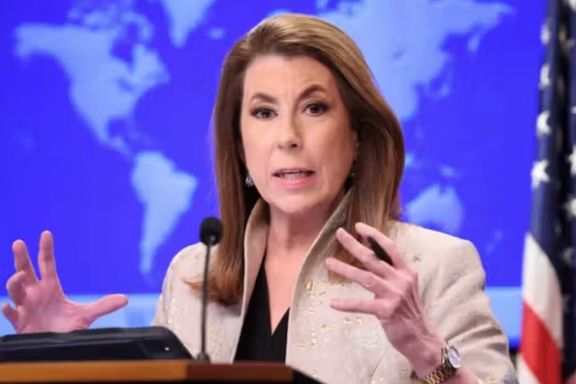
Tammy Bruce, spokesperson for the U.S. State Department, has emphasised the shared interests of the United States and Pakistan in combating terrorism.

Tammy Bruce, spokesperson for the U.S. State Department, has emphasised the shared interests of the United States and Pakistan in combating terrorism.
During a press briefing, Bruce cited the recent arrest of Sharifullah, the alleged mastermind behind the August 2021 Kabul Airport attack, as evidence of the importance of U.S.-Pakistan counterterrorism collaboration.
On Tuesday, U.S. President Donald Trump, in his speech at a joint session of Congress, announced that Sharifullah, the key planner of the deadly Kabul airport bombing, was captured with Pakistan’s cooperation.
The August 26, 2021 suicide bombing, carried out by ISIS, occurred amid the chaotic withdrawal of U.S. forces and the evacuation of Afghans from Kabul Airport. The attack killed approximately 160 Afghan civilians and 13 U.S. soldiers.
Trump and other U.S. officials described Sharifullah’s capture as a relief for the families of the fallen U.S. soldiers and a step toward justice. They also expressed gratitude to the Pakistani government for its role in his arrest.
Pakistani Prime Minister Shehbaz Sharif had earlier confirmed that Mohammad Sharifullah is an Afghan citizen who was arrested during an operation near the Afghanistan-Pakistan border.
Following his detention in Pakistan, Sharifullah was transferred to the United States for further legal proceedings.


After a 48-day absence, Abdul Hakim Sharei, the Taliban’s Minister of Justice, who is on the European Union’s sanctions list, has resurfaced in Mecca, Saudi Arabia.
Sharei is attending the Global Conference for Building Bridges Between Islamic Schools of Thought and Sects.
The two-day conference brings together scholars and religious figures from various Islamic nations. The Taliban’s Deputy Spokesperson, Hamdullah Fitrat, confirmed on Friday that Sharei participated in the event.
Recently, Afghanistan International reported that Sharei had travelled to Dubai and was allegedly considering resigning from his position as Justice Minister.
Afghanistan International obtained an audio recording in which Sharei expressed frustration over widespread corruption and ethnic nepotism within the Taliban leadership. In the recording, he claimed to have repeatedly attempted to resign in protest but stated that his resignation had been rejected.
In response to the Afghanistan International report, the Taliban’s Ministry of Justice denied that Sharei had resigned. The ministry confirmed that he had travelled to Dubai but insisted that his trip was for medical treatment under the directive of Taliban leader Hibatullah Akhundzada. Officials stated that Sharei would soon return and resume his duties.
The last official statement from the Taliban’s Ministry of Justice regarding Sharei was issued on 19 January, and no public updates had been provided about him until now.
The Taliban have not disclosed details about his illness, nor is it clear when he travelled to Saudi Arabia for the conference.
Abdul Hakim Sharei is on the global sanctions list, and in 2023, the European Union sanctioned him for systematically depriving Afghan women of work and education.
Alongside him, the Taliban’s Minister of Education and Chief Justice were also sanctioned for gender-based violence.
The EU’s sanctions report accused Sharei of restructuring Afghanistan’s judicial system to oppress women, stating that he revoked women’s law licenses, denied women access to legal representation, and blocked the enforcement of laws against gender-based violence
The report further noted that his policies had left Afghan women in a legal void, contributing to widespread human rights violations and obstructing justice and equality.

Pakistan’s Defence Minister, Khawaja Muhammad Asif, has welcomed the United States’ decision to retrieve military weapons left behind in Afghanistan, stating that the abandoned advanced weaponry has fuelled terrorism in the region.
Speaking at a press conference in Islamabad on Thursday, Asif highlighted the U.S. commitment to reclaiming these weapons, calling it a positive step. He asserted that the rise in terrorist attacks in Pakistan is directly linked to the use of American weapons now in militant hands.
U.S. President Donald Trump has repeatedly stressed the need to recover American military equipment from the Taliban. Pakistan’s Foreign Ministry echoed this position on Thursday, stating its full support for the U.S. initiative. Additionally, Pakistan’s Deputy Prime Minister backed the decision in discussions with the U.S. National Security Advisor.
Addressing the spike in terrorist attacks in Balochistan and Khyber Pakhtunkhwa, Asif blamed former Prime Minister Imran Khan, ex-Army Chief General Qamar Javed Bajwa, and former ISI Chief General Faiz Hameed for supporting militant groups.
He reiterated that Pakistan remains the biggest victim of terrorism and continues to lead efforts against extremist threats.
Pakistani officials have long accused the Afghan Taliban of backing Tehreek-e-Taliban Pakistan (TTP), alleging that TTP militants are using U.S. weapons to threaten Pakistan’s security.
These statements come amid growing tensions between Pakistan and the Taliban. While Islamabad pushes for the retrieval of U.S. weaponry, the Taliban have rejected any possibility of returning the arms, insisting that they are “war spoils” and will not be surrendered under any circumstances.

Daoud Naji, head of the political committee of the Afghanistan Freedom Front (AFF), has criticised the latest United Nations report on the targeted killings of former security forces by the Taliban, calling it incomplete.
Naji stated that at least 12 former Afghan security personnel were killed by the Taliban in January alone.
On Friday, he posted on X, saying “Only in January, 12 security personnel lost their lives either in Taliban kangaroo courts or under torture by Taliban members.”
According to Naji, these killings occurred in multiple provinces including three deaths in Parwan, three other in Badakhshan, two in Panjshir, four other in Nangarhar, Kabul, Laghman, and Helmand provinces.
He further expressed concerns that violence against UN staff in Afghanistan in recent months may have affected the collection of information and the accuracy of UNAMA’s report.
The UN Secretary-General’s latest report highlights 42 security incidents against UN staff in Afghanistan over the past three months. These incidents include arrests, beatings, harassment, shootings, threats, and other violations.
On Thursday, the United Nations Assistance Mission in Afghanistan (UNAMA) published its quarterly report, stating that in this period one former Afghan security forces member was killed, 37 people were arbitrarily detained and 18 were subjected to torture.
Despite Taliban leader Hibatullah Akhundzada’s 2021 general amnesty, the UN reported that human rights violations against former government officials and members of Afghanistan’s national defence and security forces continue.
The National Resistance Front (NRF) welcomed the UN’s report, but challenged its accuracy, claiming that it underreported the group’s attacks.
Ali Maisam Nazary, head of foreign relations for the NRF, stated that the number of anti-Taliban attacks exceeds the 53 mentioned in the UN’s findings.
Calling the UN’s recognition of anti-Taliban operations a step forward, Nazary said “It is time for all countries to take the next step and actively support our fight for a safer world so we can make Afghanistan free again!”
In his latest report, UN Secretary-General António Guterres confirmed that military groups opposing the Taliban launched 91 attacks over the past three months, including 53 attacks by the National Resistance Front (NRF), and 21 attacks by the Afghanistan Freedom Front (AFF). Additionally, UNAMA reported that 81 civilians were killed during this period, including 37 men, 8 women, 18 girls, 18 boys, while at least 111 others were injured.
The UN also highlighted an attack on Sufi worshippers in Baghlan, where 11 people were shot dead. While ISIS claimed responsibility, UNAMA noted that other groups were also involved in civilian casualties during the reporting period.

The United Nations Office for the Coordination of Humanitarian Affairs (OCHA) announced on Friday, 7 March, that $48.5 million has been allocated to provide urgent humanitarian assistance to Afghanistan.
According to OCHA, the funding comes from the Afghanistan Humanitarian Fund (AHF) and the UN’s Emergency Fund, aimed at addressing the country’s worsening humanitarian crisis.
Indrika Ratwatte, Deputy Special Representative of the UN Secretary-General in Afghanistan, stated that after decades of conflict, poverty, climate shocks, and escalating security threats, the Afghan people are now facing a decline in life-saving assistance.
Of the newly allocated aid, $19 million originates from the UN’s Emergency Fund, while the remaining $29.5 million comes from the Afghanistan Humanitarian Fund.
Earlier, on Wednesday, 5 March, OCHA reported that at least $3.06 billion is required to meet Afghanistan’s humanitarian needs in 2025. However, 48% of the budget remains unfunded, raising concerns over the UN’s ability to sustain aid operations.
OCHA also warned that there are insufficient funds available to respond to sudden crises this year, heightening the risk for millions of vulnerable Afghans in need of urgent assistance.

Pakistan’s Ministry of Foreign Affairs on Thursday expressed support for U.S. President Donald Trump’s remarks regarding the retrieval of American weapons left in Afghanistan.
The ministry spokesperson stated that the removal of these arms from Taliban control would enhance regional security.
Foreign Ministry spokesperson Shafqat Ali Khan affirmed Pakistan’s concerns over these weapons, noting that their absence from Taliban hands would contribute to stability in Pakistan and the wider region.
Trump recently voiced his frustration over the Taliban’s possession of U.S. military equipment, describing the group as the “world’s biggest arms dealer” and expressing anger at seeing his country’s former enemy parade American weapons.
Pakistan’s Foreign Ministry spokesperson echoed these concerns, stating that militants within Pakistan have used these weapons—claimed by the Taliban to be under their full control—against Pakistani security forces.
“Our concern is that those weapons have been found being used by terrorists in their operations inside Pakistan. We have flagged it. If the US can make any efforts to get those weapons back, it would be helpful for the overall regional security environment.,” Khan stated.
The spokesperson also highlighted Pakistan’s recent cooperation with the U.S., including the handover of a key ISIS member to American authorities. He emphasised that Pakistan’s security collaboration with the U.S. remains ongoing, covering counterterrorism and intelligence-sharing efforts.
Following Pakistan’s role in capturing the ISIS operative involved in the deadly 2021 Kabul airport attack, Pakistan’s Foreign Minister reportedly conveyed to the U.S. National Security Advisor that Islamabad supports Trump’s stance on retrieving American weapons from the Taliban.
Pakistan’s endorsement of the U.S. position on Taliban-held weapons signals growing frustration with the Afghan Taliban, despite Islamabad’s long-standing investment in the group’s rise to power over the past two decades.
While Pakistan previously backed the Taliban, it now appears to be advocating for U.S. pressure on the group to surrender stockpiles of American-made weapons, which the Taliban deem essential for maintaining their rule and security.