Pakistan Backs U.S. Plan To Reclaim American Weapons From Taliban
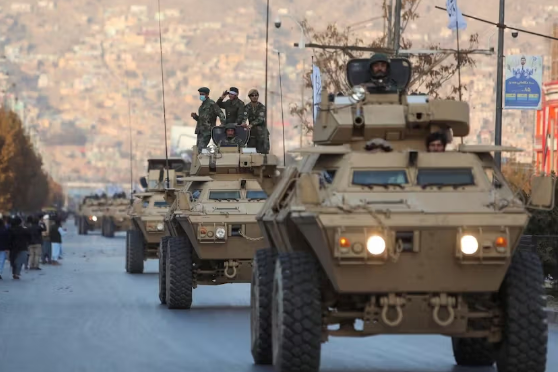
Pakistan’s Ministry of Foreign Affairs on Thursday expressed support for U.S. President Donald Trump’s remarks regarding the retrieval of American weapons left in Afghanistan.
Pakistan’s Ministry of Foreign Affairs on Thursday expressed support for U.S. President Donald Trump’s remarks regarding the retrieval of American weapons left in Afghanistan.
The ministry spokesperson stated that the removal of these arms from Taliban control would enhance regional security.
Foreign Ministry spokesperson Shafqat Ali Khan affirmed Pakistan’s concerns over these weapons, noting that their absence from Taliban hands would contribute to stability in Pakistan and the wider region.
Trump recently voiced his frustration over the Taliban’s possession of U.S. military equipment, describing the group as the “world’s biggest arms dealer” and expressing anger at seeing his country’s former enemy parade American weapons.
Pakistan’s Foreign Ministry spokesperson echoed these concerns, stating that militants within Pakistan have used these weapons—claimed by the Taliban to be under their full control—against Pakistani security forces.
“Our concern is that those weapons have been found being used by terrorists in their operations inside Pakistan. We have flagged it. If the US can make any efforts to get those weapons back, it would be helpful for the overall regional security environment.,” Khan stated.
The spokesperson also highlighted Pakistan’s recent cooperation with the U.S., including the handover of a key ISIS member to American authorities. He emphasised that Pakistan’s security collaboration with the U.S. remains ongoing, covering counterterrorism and intelligence-sharing efforts.
Following Pakistan’s role in capturing the ISIS operative involved in the deadly 2021 Kabul airport attack, Pakistan’s Foreign Minister reportedly conveyed to the U.S. National Security Advisor that Islamabad supports Trump’s stance on retrieving American weapons from the Taliban.
Pakistan’s endorsement of the U.S. position on Taliban-held weapons signals growing frustration with the Afghan Taliban, despite Islamabad’s long-standing investment in the group’s rise to power over the past two decades.
While Pakistan previously backed the Taliban, it now appears to be advocating for U.S. pressure on the group to surrender stockpiles of American-made weapons, which the Taliban deem essential for maintaining their rule and security.

Taliban leader Hibatullah Akhundzada is reportedly planning to convene a Loya Jirga in an effort to transition his administration from an interim government to a recognised ruling body.
However, political opponents, Afghan political figures inside Afghanistan, women, and human rights activists are expected to be excluded from the gathering.
The assembly is expected to include approximately 2,000 members and will likely be held after Eid al-Fitr.
Selection of Jirga Members Under Taliban Oversight
According to sources in Kabul, the process of selecting members of the Loya Jirga has already begun at both provincial and district levels under the supervision of Taliban-appointed governors.
Reports indicate that 1,344 representatives from all districts will participate in the gathering. Each district will send three members, including a religious scholar, a tribal elder, and a youth representative.
Additionally, provincial clerical councils' leaders and deputies, who operate under Akhundzada’s direct oversight, will also be included in the Jirga’s composition.
Two years ago, the Taliban formed provincial organisations called "Islamist Fighters", primarily composed of young supporters. Although these groups were dissolved after the Taliban consolidated power, there is speculation that youth representatives in the Jirga may be selected from former members of these groups.
The Loya Jirga will be held at Kabul’s Jirga Hall, with its exact date yet to be announced. However, the agenda, committee formations, and the selection process are reportedly being managed from Kandahar.
Akhundzada’s Push for Absolute Control
According to a source familiar with the matter, Akhundzada has instructed provincial governors to submit a list of Jirga members and provincial committee nominees, which will then be sent to Kandahar for approval.
Through this Jirga, Akhundzada aims to legitimise his leadership, transition the cabinet from an interim structure, and establish full control over the Taliban’s governance framework.
Sources indicate that one of the primary objectives of the Jirga is to formalise the Taliban government, removing the “interim” status from all officials, including ministers.
The Taliban regime continues to face a legitimacy crisis both domestically and internationally, with internal divisions within the group further complicating governance.
Internal Taliban Disputes and Rivalries
Several Taliban leaders oppose Akhundzada’s policies and have urged him to moderate his governance approach.
Additionally, the influence of Sirajuddin Haqqani, Minister of Interior, and Mullah Yaqoob Mujahid, Minister of Defence, has challenged Akhundzada’s absolute authority in certain matters.
While the Haqqani faction is expected to attempt to influence the Jirga, the final list of attendees will ultimately be approved in Kandahar.
A source in Kabul confirmed that all provincial governors are Akhundzada loyalists and will seek to exclude any participants who might challenge his leadership.
"Akhundzada frequently consults with clerics and jihadi madrassa leaders when appointing governors and police chiefs. It is expected that he will do the same when selecting Jirga members," the source added.
Previously, Sirajuddin Haqqani attempted to include tribal elders in provincial clerical councils, but his efforts were unsuccessful.
Since the Taliban took control of Afghanistan, Akhundzada has established new provincial councils composed of clerics and tribal elders aligned with the Kandahar-based leadership, effectively replacing the former provincial councils and consolidating power at the local level.
Will the Jirga Address Key National Issues?
It remains unclear whether the Jirga will address fundamental national issues, such as a new Afghan constitution, the national anthem and flag, the structure of government,and the right to education for women and girls. However, initial indications suggest that political opponents, former Afghan officials, and women will be entirely excluded from the assembly.
Political Opposition and International Rejection
A political figure in Kabul, speaking on condition of anonymity, told Afghanistan International that the Jirga, as envisioned by Akhundzada, will not be recognised by Afghan political factions or the international community.
He claimed that "international players" have discussed the potential formation of a Supreme Council representing the Afghan people, which would include both Taliban and non-Taliban members. This council would be responsible for organising a larger assembly to draft a new constitution.
"The focus is on ensuring that representatives of the Afghan people participate in a Grand Council, which will oversee the drafting and ratification of the constitution, ultimately leading to the establishment of a legitimate government," the source stated.
He further noted that work on this proposal is ongoing, though he did not specify which international actors were involved. However, he expressed scepticism that the international community would accept a Taliban-led Jirga as a legitimate political solution.
To date, no country has officially announced support for the creation of a Supreme Council to draft Afghanistan’s constitution.
Debate Over Governance: Jirga or Elections?
While some political figures have supported the idea of a Jirga, others argue that a democratic election is the only viable solution to Afghanistan’s political crisis.
Abdul Rab Rasul Sayyaf, a long-time opponent of the Taliban, recently called for the formation of Shurā-ye Ḥall wa ‘Aqd, a council composed of “those who are qualified to unbind and to bind”—also described as “the people who loosen and bind”—instead of holding elections, asserting that if a leader is chosen through this council, people will pledge allegiance to him.
Conversely, Habib ur Rahman Hekmatyar, son of Gulbuddin Hekmatyar and a member of Hezb-e-Islami, has argued that only a democratic election can provide a legitimate and sustainable resolution.
"Past experiences have shown that forming a council does not resolve disputes. The Taliban’s first regime also established such a council and pledged allegiance to Mullah Mohammad Omar, yet the conflict persisted," Hekmatyar stated.
The National Resistance Front (NRF), led by Ahmad Massoud, and the Afghanistan Freedom Front (AFF), led by Yasin Zia, have both insisted on free and democratic elections as a prerequisite for any peace negotiations with the Taliban.
Additionally, women’s activist groups in Afghanistan continue to demand a legitimate government that upholds gender equality, calling for transparent and inclusive elections.
Jirga Expected to Deepen Taliban’s Legitimacy Crisis
A source aware of the situation in Kabul told Afghanistan International that a "staged Jirga" orchestrated by Akhundzada will not grant legitimacy to the Taliban regime but rather deepen the existing crisis.
"There remains a slight hope for reform within the current administration, with Taliban spokespersons justifying their policies as temporary. However, if Akhundzada uses the Jirga to remove the interim status of his government, even this small hope for change will disappear," the source explained.
He further suggested that Western and regional powers no longer prioritise democratic governance in Afghanistan, stating "The United States, Western nations, and regional powers are not particularly focused on democratic representation in Afghanistan. If their strategic interests are met, they are unlikely to challenge the Taliban’s human rights violations and authoritarian rule."
As of now, no official statements have been made regarding international recognition of Akhundzada’s proposed Jirga, nor has there been any indication that the global community will accept a Taliban-controlled Jirga as a legitimate governing body.
Taliban Minister of Refugees Abdul Kabir has urged Pakistan to resolve bilateral tensions through dialogue, emphasising that closing the Torkham border, war, and violence are not viable solutions.
During a meeting with Ubaid-ur-Rehman Nizamani, the Chargé d’Affaires of the Pakistani Embassy in Kabul, Kabir called for diplomatic engagement to address ongoing issues between the two countries.
The Torkham border, a key crossing between Pakistan and Afghanistan, has been closed since 22 February, triggering multiple clashes between Taliban forces and Pakistani border guards over the past two weeks.
On Thursday, the Taliban Ministry of Refugees stated that Abdul Kabir had called for an end to “destructive actions” at the crossing and urged its reopening to mitigate financial losses for traders and ease difficulties for travellers.
The prolonged closure has stranded thousands of trucks on both sides of the border, causing millions of dollars in daily losses for businesses. Despite several rounds of negotiations, Taliban officials have been unable to reach an agreement with Pakistan to reopen the crossing.
Abdul Kabir also appealed to the Pakistani government to extend the deadline for Afghan refugees to return, arguing that the current timeline for expulsions is impractical. He urged Pakistan to handle the situation with patience and tolerance, stressing the humanitarian implications of forced deportations.
Reaffirming the Taliban’s commitment to regional cooperation, Abdul Kabir assured that the Taliban does not seek to create problems for neighbouring countries.
In a separate meeting with Alireza Bikdeli, the Iranian Ambassador to Kabul, Abdul Kabir stressed that border disputes should be resolved through bilateral and trilateral talks. He also called on Pakistan and Iran to ensure the humane treatment of Afghan refugees in line with international migration principles.
According to the Taliban Ministry of Refugees, Nizamani assured Kabir that he would relay the discussions to Pakistani authorities and pledged that Afghan refugees in Pakistan would not be used for political purposes.
Pakistan’s Permanent Representative to the United Nations, Munir Akram, met with Roza Otunbayeva, the UN Secretary-General’s Special Representative for Afghanistan, on Thursday, expressing Pakistan’s full support for the UN Assistance Mission in Afghanistan (UNAMA).
During their meeting, Akram and Otunbayeva also discussed ongoing humanitarian aid efforts in Afghanistan, according to a statement issued by Pakistan’s UN mission.
The meeting comes amid criticism from the Taliban, who recently labelled UNAMA’s mission in Afghanistan a “failure.” Taliban spokesperson Zabihullah Mujahid accused the UN mission of publishing “negative and inaccurate” reports about Afghanistan, arguing that such reports contribute to a “negative perception” of the country within the United Nations.
The United Nations has announced that Otunbayeva will brief the UN Security Council on the situation in Afghanistan on 10 March.
On 15 March last year, the UN Security Council unanimously adopted a resolution extending UNAMA’s mandate for another year. A decision on whether to extend the mission further is expected soon.
Pakistan’s UN mission emphasised that Ambassador Akram reaffirmed Pakistan’s commitment to supporting UNAMA’s mandate and its role in Afghanistan.
In June 2024, Pakistan was elected as a non-permanent member of the UN Security Council. Alongside Denmark, Greece, Panama, and Somalia, Pakistan secured a two-year term with overwhelming support from the UN General Assembly. These five countries will serve on the Security Council from 1 January 2025 to 31 December 2026.
UN Secretary-General António Guterres has confirmed in his latest report that anti-Taliban armed groups conducted 91 attacks against the Taliban over the past three months.
According to the report, the National Resistance Front of Afghanistan (NRF) was responsible for 53 of these attacks, while the Afghanistan Freedom Front (AFF) carried out 21. The People's Sovereignty Front of Afghanistan, a group reportedly led by former parliament members and politicians, claimed responsibility for one attack.
The perpetrators of 16 additional attacks remain unidentified.
The UN confirmed that anti-Taliban groups have targeted key locations, including the Ministry of Interior in Kabul and the Bagram military base in Parwan province. The NRF claimed responsibility for an attack on 28 December targeting the Taliban’s Ministry of Interior in Kabul. Meanwhile, the AFF claimed responsibility for two separate attacks on Bagram base and district on 19 December and 31 December.
The United Nations has warned of a severe funding shortfall for humanitarian aid in Afghanistan, revealing that as of January 2025, only 3.5 percent of the requested aid has been secured.
This funding is part of the 2025 Humanitarian Needs and Response Plan, which aims to assist 16.8 million people. The UN has identified 22.9 million Afghans in need of urgent aid.
Reports indicate that out of the $2.42 billion required for the response plan, only 3.5 percent has been funded. Similarly, the UN’s Strategic Framework for Afghanistan (2023–2025) has received less than 11 percent of the $2.53 billion needed for 2025.
The ongoing humanitarian crisis in Afghanistan has been exacerbated by dwindling financial resources and restricted access to affected regions. Aid agencies have warned that without sufficient funding, the UN’s ability to provide critical assistance could be severely impacted, endangering millions of lives.
The UN Assistance Mission in Afghanistan (UNAMA) has reported that Taliban leader Hibatullah Akhundzada is tightening his grip on power.
According to the UN report, Akhundzada has recently convened high-level meetings in Kandahar, reinforcing his direct control over the Taliban administration. He has also appointed loyalists to key positions, further solidifying his influence within the regime.
Khyber Pakhtunkhwa Chief Minister Ali Amin Gandapur announced on Wednesday that the Afghan Taliban have agreed to engage in negotiations on security issues, with a committee established to facilitate the process.
However, he accused Pakistan’s federal government of failing to cooperate with the provincial administration on the matter.
Speaking at a press conference at the Peshawar High Court, the senior Khyber Pakhtunkhwa government official revealed that the provincial administration had submitted Terms of Reference (TORs) for talks with Afghanistan to the federal government but had received no response despite multiple reminders.
“We have sent the TORs for talks with Afghanistan to the federal government, but despite repeated reminders, no response has been received. Terrorism is not just an issue for our province but for the entire country,” the official stated, as quoted by The News International.
Call for Dialogue Amid Rising Terrorism
Gandapur stressed that dialogue with the Afghan Taliban is the only viable solution to counter terrorism in Pakistan. He urged the federal government to take the security crisis seriously and respond to the proposals submitted by the Khyber Pakhtunkhwa government. He warned that if terrorism in the province is not effectively addressed, it could soon spread across the country.
Over the past year, both Khyber Pakhtunkhwa and Balochistan have witnessed a surge in terrorist attacks. In response, the Khyber Pakhtunkhwa administration has repeatedly called for negotiations with the Afghan Taliban.
Political Divide Over Engagement with the Taliban
Currently, Khyber Pakhtunkhwa is governed by the Pakistan Tehreek-e-Insaf (PTI), led by former Prime Minister Imran Khan, while the federal government is controlled by opposition parties. The PTI-led provincial government has historically favoured engagement with both the Afghan Taliban and the Tehreek-e-Taliban Pakistan (TTP). However, Pakistan’s federal government and military firmly oppose granting any concessions to the Taliban, particularly the TTP.
The primary obstacle in past negotiations between the Pakistani government and the TTP has been the militants’ demands. While the government insists on the surrender of the TTP, the group demands control over parts of the tribal areas and the implementation of Sharia law. Previous negotiations, facilitated by the Afghan Taliban, were held in Kabul in 2022 but ultimately failed due to these irreconcilable differences.