Taliban Resumes Border Post Construction Despite Ceasefire Agreement With Pakistan

Pakistani security sources have reported that the Taliban resumed construction of a border post on Monday, despite a ceasefire agreement reached by a tribal council.

Pakistani security sources have reported that the Taliban resumed construction of a border post on Monday, despite a ceasefire agreement reached by a tribal council.
This comes after Pakistan requested a halt to border facility construction near the Durand Line just a day earlier.
Sources told Afghanistan International that Taliban forces restarted work on the post on 10 March, violating the peace agreement signed a day earlier.
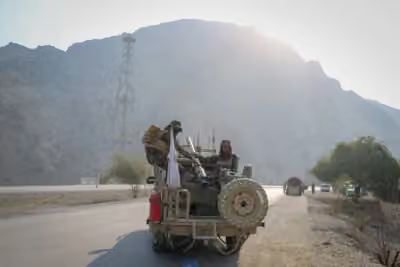
Images from the area show that the post is located within Afghan territory, near the border fence.
On Sunday, Taliban and Pakistani officials held their first round of talks aimed at ending border clashes and reopening the Torkham crossing. During the meeting, Pakistan requested that the Taliban notify Islamabad before constructing any border facilities.
According to sources, the Taliban was expected to respond to Pakistan’s request by Monday. However, the reopening of Torkham crossing remains conditional on halting construction activities. The crossing has now been closed for over two weeks due to ongoing tensions.
The Taliban’s actions indicate that, despite Pakistan’s pressure, they remain committed to their border projects, which could further complicate negotiations.
Border tensions have escalated, with Islamabad accusing the Taliban of building posts near the border and inside Pakistani territory. The Taliban, however, insists that all construction is within Afghanistan’s borders.

Reports that the Trump administration may impose a travel ban on Afghan citizens have deeply alarmed Afghans who worked with U.S. forces and are awaiting resettlement. The White House is expected to announce the decision on Monday.
Estimates suggest that around 25,000 Afghans with approved U.S. resettlement applications now face uncertainty due to Trump’s recent orders. On his first day back in office, Trump suspended all refugee admissions, a move that has severely impacted former Afghan allies.
Now, AfghanEvac, a refugee support coalition, and several US media outlets have reported that Trump may take an even stricter approach by banning all Afghan entry into the US, even for those with valid visas. The reports have intensified fears among Afghan refugees in Pakistan.
Afghan US Allies Face Rising Uncertainty
Ahmadullah (a pseudonym), an Afghan living in Islamabad, worked on US-related projects in Afghanistan. He called Trump’s decision unfair. He fears that if the travel ban is enforced, his refugee status will become even more unstable.
“I’m completely confused—what is happening to us?” he said. “We supported the US mission in Afghanistan, and now we are abandoned in this dire situation.”
For three years, Ahmadullah and his family have faced severe financial struggles. Another former US non-profit employee in Rawalpindi said the new restrictions have deeply affected his mental health.
Living in a two-bedroom apartment with his wife and two daughters, he described delays in his asylum case and worsening financial difficulties.
“My daughters keep asking when we will go to the US,” he said. “I have no answers—what am I supposed to say?”
He added that rumours of a total ban on Afghan travel have only worsened his fears. “This will destroy all our hopes.”
His daughters, aged 13 and 11, previously attended school in Afghanistan, but now cannot continue their education in Pakistan. Afghan refugees are barred from public schools, while private schools require legal stay permits and high tuition fees.
Speaking to Afghanistan International, several Afghan refugees said they are trapped in worsening conditions. Many cannot work, their visas have expired, and they struggle to enrol their children in school.
Afghan Refugees Face Crackdown in Pakistan
A refugee waiting for US resettlement told Afghanistan International he could not speak freely because Pakistani police were stationed outside his home.
In the past three months, Pakistani authorities have intensified a nationwide crackdown on Afghan refugees, with mass arrests in Islamabad and Rawalpindi cities.
The crackdown escalated after Pakistan’s security agencies claimed that some Afghan refugees participated in violent protests organised by Imran Khan’s Pakistan Tehreek-e-Insaf (PTI) party.
Following these claims, Interior Minister Mohsin Naqvi ordered a large-scale operation against Afghan refugees. However, Afghans deny involvement, calling it an internal political issue in Pakistan.
Pakistan Sets 31 March Deadline for Afghan Departures
The Pakistani government has announced that Afghan refugees must leave Islamabad and Rawalpindi by 31 March.
Under this directive undocumented refugees will be arrested and deported to Afghanistan and those with valid visas must leave the capital city and Rawalpindi.
Last week, Pakistan’s Foreign Minister Ishaq Dar stated that even Afghans whose US asylum cases are delayed or rejected may face deportation.
Some landlords in Islamabad and Rawalpindi have told Afghan tenants to vacate their homes, while others refuse to rent to Afghans fearing police action.
Former US Allies Plead for Protection
Afghans who worked with the US government are calling on Trump to exempt them from the travel restrictions.
“We collaborated with the US in Afghanistan,” Ahmadullah said. “Now, the US must not abandon us. If Pakistan deport us to Afghanistan, we will face death threats.”

US Congresswoman Doris Matsui has urged the United States to increase support for former Afghan allies who assisted US forces during the twenty years presence in Afghanistan. She called on President Donald Trump to honour the commitment to protect thousands of at-risk Afghans.
Matsui stressed that the US has an obligation to support these Afghans, who put themselves and their families in danger for a future they were promised.
On Monday, she posted on X, stating that thousands of Afghans sacrificed greatly to assist US service members. She criticised Trump’s executive orders, saying they have left tens of thousands of allies stranded under Taliban rule.
Matsui noted that these individuals have already undergone extensive security screenings. She added that families and supporters across the US are waiting for their relocation.
Alongside Congresswoman Jennifer McClellan, Matsui sent a letter to Trump on 6 March, urging action on Afghan refugee resettlement. The letter, signed by at least 45 Democratic lawmakers, called on Trump to reverse executive orders that have restricted refugee admissions and cut foreign aid.
Matsui and her colleagues continue to push for action, stressing the strategic importance of fulfilling US commitments to Afghan allies.

Mohsen Bagheri, a representative in Iran’s Supreme Labour Council, has stated that Iranian workers are leaving for Afghanistan and Iraq in search of better wages.
He said that employers in Iran are struggling due to a shortage of workers, while many Iranians are seeking jobs abroad. He noted that most of these workers are looking for simple jobs in neighbouring countries.
Bagheri attributed this trend to Iran’s weak domestic labour market, which has forced workers to seek opportunities elsewhere.
According to Entekhab news agency, he also claimed that Afghan migrants in Iran are no longer taking on physically demanding jobs, such as working in mines. Instead, he alleged that many now occupy well-paid jobs in northern Tehran, replacing Iranian workers.

Ehsanullah Ehsan, former spokesperson of Tehreek-e-Taliban Pakistan (TTP), has claimed that Pakistan is increasingly concerned about the Taliban’s growing ties with India. He also alleged that Pakistan is using ISIS to pressure the Afghan Taliban.
On Sunday, 10 March, The Sunday Guardian, an Indian newspaper, published an article by Ehsan. He argued that Pakistan has long used ISIS as a proxy force in Afghanistan to destabilise the region and weaken the Taliban’s control.
Tensions between Pakistan and the Taliban have increased over accusations of Islamabad’s alleged support for ISIS. In response to Pakistan’s criticism of the Taliban for backing TTP militants, the Afghan Taliban accused Pakistan of harbouring ISIS members in Balochistan.
Pakistan’s Foreign Ministry strongly denied this claim. However, Ehsan wrote that Pakistan’s renewed use of militant groups in Kashmir and Afghanistan reflects its strategic failures.
India supported Afghanistan’s former government but has since strengthened its diplomatic, trade, and political ties with the Taliban. Meanwhile, the Taliban, once a Pakistani proxy, has shifted towards closer engagement with India.
According to Ehsan, Pakistan does not want Afghanistan to develop strong ties with India. He claimed that Islamabad fears New Delhi’s growing influence in the region.
Ehsan alleged that Pakistan is now attempting to destabilise Afghanistan to pressure the Taliban, using ISIS as one of its tools. He warned that the rise of ISIS in Afghanistan could further damage relations between the Taliban and Pakistan.
The claim that Pakistan supports ISIS has been repeatedly made by Afghan Taliban officials. Recently, after the arrest of one of the perpetrators of the September 2021 Kabul airport attack in Pakistan, the Taliban accused Islamabad of protecting ISIS members and giving them safe havens.
Taliban officials also alleged that ISIS-Khorasan leaders and fighters have been relocated to Khyber Pakhtunkhwa and Balochistan with help from Pakistani intelligence agencies.
Pakistan has strongly rejected these accusations, calling them baseless. It has also denied the presence of ISIS-Khorasan leaders, fighters, or training camps in its territory.
Historically, the Afghan and Pakistani Taliban have been allies, supporting each other in conflicts. TTP militants fought alongside the Afghan Taliban against Afghanistan’s previous government. Now, in return, the Afghan Taliban is accused of providing sanctuary to TTP fighters in Afghanistan.

Afghan and Pakistani tribal elders have agreed on a temporary ceasefire at the Torkham border until 11 March. The decision was made during the first round of a tribal jirga, aimed at easing border tensions.
According to sources, both sides agreed not to construct any new military installations along the border during this period.
The jirga took place on Sunday and included 35 representatives from Taliban-controlled Afghanistan and 40 from Khyber Pakhtunkhwa, Pakistan. The province shares a border with Nangarhar, Afghanistan, and Torkham remains one of the most critical crossing points between the two countries.
A reliable source stated that the jirga participants, including tribal elders and Pakistani officials, decided to form a joint assessment team on 11 March. This team will review disputed construction activities by the Taliban near the border. The next steps will be determined based on this assessment.
Local sources confirmed that once the border dispute is resolved, the Torkham crossing will reopen, restoring trade and travel between Afghanistan and Pakistan.
The Torkham border has been closed for 16 days due to rising tensions. Pakistani officials accused the Taliban of building checkpoints inside Pakistan’s territory, a claim the Taliban denied. The group insisted it was only constructing a post on Afghan soil.