Taliban Balkh Governor Visits Uzbekistan To Boost Ties
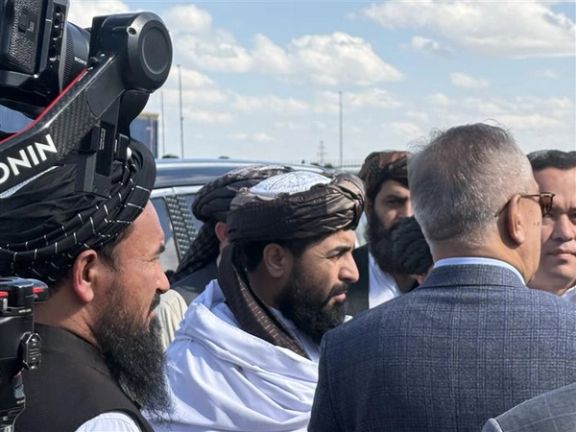
Yousuf Wafa, the Taliban governor of Balkh, led a senior delegation to Uzbekistan on Friday to enhance trade, economic, and border security cooperation, his office announced.
Yousuf Wafa, the Taliban governor of Balkh, led a senior delegation to Uzbekistan on Friday to enhance trade, economic, and border security cooperation, his office announced.
Though Uzbekistan does not formally recognise the Taliban, both sides have maintained engagement in these areas.
Last August, the Taliban revealed that Uzbekistan, at Wafa’s request, began building a $6 million religious school in Shahr-e-Naw, near Mazar-e-Sharif. Over the past three years, Taliban and Uzbek officials have held several meetings.
In August 2024, Kabul hosted Uzbek Prime Minister Abdulla Aripov, and Uzbekistan accepted a Taliban diplomat as chargé d'affaires at the Afghan embassy in Tashkent.

The Afghanistan Journalists Support Organization (AJSO) on Friday, 29 March, demanded an end to the arrests, harassment, and deportations of Afghan journalists in Pakistan.
The group highlighted the dire circumstances faced by journalists who fled Taliban threats, only to encounter further risks in Pakistan due to unrenewed or rejected legal documents.
AJSO pressed Pakistani authorities to cease detentions and ensure safe living conditions for these journalists, while calling for legal protections via the United Nations and other global bodies. It urged media, free speech advocates, and human rights groups to act swiftly to address the crisis, warning that ongoing pressures threaten freedom of expression.
Pakistan’s deadline for Afghan nationals’ voluntary return expires on 31 March, with local media reporting on Thursday that the government will not extend it. Earlier, Amnesty International also called for a halt to Afghan migrant deportations.
Australia has pledged $5 million to bolster United Nations efforts in delivering vital services to Afghan women and girls, the government announced on Friday.
The funding, channelled through UN partners, will target sexual and reproductive health, gender-based violence reduction, and support for returning refugees.
The Department of Foreign Affairs also committed $15 million in total humanitarian aid for crises in Myanmar and Afghanistan. Of this, $7 million will provide food assistance to Rohingya refugees fleeing Myanmar, while $3 million will support food, healthcare, and shelter for displaced people near the Thailand-Myanmar border.
With US aid suspended, UN agencies in Afghanistan face severe funding gaps, disrupting operations. The UN has warned that cuts could deepen poverty, as much of Afghanistan’s population depends on humanitarian support.
Australia’s government stressed that aiding those in crisis aligns with its values, reaffirming its dedication to global peace, stability, and life-saving assistance. It called for an end to hostilities, diplomatic engagement, civilian protection, hostage releases, and sustained humanitarian efforts.
Taliban border police arrested four Chinese nationals at Kabul Airport for attempting to smuggle 678 grams of raw gold to China, spokesperson Abidullah Farooqi announced.
The arrests highlight growing Chinese activity in Afghanistan since the Taliban’s 2021 takeover, with increased numbers of tourists and investors drawn by the country’s resources.
France Televisions reported in January on China’s expanding economic footprint in Afghanistan, particularly in resource extraction. Afghanistan boasts reserves of copper, gold, oil, and precious stones worth over £780 billion. China has capitalised on this, restarting the Aynak copper mine and signing major oil extraction deals in the Amu Darya Basin, where production began in 2024.
Despite Taliban regulations, security remains a concern. In Takhar province’s Khwaja Bahauddin district, unidentified gunmen killed a Chinese national, though the victim’s translator and driver escaped and alerted a Taliban checkpoint, sources told Afghanistan International. In December 2022, an attack on a Kabul hotel in Shahr-e-Naw, frequented by Chinese nationals, killed 3 and injured 18.
Analysts view Afghanistan as a strategic prize for Beijing, dubbed a modern “El Dorado” for its vast untapped wealth, despite ongoing risks.
Taliban spokesman Zabihullah Mujahid said Interior Minister Sirajuddin Haqqani attended a recent security meeting in Kandahar chaired by Taliban supreme leader Mullah Hibatullah Akhundzada.
Haqqani briefed Akhundzada during the meeting, which also included Defence Minister Mohammad Yaqub Mujahid and Intelligence Chief Abdul Haq Wasiq.
Deputy Defence Minister Abdul Qayyum Zakir and Deputy Interior Minister Nabi Omari also attended.
Mujahid said the meeting reviewed proposals from security institutions and issued directives regarding their operations and strategic direction. He added that decisions were taken to improve public order, equip security forces, and enhance their capabilities.
The exact timing of the meeting was not disclosed.
This is the first public confirmation by Mujahid of Haqqani’s participation in a Taliban leadership meeting since reports surfaced of internal tensions. Haqqani had been notably absent from such meetings and from his office in Kabul for at least two months.
The announcement follows recent reports that the US removed a $10 million bounty on Haqqani, a move viewed as a diplomatic victory that may have enabled his return to active participation in Taliban leadership discussions.
The Taliban has widened its ban on broadcasting images of living beings to media in Badakhshan, Baghlan, and Nimroz, bringing the total to 10 provinces, the Afghanistan Journalists Center (AFJC) reported on Thursday.
The restriction stems from a law by the Taliban’s Ministry for the Propagation of Virtue and Prevention of Vice.
The AFJC obtained voice messages from ministry officials in Badakhshan and Baghlan, sent via WhatsApp groups with journalists and Taliban members, ordering local media to comply. Sources told the centre that officials in all three provinces summoned media executives to reinforce the ban and warn of penalties for violations.
In Badakhshan, 10 private radio stations and 2 private TV channels operate, while Baghlan has one TV station and 5 radio stations, and Nimroz has 2 TV channels and 4 radio stations. Taliban-run Radio Television Afghanistan and the Bakhtar News Agency also function in these areas.
Enacted last year, Article 17 of the ministry’s law forbids depicting or sharing images of living beings, empowering officials to enforce it. The ban already applies in 7 other provinces: Kandahar, Takhar, Badghis, Helmand, Nangarhar, Nuristan, and Farah.
The AFJC cautioned that the measure hampers TV news and further restricts radio, a key news source via social media. Press freedom groups have slammed the Taliban’s censorship as a grave attack on media independence and expression.
Over three years, the Taliban has intensified its media crackdown, imposing harsh limits that have shuttered many outlets and driven numerous journalists to flee Afghanistan for safety and work.