• العربية
  • پښتو
  • فارسی
Brand
  • Afghanistan
  • Sport
  • Markets
  • Afghanistan
  • Sport
  • Markets
  • Theme
  • Language
    • العربية
    • پښتو
    • فارسی
  • Afghanistan
  • Sport
  • Markets
All rights reserved for Volant Media UK Limited
volant media logo

Clerics Hold More Authority Than Officials, Says Taliban Governor

Apr 25, 2025, 16:34 GMT+1

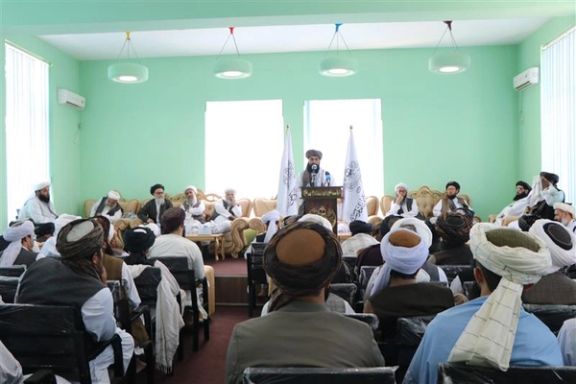
The Taliban governor of Balkh province has stated that clerics are not only the special representatives of Taliban leader, but also hold responsibilities surpassing those of state officials.

During a regional coordination meeting with religious council representatives from nine northern provinces, Governor Yousuf Wafa underscored the central role of religious scholars in the Taliban’s Islamic governance structure. The meeting, held at the Balkh Ulema Council, aimed to enhance cooperation among religious leaders across the northern region, according to a statement from the governor’s press office.

Wafa emphasised that clerics are vital to the continuation of Taliban rule and the enforcement of decrees issued by its leader. “The Islamic system we have today was achieved through great sacrifice, and its preservation lies in the hands of the clerics,” he said.

He described the nation’s Islamic scholars as the “heirs of the prophets” and maintained that all key Taliban figures including the group’s founders and leaders, Mullah Mohammad Omar, Mullah Akhtar Mansour, and current leader Hibatullah Akhundzada have remained firmly committed to Islamic and Sharia principles.

The governor further stated that clerics bear responsibility not only for spiritual guidance but also for advising civilians, district officials, and security personnel. He urged the religious community to counter ideological rifts, mediate internal conflicts, and foster national unity.

Wafa concluded by affirming that the Taliban leadership continues to value the counsel of Islamic scholars and actively seeks their input in matters of governance and administration.

Most Viewed

Pakistan Hosts Regional Meet On Afghanistan Without Taliban
1

Pakistan Hosts Regional Meet On Afghanistan Without Taliban

2

Taliban Ignore Afghanistan’s Interests By Backing Militants, Says Pakistan Army Chief

3

United Nations Delivers Education Kits To Four Million Afghan Children

4

European Parliament To Review Petition On Gender Apartheid, Taliban Status

5

Taliban Leaders In South-West Hold Security Meet In Kandahar

•
•
•

More Stories

Former Afghan NSA Criticises Pakistan’s Terror Policy Shift As ‘Too Late but Right’

Apr 25, 2025, 15:06 GMT+1

Rangin Dadfar Spanta, Afghanistan’s former National Security Adviser, has strongly criticised Pakistan amid renewed tensions with India, accusing Islamabad of "rewriting history" following its recent shift in stance on terrorism.

In a statement published on Friday, Spanta described Pakistan’s reconsideration of its historic support for terrorist groups as “too late, but right.” He called on Islamabad to abandon the use of terrorism as an instrument of foreign policy, asserting that the country had long provided increasing support to extremist networks.

His remarks came in response to a rare admission by Pakistani Defence Minister Khawaja Asif, who told Sky News that successive Pakistani governments had supported terrorist organisations for decades. “We have been doing this dirty work for the United States for about three decades, you know, and the West, including Britain,” Asif said.

Spanta, a key figure in Afghanistan’s previous administration, highlighted that Kabul had consistently warned Pakistan against allowing its territory to be used as a base for terrorist activities. However, he stated that Pakistan had never responded constructively to Afghanistan’s repeated calls to end the use of terrorism against its neighbour.

Concluding his statement, Spanta emphasised that both Afghanistan and Pakistan are now victims of terrorism. He urged that neither country should serve as a base for extremist operations against one another or any other nation.

Taliban Foreign Minister Mum On Shia Leaders’ Call To Include Educated Professionals

Apr 25, 2025, 13:27 GMT+1

The Taliban’s Foreign Minister, Amir Khan Muttaqi, remained silent on a key request made by the High Shia Commission of Afghanistan during a recent meeting, where the commission urged the inclusion of educated individuals in the governing structure.

According to an official statement, the meeting took place on 23 April and was attended by the commission’s leadership, heads of committees, and members of its evaluation council.

The commission noted that while Muttaqi did not directly respond to their call for greater representation of educated professionals, he emphasised the need for comprehensive cooperation with the council.

Mohammad Ali Akhlaqi, head of the High Shia Commission, stated that over the past three years the body has worked to “strengthen unity, serve as a bridge between the people and the Taliban, and reflect the demands and problems of the Shia community.”

Committee members also pressed the Ministry of Foreign Affairs to take meaningful steps in addressing the challenges faced by migrants and returnees.

During the meeting, Muttaqi reportedly underscored the importance of ethnic unity, though without making any commitments regarding the commission’s specific appeals.

In late February, the High Shia Commission organised a major conference in support of the Taliban regime at the Loya Jirga Hall in Kabul. At the event, Mullah Abdul Ghani Baradar, the Taliban’s Deputy Prime Minister for Economic Affairs, acknowledged the country’s ethnic, linguistic, and sectarian diversity, describing it as a source of national unity.

Jafar Mahdavi, a former member of parliament and known supporter of the Taliban, used the platform to urge the Taliban leadership to take concrete steps toward safeguarding the basic rights of the Hazara and Shia communities.

Over the past four years, the Shia Ulema Council of Afghanistan has consistently called for the recognition and protection of Shia rights.

Mohammad Akbari, deputy of the Shia Ulema Council, stated that these requests have been repeatedly shared with Taliban officials both verbally and in writing, but have yet to receive any formal response.

The continued silence from Taliban leadership on these issues has raised concerns within Afghanistan’s Shia community, who remain marginalised in the current political structure despite their ongoing efforts to engage constructively with the regime.

Nearly 120000 Afghans Deported From Pakistan In 25 Days, Says UN

Apr 25, 2025, 11:36 GMT+1

The United Nations High Commissioner for Refugees (UNHCR) has reported that almost 120,000 Afghan nationals have been deported from Pakistan since 1 April.

The report raising serious humanitarian concerns as thousands of vulnerable individuals particularly women and girls return to uncertain and often dire conditions in Afghanistan.

Arafat Jamal, UNHCR Representative in Afghanistan, visited the Torkham border crossing and described the situation as deeply troubling. "Tens of thousands of Afghans are returning from Pakistan, many of whom have been forced to leave," he said. "They are exhausted, anxious, and unsure of what lies ahead."

According to Jamal, many of the returnees were forced to leave with only a few personal belongings, and some have never set foot in Afghanistan before. "Vulnerable groups especially women and girls are particularly distressed. They face a future devoid of access to education, livelihoods, and basic freedoms."

The UN official emphasised that the humanitarian situation in Afghanistan remains precarious, with half the population reliant on aid. He reiterated the UNHCR’s commitment to providing emergency assistance at border crossings, including protection services and essential cash support.

However, Jamal warned that the agency is grappling with severe budget cuts. "We urgently need more support. The lives of millions of Afghans depend on this assistance," he said.

On Sunday, Pakistan’s Ministry of Interior reported that 100,529 Afghan nationals had been expelled since the beginning of April. The ministry noted that approximately three million Afghans currently reside in Pakistan.

Russia Protecting Interests In Afghanistan & Syria, Says Security Chief Shoigu

Apr 25, 2025, 10:39 GMT+1

Sergei Shoigu, Secretary of Russia’s Security Council, has emphasised that Moscow’s longstanding priority since the Soviet era has been ensuring the security of Central Asia.

He added that simultaneously Russia has been working to safeguard its interests in Afghanistan, Syria, and the broader Middle East.

Speaking to the Russian state news agency TASS, Shoigu stated: “Russia’s national interests in the global arena include such comprehensive problems as the situation in the Middle East, Syria, and Afghanistan.” He did not elaborate further but noted that Russia’s interests vary depending on the specific circumstances in each region.

Shoigu highlighted that, within the post-Soviet space, a key strategic objective remains the development of bilateral and multilateral cooperation with neighbouring countries through organisations such as the Collective Security Treaty Organisation (CSTO), the Shanghai Cooperation Organisation (SCO), the Commonwealth of Independent States (CIS), and the Eurasian Economic Union (EAEU).

His comments on Afghanistan come shortly after Russia’s Supreme Court approved a request from the Prosecutor General’s Office to suspend the Taliban’s designation as a terrorist organisation in Russia. Following this decision, Russia’s special envoy for Afghanistan, Zamir Kabulov, visited Kabul and held meetings with senior Taliban officials, including Amir Khan Muttaqi, Foreign Minister, and Sirajuddin Haqqani, Interior Minister.

Moscow Security Conference Set for May

Shoigu also announced that this year’s Moscow International Security Conference will be held from 27 to 29 May. According to Shoigu, representatives from more than 150 countries are expected to attend the annual gathering.

Organised by the Security Council of the Russian Federation, the conference focuses on multilateral cooperation and regional and global security challenges. It remains unclear whether the Taliban has been invited to participate this year, although former Afghan President Hamid Karzai has attended in previous years.

Regarding the conference agenda, Shoigu stated: “We plan to discuss concrete ways of strengthening security cooperation with countries of the global majority, or, as it is said today, the global South and East.”

In addition to plenary sessions and panel discussions, the event will feature exhibitions showcasing modern Russian weaponry, military equipment, and achievements in the field of information security.

Taliban Enforces 10 New Laws Since Seizing Power In 2021

Apr 25, 2025, 09:28 GMT+1

The Taliban’s Ministry of Justice has announced that, over the past three and a half years, it has enacted 10 new laws, all of which have been approved and enforced by the group’s leader, Hibatullah Akhundzada. These laws have been officially published in the national gazette.

Among the most controversial is the law on the propagation of virtue and the prevention of vice, which has drawn significant criticism for its sweeping restrictions on human rights, particularly the rights of women and girls. Since taking control of Afghanistan in August 2021, the Taliban have abolished nearly all laws instituted under the previous government, including the Afghan Constitution, replacing them with decrees and directives attributed to Mullah Hibatullah, which are now treated as binding law.

In its recent statement, the Ministry of Justice also highlighted several other enacted laws, including the law on hearing complaints, the law on preventing land usurpation and returning seized lands, the law on the money exchange and financial services sector, the law on industrial zones, and the law on leasing “Emirati” lands.

While comprehensive legislation already existed in these sectors under the former administration, the Taliban have opted to overhaul or replace them entirely.

The ministry also reported that, since 2021, it has issued four procedural guidelines, one charter, and dozens of decrees, rulings, and directives from Akhundzada. A substantial number of these have directly targeted women’s rights and personal freedoms, contributing to ongoing domestic and international concern.

Legislation Rooted in Quran and Hanafi Jurisprudence

According to the ministry, over the past four years it has reviewed, researched, and finalised 119 legislative documents, including laws, charters, statutes, procedural guidelines, and regulations. An additional 196 documents have undergone jurisprudential analysis based on the Holy Quran, the traditions of the Prophet, and Hanafi jurisprudence.

These legislative documents include revisions or new drafts of the Police law, the law on the regulation of prisons, the mining law, the law on the transfer and repatriation of prisoners, the environmental law, the customs law, the labour law, and the private investment law.

By discarding the previous constitution, the Taliban have reaffirmed that their legal system is now grounded solely in Islamic texts, Hanafi legal tradition, and the decrees of their supreme leader.

Despite nearly four years in power, the Taliban government remains unrecognised by any country including Pakistan. Their rigid interpretation and enforcement of Sharia, particularly in regard to women’s freedoms, have not only isolated the regime internationally but also fuelled growing divisions within the Taliban leadership itself.

Prominent figures such as Deputy Foreign Minister Sher Mohammad Abbas Stanekzai have publicly opposed policies like the continued ban on education for girls and women, highlighting internal dissent within the group over the direction of its rule.