• العربية
  • پښتو
  • فارسی
Brand
  • Afghanistan
  • Sport
  • Markets
  • Afghanistan
  • Sport
  • Markets
  • Theme
  • Language
    • العربية
    • پښتو
    • فارسی
  • Afghanistan
  • Sport
  • Markets
All rights reserved for Volant Media UK Limited
volant media logo

Cheryl Benard Vows To Celebrate Day Afghan Women Are Freed From Taliban Rule

May 24, 2025, 10:56 GMT+1

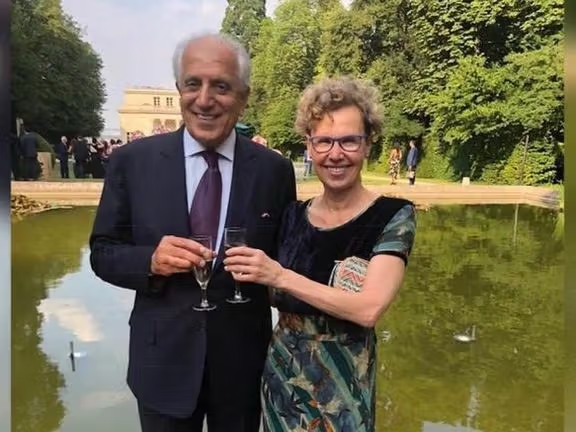
Cheryl Benard, author and wife of former US Special Representative for Afghanistan Zalmay Khalilzad, said she would “celebrate and eat ice cream” if Afghan women were freed from Taliban rule, urging Afghans to resist gender apartheid from within the country.

In an exclusive interview with Afghanistan International, Benard said that she was aware of criticism from Afghan women who accuse her of downplaying Taliban repression. She said those seeking to remain in the United States are choosing freedom, while many European countries are now pursuing deportation of Afghan refugees.

Benard said meaningful change would only come if Afghans return and challenge Taliban rule from within. “If Afghan refugees return and fight gender apartheid from within, I would support them,” she said, accusing some educated Afghan women of abandoning their less-privileged counterparts.

She described the situation in Afghanistan as gender apartheid but argued that, like apartheid-era South Africa, internal resistance is key. While criticising the Taliban’s policies on women’s education, which she called “unacceptable,” Benard said the group reflects rural and Pashtun traditions the West failed to reform during its 20-year presence.

Benard claimed security in Afghanistan is currently the best it has been in 15 years and disputed reports of widespread violence against women and former officials. She urged Afghan intellectuals to remain in the country and work toward change rather than rely on international intervention.

Describing the Taliban as pragmatic actors seeking global legitimacy, Benard said they understand that harming returnees would hurt their international standing.

Most Viewed

Explosions & Aircraft Activity Reported Over Kabul
1

Explosions & Aircraft Activity Reported Over Kabul

2

Nearly 23,000 Militants Operating In Afghanistan, Says Russian Security Chief

3

Afghanistan Instability Is A Direct Regional Security Threat, Says Russia

4

EU Again Calls For Lifting Restrictions On Afghan Women & Girls

5

More Than One Million Added To Afghanistan’s Poor Under Taliban Rule, Says UN

•
•
•

More Stories

Taliban Embassy In Tehran Suspends Passport, Legal Document Services Indefinitely

May 24, 2025, 09:56 GMT+1

The Taliban embassy in Tehran has announced the suspension of various consular services, including the issuance and renewal of passports and other legal documents, effective Saturday, 24 May.

In a statement posted on the social media platform X, the embassy confirmed that services such as the processing of passports, as well as the issuance of marriage certificates, divorce certificates, birth certificates, legal guarantees, and certificates of non-criminal liability, will be temporarily halted.

The embassy urged Afghan nationals residing in Iran to refrain from visiting the consular section until further notice. No explanation has been provided for the suspension, and the Taliban authorities have not indicated when services will resume.

This suspension affects thousands of Afghan citizens in Iran who rely on the embassy for essential legal documentation.

Former Afghan Army Pilot Dies By Suicide In Iran After Facing Deportation

May 23, 2025, 16:47 GMT+1

Mohammad Amir Tawasoli, a former pilot in the Afghan army, has died by suicide in Mashhad, Iran, after reportedly receiving an exit notice from Iranian authorities.

Sources told Afghanistan International that Tawasoli took his own life due to fear of deportation and potential reprisals by the Taliban upon return to Afghanistan.

Hamidreza Kafinia, head of Mashhad’s fire department, confirmed that a 40-year-old man died by self-immolation in a residential property in the Golshahr area of Mashhad on Sunday, 18 May. He stated the incident occurred around 12:52 pm and that the man had suffered fatal burns before emergency services arrived. Kafinia did not disclose the identity of the deceased.

According to sources, Tawasoli had visited the Kefalat office to renew his residency permit but was instead issued an exit notice. The reasons for the denial of his residency extension remain unclear. The pilot had reportedly lost hope following the rejection and ended his life shortly thereafter.

Mohammad Mohaqiq, a senior member of the National Resistance Council for the Salvation of Afghanistan, expressed sorrow over the incident. Mohaqiq, who recently led a delegation to Iran, said Iranian officials had pledged not to deport vulnerable Afghan migrants, including former military personnel and officials from the previous government.

He called on Iranian authorities to act with “Islamic mercy and compassion” in their treatment of Afghan migrants to prevent further tragedies.

Following the Taliban’s return to power in 2021, thousands of former Afghan military and government personnel sought refuge in Iran. Many now face deportation amid tightening regulations. While Iranian authorities reportedly provide a six-month residency extension for such individuals upon verification by international organisations, the renewal process remains fraught with challenges.

Several former officials who have returned to Afghanistan have reportedly faced arrest, persecution, or death at the hands of the Taliban.

Hekmatyar Calls For Afghan Unity Against External Threats, Geopolitical Intrusion

May 23, 2025, 15:12 GMT+1

Gulbuddin Hekmatyar, leader of Afghanistan’s Hezb-e Islami party, has called on Afghans to unite in the face of what he describes as renewed external threats and potential geopolitical manoeuvring over Afghanistan.

In a statement shared on the social media platform X, Hekmatyar warned that failure to adopt a unified national stance could result in fragmentation, chaos, and renewed conflict.

Citing reports and comments from Russian and American officials, Hekmatyar claimed that Moscow and Washington are exploring a potential agreement in which the United States would cede Ukraine to Russia in exchange for regaining access to Bagram Airfield and the recovery of leftover American weapons in Afghanistan.

He referred to statements from Russia’s Foreign Minister indicating Moscow’s openness to dialogue with Washington on Afghanistan, and noted that discussions between the two countries on this issue reportedly continued until 2022. Hekmatyar also mentioned remarks by Russia’s special envoy for Afghanistan, Zamir Kabulov, who stated that Bagram Airfield held no special importance for Moscow, a claim Hekmatyar views as strategic posturing ahead of possible negotiations.

Pointing to growing concern in Russia, Pakistan, and India about American arms left behind in Afghanistan, Hekmatyar argued that Moscow’s interest in resuming dialogue with the US is part of a broader effort to reach a deal involving Ukraine, Afghanistan, and strategic infrastructure such as Bagram.

He suggested that US President Donald Trump’s public stance on Ukraine, as well as his reported attitude toward Ukrainian President Volodymyr Zelensky, hinted at Washington’s willingness to make such a trade-off. “Statements by Russian officials indicate that Moscow is fully prepared for such a deal,” he wrote.

Hekmatyar also warned that the Taliban’s decision to join China’s air corridor initiative could trigger a regional backlash involving the United States, India, and Iran. He claimed this move undermines the Chabahar Port development project, a joint venture between Iran and India, and contradicts Washington’s expectations that the Taliban would avoid aligning with US adversaries.

He further speculated that countries such as Pakistan, India, Iran, and Russia could ultimately cooperate with the United States on Afghanistan, much like during the US-led occupation, in an effort to reclaim influence over strategic assets such as Bagram Airfield.

“These threats are real, not imaginary or born of illusion. They have happened before and may happen again,” Hekmatyar warned, stating that Afghanistan now stands on the threshold of a new and potentially perilous phase.

In a plea for national solidarity, he posed a stark question: “Are we prepared to confront these threats, or will some surrender tomorrow, some flee to the mountains, and others escape abroad in moments of crisis?”

Concluding his statement, Hekmatyar urged Afghans to reflect on past experiences and to adopt a unified strategy to face emerging geopolitical risks. “We must have learned many lessons from our history,” he wrote.
Iran, India No Longer See Group As Pakistan Proxy, Says Taliban Envoy

May 23, 2025, 14:18 GMT+1

Suhail Shaheen, the Taliban’s ambassador in Qatar has claimed that Iran and India no longer regard the group as a proxy of Pakistan. Speaking in an interview with Al Jazeera, Shaheen stated that both New Delhi and Tehran have come to recognise that this perception was inaccurate.

He asserted that regional powers have begun to accept the Taliban as the de facto rulers of Afghanistan, engaging with them as a matter of pragmatism. “The regional countries know this fact and, as such, they engage with the Islamic Emirate at various levels, which is a pragmatic and rational approach in my view,” he said.

Despite no country having officially recognised the Taliban government, Al Jazeera reported that India, Pakistan, and Iran are actively seeking to engage with the group.

Taliban Foreign Minister Amir Khan Muttaqi has recently held meetings with high-ranking officials from all three nations. He hosted Pakistan’s foreign minister in Kabul, conducted a phone call with India’s foreign minister, and travelled to Tehran and Beijing, where he participated in trilateral discussions involving Pakistan and China.

These diplomatic overtures signal growing regional engagement, despite the Taliban’s historically strained ties with all three countries.

India, once highly critical of the Taliban during the 1990s, has cautiously rebuilt its relationship since the collapse of the previous Afghan government. The Indian embassy in Kabul has resumed operations, and several high-level meetings have taken place.

Shaheen stressed that dialogue remains essential for addressing regional challenges and reiterated the Taliban’s position that international recognition should not be delayed further.

Meanwhile, Pakistan once a key Taliban backer is increasingly concerned about the Tehreek-e-Taliban Pakistan (TTP), which Islamabad claims is operating from Afghan soil. The Taliban deny these accusations. The situation has been further complicated by Pakistan’s mass deportation of Afghan migrants, which has heightened tensions between the two neighbours.

Iran, too, has shifted its posture, now pursuing security and economic cooperation with the Taliban. Tehran is particularly alarmed by the threat of Islamic State Khorasan Province (ISIS-K), which claimed responsibility for a deadly attack in Kerman in January 2024. Iran is also seeking progress on the long-standing Helmand River water dispute and the status of Afghan refugees within its borders.

According to Al Jazeera, citing regional analysts, the recent diplomatic interactions between the Taliban and Pakistan appear to be tactical in nature rather than indicative of a long-term strategic shift.

Rabia Akhtar, Director at the Centre for Security, Strategy and Policy Research at the University of Lahore, told Al Jazeera that Pakistan’s primary concern is potential collaboration between the Taliban and India, prompting Islamabad to maintain a careful approach to its western frontier.

Though still lacking formal international recognition, the Taliban has, by most measures, established itself as a significant player in the regional geopolitical landscape.

Iran, Pakistan Deport More Than 4,000 Afghan Migrants In One Day

May 23, 2025, 12:16 GMT+1

Iran and Pakistan deported a combined total of 4047 Afghan migrants on Thursday, 22 May, according to the Taliban’s High Commission for Addressing Migrants’ Issues.

The commission stated that 2736 Afghans were deported from Iran, while 1311 were returned from Pakistan. The deportees reportedly reentered Afghanistan through various border crossings, including Torkham, Spin Boldak, Bahramcha, Angoor Ada, Pul-e-Abrisham, and Islam Qala.

Despite ongoing talks between Taliban officials and authorities in both Iran and Pakistan regarding the treatment and status of Afghan migrants, mass deportations continue unabated.

The Taliban have not provided further details about the condition of the returnees or the circumstances under which they were expelled. Human rights groups have previously raised concerns about the treatment of Afghan migrants in both neighbouring countries, particularly in light of Afghanistan’s ongoing humanitarian crisis.