Taliban Publicly Flogs Seven In Ghazni & Sar-e Pol For Theft, Gambling
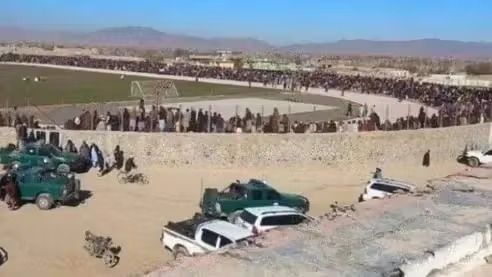
The Taliban’s Supreme Court announced that seven individuals were publicly flogged in Ghazni and Sar-e Pol provinces on charges of theft, gambling, and illicit relationships.
The Taliban’s Supreme Court announced that seven individuals were publicly flogged in Ghazni and Sar-e Pol provinces on charges of theft, gambling, and illicit relationships.
The court issued separate statements detailing the punishments. In Sar-e Pol’s Sayyad district, five individuals were flogged for gambling. In Ghazni’s Muqur and Waghaz districts, two others faced lashes for theft and “illicit relationships.” All seven were also sentenced to prison terms ranging from two months to five years.
No details were provided about the identities of those punished or the legal proceedings involved. The Taliban have previously imposed punishments for minor interactions, such as phone contact between men and women.
The floggings were carried out in public, witnessed by local officials, court staff, and residents, according to the court.
In the past week, Taliban courts have publicly flogged at least 33 people across Afghanistan, including five women, as part of their enforcement of strict moral and criminal codes.

The Purple Saturdays Movement, a prominent women’s rights group, has raised alarm over the rising number of forced and early marriages involving girls in Afghanistan.
The group warned that the situation has worsened under Taliban rule and called for urgent international solidarity to address the crisis.
In a statement issued on Wednesday, the group described forced marriage especially among underage girls as a deepening social crisis in Taliban-controlled Afghanistan. The return of the Taliban to power, it said, has intensified the practice, placing young girls at severe risk of mental, physical, and social harm.
“In Taliban-ruled Afghanistan, where a systematic gender apartheid regime governs, young girls, many not even past the threshold of adolescence, are coerced into unequal and forced marriages, often with men significantly older than themselves,” the statement read.
The movement highlighted that these girls are routinely denied access to education, personal development, and childhood experiences. As a result, they face early pregnancies, domestic violence, extreme poverty, and isolation further compounding their vulnerability.
The United Nations Children’s Fund (UNICEF) has echoed these concerns, stating that the ongoing closure of schools for girls has contributed directly to a rise in underage marriages. UNICEF has also criticised Taliban policies for exacerbating gender inequality across the country.
The Purple Saturdays Movement cited recent distressing cases that underscore the human cost of the crisis. In one instance, Abida, a young girl from Darzab-e-Nili village in Ghor province’s Taywara district, took her own life to escape a forced marriage to a Taliban member. In another case last year, a girl in Kandahar’s Khakrez district also died by suicide after being forced to marry an elderly man.
While forced marriage has long been a serious issue in Afghanistan, activists say it has sharply escalated since the Taliban returned to power in August 2021. Key drivers include economic hardship, severe restrictions on women’s education and employment, and fear of Taliban retaliation, which together push families to marry off their daughters in desperation.
The Taliban, however, claim they are addressing the issue. The Ministry for the Propagation of Virtue and Prevention of Vice stated that it had prevented 38 cases of forced marriage during April and May. Despite these claims, rights groups argue that such efforts are insufficient and largely overshadowed by broader structural repression against women and girls.
The Purple Saturdays Movement has called on the international community to increase pressure on the Taliban and to support initiatives that protect Afghan girls from abuse, early marriage, and the denial of fundamental rights.
The Taliban have arrested another prominent cleric in Kabul, continuing a wave of detentions targeting religious scholars who have expressed dissent against the group’s leadership.
On Sunday, Qari Sirajuddin, an imam at a mosque in Kabul and a close associate of detained scholar Mawlawi Abdul Qadir Qanit, was arrested in the Qala-e-Fathullah area of the capital. His family confirmed the arrest and said they have no information about his current whereabouts.
The reason for Sirajuddin’s detention remains unclear. However, his arrest comes shortly after that of Qanit, a well-known religious scholar and vocal critic of the Taliban, who was taken into custody last week. Sirajuddin is known to have been a close confidant of Qanit.
Recently, Qari Sirajuddin delivered a statement at a clerics’ conference in Kabul that was openly critical of the Taliban. In it, religious scholars urged the group to form an inclusive government, reject monopolistic governance, and avoid unilateral decision-making.
A number of clerics who had previously supported the Taliban have begun to express concerns about the group’s centralisation of power and perceived tribalism in its leadership structure.
In addition to Sirajuddin and Qanit, the Taliban’s intelligence agency has also detained another religious figure in recent days. Mawlawi Bashir Ahmad Hanafi was arrested in Helmand province. All three clerics are reportedly being held in Taliban-run prisons.
The Taliban have not issued any public statements regarding the arrests.
The Taliban has reportedly arrested Mawlawi Bashir Ahmad Hanafi, a religious scholar in Helmand province, for the second time.
Sources close to Hanafi told Afghanistan International that he was detained by Taliban intelligence agents shortly after returning from Egypt and is currently being held in Lashkar Gah, the provincial capital.
According to those familiar with the case, Hanafi was arrested one day after arriving in Afghanistan and has now spent over a week in Taliban custody. The group has referred his case to the court, though no formal charges have been made public.
A relative of the cleric said, “We do not know why he has been detained again. This is the second time the Taliban have arrested him. He is now so exhausted he doesn’t know what to do.”
Hanafi had previously been arrested by the Taliban last year. He is currently a PhD candidate in Islamic studies at Al-Azhar University in Egypt. His family expressed concern that his continued detention could cause him to miss an important exam in the coming weeks, jeopardising years of academic work.
Four weeks ago, Hanafi gave an interview to BBC Pashto in which he spoke about Ibn Hibban al-Busti, a prominent 10th-century Shafi'i scholar. In the interview, he emphasised the value of knowledge and highlighted the injustice faced by Ibn Hibban, who was reportedly denounced by some contemporaries despite his scholarly contributions.
Some speculate the interview may have triggered his arrest, though his family says they have not been given any official explanation.
Hanafi has been an outspoken critic of the Taliban's policies, particularly the ban on girls’ education. He has publicly called for the reopening of schools and universities for girls and has challenged the Taliban's silence on the issue. In addition to his academic work, Hanafi runs a madrasa for children in Lashkar Gah city.
Taliban officials in Helmand have not yet commented on his arrest.
His detention comes just a day after another Taliban critic, Mawlawi Abdul Qadir Qanit, was reportedly detained in Kabul. Qanit is said to be held at Directorate 40 of Taliban intelligence and was allowed to briefly contact his family by phone.
In recent months, the Taliban has increasingly targeted dissenting voices, with several critical clerics arrested across Afghanistan. Human rights groups have repeatedly condemned the Taliban's suppression of free speech and religious debate.
Amnesty International has reported that Afghan women and girls have endured some of the most severe human rights violations since the Taliban’s return to power, with virtually no avenue for justice.
The organisation asserts that the Taliban have reversed all legal and institutional reforms aimed at improving women’s rights.
In a statement, Amnesty International announced its intention to submit its findings to the United Nations Committee on the Elimination of Discrimination against Women (CEDAW) during the committee’s ninety-first session, scheduled to run from 16 June through July 2025.
The report details how, since the Taliban’s takeover in August 2021, the Taliban have declared void any laws aligned with international human rights standards and disbanded bodies that offered support legal, social and public to women and girls. It emphasises that restrictions have been imposed across every sphere of women’s and girls’ lives, from education and employment to freedom of movement.
Before the Taliban’s return to power in 2021, Afghanistan had been implementing a series of legal and institutional measures designed to advance women’s rights, despite ongoing challenges. Amnesty International warns that these hard-won gains have been abruptly dismantled, leaving Afghan women and girls at risk of systemic discrimination and abuse.
Amnesty International has called on the international community and UN member states to press the Taliban to restore legal protections and institutions that safeguard women’s rights and to ensure accountability for ongoing violations.
The Taliban has publicly flogged a woman and two men in Yangi Qala district of Takhar province after convicting them of theft and engaging in sexual relations outside of marriage.
The Taliban’s Supreme Court announced on Thursday that each of the three individuals received 39 lashes in a public setting.
According to the court’s statement, issued on 21 May, the woman and one of the men were also sentenced to two years of imprisonment.
This incident is part of a broader pattern in recent days. Over the past week, the Taliban has flogged at least 36 individuals, including eight women, in various provinces across Afghanistan, in connection with a range of alleged offences.
The Taliban describes such corporal punishment as the implementation of “Islamic Sharia law.” Since reclaiming control of Afghanistan nearly four years ago, the group has consistently dismissed international calls to halt corporal punishment and torture. Despite widespread condemnation from human rights organisations, the Taliban continues to carry out public floggings and executions.