Taliban, Pakistan Border Forces Clash In Helmand’s Bahramcha District
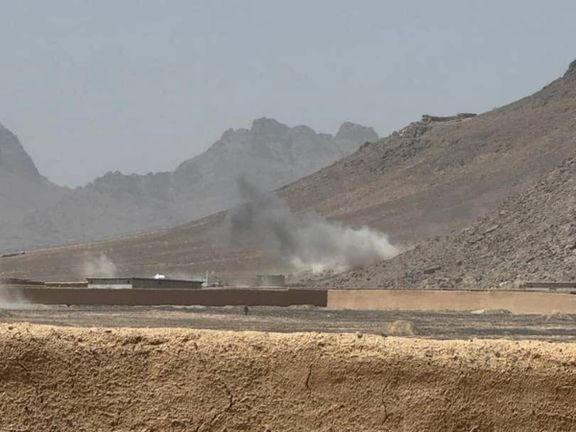
Local sources have reported ongoing clashes between Taliban forces and Pakistani border guards in the Bahramcha district of Helmand province.
Local sources have reported ongoing clashes between Taliban forces and Pakistani border guards in the Bahramcha district of Helmand province.
According to reports received by Afghanistan International, the confrontation began on Thursday morning and had yet to subside as of the latest updates.
The cause of the skirmish remains unclear, and no official statements have been issued by either the Taliban or Pakistani authorities. Additionally, there have been no confirmed reports of casualties on either side.
The border area of Bahramcha, located in southern Afghanistan, has witnessed occasional tensions in the past due to disputed border demarcations and cross-border movements. However, the latest confrontation marks a potentially serious escalation in bilateral tensions.
Further details are awaited as the situation develops.

Iran’s Ministry of Interior has officially commenced the deportation of Afghan migrants holding expired census cards, marking a significant shift in the country’s immigration policy.
Nader Yarahmadi, head of the Centre for Foreign Nationals and Immigrants Affairs, announced the cancellation of these cards and the termination of numerous educational and healthcare services for undocumented migrants.
Yarahmadi called on migrants to leave Iran voluntarily, warning that those who fail to do so may face forced deportation and will be ineligible for any future visa-related benefits. “Individuals without legal documentation will no longer have access to educational and medical services,” he stated. “Their children can only continue their education with valid documents.”
Iranian media, quoting Yarahmadi, reported that the prolonged stay of foreign nationals has sparked growing concern among Iranian citizens. While emphasising that Iran has historically treated migrants humanely, he argued that the time has come to regularise their presence due to mounting pressure on the country’s infrastructure.
The census cards, previously issued to undocumented migrants in exchange for financial deposits, were valid until March and will not be renewed. Many migrants have expressed frustration over the difficulty of reclaiming the deposits they paid for these now-cancelled cards.
Yarahmadi also noted that Iran’s immigration policies are shaped by both domestic needs and ongoing regional crises. However, he stressed that the organisation of undocumented migrants is now a national priority.
He pointed to the strain that the presence of large numbers of migrants has placed on critical public services, including education and healthcare, leading to growing public dissatisfaction.
Meanwhile, images obtained by Afghanistan International reveal the worsening humanitarian situation: thousands of Afghans are reportedly stranded in camps or stuck at immigration offices, struggling to secure exit permits amid the crackdown.
Russian Defence Minister Andrey Belousov has warned of escalating terrorist threats emanating from Afghanistan. He stated that more than twenty radical groups comprising over 15000 fighters are currently active in the country.
He issued the warning during a meeting of the Council of Defence Ministers of the Collective Security Treaty Organisation (CSTO) held on Wednesday in Bishkek, Kyrgyzstan.
Belousov highlighted the growing risk of infiltration by these groups into CSTO member states and beyond, calling Afghanistan the principal source of terrorist threats to the region. While he did not name specific organisations, he claimed that foreign fighters from the Middle East are increasingly entering Afghanistan and other Central Asian nations.
In remarks reported by Russian state media outlet TASS, Belousov also criticised Western geopolitical strategies, accusing Western countries of attempting to orchestrate Russia’s strategic defeat and placing undue pressure on CSTO members.
He said that the military-political situation in CSTO-controlled territories remains tense, with increasing challenges facing member states. The Russian defence minister added that western countries continue to pursue their agenda of weakening Russia and destabilising Moscow’s allies.
The CSTO, comprising Armenia, Belarus, Kazakhstan, Kyrgyzstan, Russia, and Tajikistan, has grown increasingly concerned about the presence of extremist groups such as ISIS and regional radical groups based in Afghanistan. These concerns have prompted member states to cautiously increase engagement with the Taliban, despite the group lacking formal recognition.
In a notable shift, Russia’s Supreme Court earlier this year approved the Prosecutor General’s request to remove the Taliban from its official list of terrorist organisations, a move signalling Moscow’s pragmatic approach to regional security.
In response to mounting security challenges, the CSTO has stepped up military cooperation across the region. Since the Taliban’s return to power in August 2021, the organisation has conducted several joint military exercises in Tajikistan. Plans are also underway to begin supplying weapons and military equipment to bolster security along the Tajik-Afghan border beginning in 2026. This effort will be rolled out in three stages over a five-year period.
Russian President Vladimir Putin also addressed the issue during a March 2025 meeting in Moscow with Tajik President Emomali Rahmon, affirming that Russia cannot remain indifferent to the threats emanating from Afghanistan.
The United Arab Emirates (UAE) Ministry of Foreign Affairs has recognised Abdul Rahman Fida, a Taliban-appointed diplomat, as the Consul General of the "Islamic Republic of Afghanistan" in Dubai.
In an official statement, the UAE Foreign Ministry referred to the Taliban envoy at least three times as the "representative of the Islamic Republic of Afghanistan", a title that has not been used by the country since the Taliban's takeover in 2021.
On Tuesday, 27 May, the ministry announced that Sheikh Maktoum bin Butti Al Maktoum, Director of the Ministry in Dubai, had received Fida’s credentials during a meeting with the Taliban representative.
"Sheikh Maktoum bin Butti Al Maktoum welcomed the Consul General and congratulated him on his appointment, wishing him success in his duties, and commended the strong political, economic, commercial, and investment ties between the United Arab Emirates and the Islamic Republic of Afghanistan," the statement read.
The phrasing has raised questions, as the Taliban refer to their administration as the "Islamic Emirate of Afghanistan." The UAE, like most nations, has not formally recognised the Taliban government.
The suicide of a former Afghan army pilot in Mashhad has highlighted the dire circumstances facing Afghan military refugees in Iran, according to Iranian researcher Arash Nasresfahani.
Mohammad Amir Tawasoli, a former Afghan military pilot, took his own life on Sunday, May 18, 2025, after receiving an order to leave Iran. The incident underscores the intense psychological pressure and constant fear experienced by former Afghan soldiers in the country, Nasresfahani told Shargh newspaper in an interview published Monday.
“These individuals live in perpetual anxiety due to the threat of deportation,” Nasresfahani said, noting that many avoid the Afghan embassy in Tehran out of fear of being identified by the Taliban or forcibly returned to Afghanistan.
The situation has worsened following a recent decision by Iran’s Ministry of Interior to invalidate census cards held by approximately two million Afghan migrants. This policy has stripped legal status from many former soldiers who initially entered Iran with valid documentation. A six-month deadline for undocumented migrants to leave Iran has further heightened their uncertainty.
Nasresfahani warned that repatriation poses severe risks for former Afghan soldiers, citing reports of returnees particularly ex-military personnel facing trials in makeshift Taliban courts or execution at the Afghanistan border. “The Taliban have blacklisted individuals suspected of harming or killing their members,” he said, adding that repatriated soldiers face potential “torture, imprisonment, deprivation, and even death.”
Many former soldiers now live in hiding in Iran without valid residency documents, fearing forced return. Nasresfahani urged the Iranian government to adhere to international conventions and treat at-risk Afghan migrants, particularly former military personnel, with humanity. “The cancellation of census cards has severely undermined the mental and physical security of those attempting to rebuild their lives after the fall of Kabul,” he said.
He also criticised domestic political and media narratives that portray Afghan military personnel as a national security threat, arguing that such perceptions have driven Iran’s security-centric approach rather than a humanitarian or legal one.
Iran has announced plans to deport all migrants lacking valid residency documents. However, migration rights activists warn that implementing these measures without regard for the unique circumstances of refugees, especially former soldiers, could lead to severe and irreversible humanitarian consequences.
Nasresfahani called for policies that prioritise the safety and rights of Afghan migrants, particularly those at risk of persecution if returned to Taliban-controlled Afghanistan.
The Taliban have prohibited table football in Daikundi province, local sources told Afghanistan International. The group claims the miniature player figures in the game resemble idols, which they say is forbidden in Islam.
On Wednesday, May 28, 2025, sources reported that the Taliban instructed table football clubs to remove the heads of the player figures to continue the game. Failure to comply will result in a complete ban.
The Taliban have not issued an official statement on the prohibition.
Over the past four years, the Taliban government has increasingly restricted or banned various games and recreational activities in Afghanistan. Earlier, the Taliban’s sports authority suspended the Afghan Chess Federation, declaring chess “haram” (forbidden).