
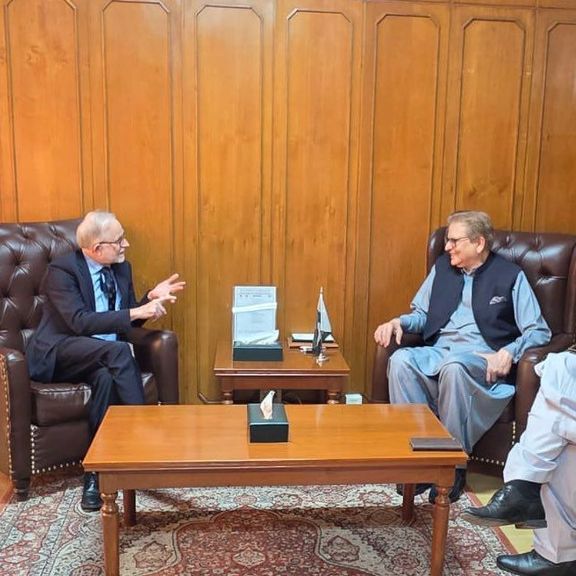
Pakistan’s special representative for Afghanistan has met the UN special rapporteur on human rights in Afghanistan to discuss the country’s human rights situation, recent developments and security challenges.
Mohammad Sadiq wrote on X on Wednesday that he had discussed human rights developments and security issues with Richard Bennett.
Bennett recently travelled to Pakistan to attend the Asma Jahangir Conference in Lahore, where he met a number of officials and institutions. At the event, he warned about the consequences of deporting migrants to Afghanistan.
He said Pakistan should adhere to its international obligations and refrain from forcibly returning people at risk. Islamabad, however, continues to detain thousands of undocumented Afghan migrants each day despite such calls.

Richard Lindsay, the United Kingdom’s special representative for Afghanistan, said on the International Day of Women and Girls in Science that the country’s future depends on equal opportunities, stressing that girls must be free to learn and women free to work in science.
Writing on X on Wednesday, the diplomat said Afghanistan’s all-girls robotics team demonstrates the progress that is possible when young women are given opportunities.
In a message marking the day, the United Nations said 1,607 days have passed since the Taliban banned girls from education.
The UN Assistance Mission in Afghanistan (UNAMA) said the continued deprivation of Afghan girls from schooling paints a bleak picture of the country’s future.
A new United Nations sanctions monitoring report says the Taliban are supporting the activities of militant groups, including al-Qaida, Tehreek-e-Taliban Pakistan and the East Turkestan Islamic Movement, inside Afghanistan.
The six-month report by the UN Analytical Support and Sanctions Monitoring Team to the Security Council says al-Qaida continues to enjoy Taliban backing and acts as a provider of training and advice in Afghanistan, particularly for Tehreek-e-Taliban Pakistan (TTP).
According to the report, al-Qaida in the Indian Subcontinent is active in south-eastern Afghanistan, while its leader, Osama Mehmood, and his deputy, Atif Yahya Ghouri, are present in Kabul. The group’s media team is reported to operate in Herat.
The United States has offered a $10 million reward for information on Mehmood and $5 million for information on Ghouri.
The report also says TTP has enjoyed greater freedom of movement and support from the Taliban in Afghanistan, an approach that has led to an increase in the group’s attacks against Pakistan. It describes TTP as one of the largest militant organisations operating in Afghanistan, saying its assaults on Pakistani security forces and state institutions have amounted to a military confrontation.
The report states that members of the East Turkestan Islamic Movement have received identity documents from the Taliban, allowing them freedom of movement inside Afghanistan, and are financed through poppy cultivation and mining in Badakhshan.
The United Nations said around 250 members of the group joined Taliban police units in 2025.
Citing a UN member state, the report adds that the East Turkestan Islamic Movement has asked its fighters in Syria and neighbouring countries to relocate to Afghanistan in preparation for what it described as a return to Xinjiang for jihad.
According to the report, Islamic State Khorasan remains active, with a primary focus on northern Afghanistan, particularly Badakhshan and areas near the Pakistani border, while also seeking alliances with other armed groups beyond the region.
The report emphasises that countries in the region remain concerned about the number of militant groups in Afghanistan and the consequences of their presence.
Pakistan’s defence minister has said the country may take action against militants in Afghanistan before the start of Ramadan, warning that delays in addressing security threats would carry serious consequences.
Khawaja Asif told ARY News that some level of contact with the Taliban in Afghanistan was continuing, but militant activity from Afghan territory had not subsided.
He said that if authorities on the other side of the border remained passive observers, responsibility for the consequences would lie with them.
Asif added that Pakistan still preferred dialogue but could not accept a situation in which attacks were carried out on its territory after negotiations.
The defence minister said Taliban officials had acknowledged they could not provide written guarantees on security matters and could only offer verbal assurances.
His remarks come amid a rise in militant attacks in Pakistan.
In one of the latest incidents, a suicide bombing targeted a Shia mosque in the Pakistani capital during Friday prayers, killing at least 31 people and wounding 169 others.
Following the attack, Asif said the attacker had travelled back and forth to Afghanistan.
The United Nations says 1,607 days have passed since the Taliban banned girls from attending secondary school in Afghanistan, warning that the continued restriction threatens the country’s future.
In a message marking the International Day of Women and Girls in Science on 11 February, the UN Assistance Mission in Afghanistan (UNAMA) said the exclusion of girls from education presents a troubling outlook for Afghanistan’s development.
UNAMA said in a statement that it was observing the day with deep sadness, noting that girls above the sixth grade have been unable to attend school for more than four years.
The mission said that it is more than four years of deprivation and lost opportunities that paint a painful picture of Afghanistan’s future , a future in which women and girls are absent from science and other vital fields.
The UN mission again called on the Taliban authorities to lift the ban on girls’ education, adding that millions of Afghan girls remain waiting to return to school.
Earlier this year, the United Nations reported that 2.2 million adolescent girls in Afghanistan are currently out of secondary school, warning that the prolonged restriction could seriously undermine both the future of girls and Afghanistan’s long-term development and stability.
The UN Educational, Scientific and Cultural Organisation (UNESCO) has warned that if restrictions continue until 2030, the number of girls deprived of education in Afghanistan could rise to more than four million.
The continued closure of girls’ schools has drawn widespread international criticism. Prominent public figures, political leaders and international organisations including Amnesty International and UNICEF have repeatedly called for the reopening of schools to girls.
Taliban officials, however, have consistently described the education ban as an internal matter, saying their policies are based on their interpretation of Islamic law.
The United Nations Development Programme (UNDP) says more than 75 precent of Afghanistan’s population is facing livelihood insecurity, with female-headed households among the most affected.
In a new report, the agency said only about 7 precent of women in Afghanistan are employed and that 88 precent of female-headed households lack access to basic needs.
Since returning to power, the Taliban have imposed policies restricting women’s access to education and employment. As poverty has spread across Afghanistan, the ban on women’s work has placed female-headed households under increasing economic strain.
Experts have repeatedly warned that Taliban restrictions on women’s education and employment threaten their future and undermine long-term economic stability.
In late 2025, the UN Security Council said Taliban policies affecting women cost Afghanistan’s economy more than $1 billion annually.
In its report, the council described the situation of women and girls in Afghanistan as “dire,” noting that eight out of ten Afghan women are deprived of education, employment and vocational training opportunities.