Zahedan Police Detain Over 600 Undocumented Afghan Migrants

Police in Zahedan, the capital of Iran’s Sistan and Baluchestan province, have detained at least 661 undocumented Afghan migrants, authorities said.

Police in Zahedan, the capital of Iran’s Sistan and Baluchestan province, have detained at least 661 undocumented Afghan migrants, authorities said.
Hamid Noori, the city’s police chief, announced that the arrests were made over the past week. The detained individuals have been handed over to the relevant authorities for deportation, he said.
Noori described the detentions as part of a broader initiative to “enhance social security and promote public satisfaction,” and said the effort was aimed at combating crime.
Iranian authorities have recently stepped up the detention and deportation of Afghan migrants.
Fatemeh Mohajerani, spokesperson for the Iranian government, previously stated that under Iranian law, Afghan migrants with proper documentation are permitted to reside in the country, while those without legal papers will be deported.
Meanwhile, during recent Eid speeches, several Taliban officials called for an end to the mass deportation of Afghan migrants from neighbouring countries. Abdul Kabir, the Taliban’s minister of refugees and repatriation, urged neighbouring states to show patience and tolerance towards Afghan refugees.

The international humanitarian organisation Mercy Corps has issued a stark warning that seven million residents of Kabul face a life-threatening water crisis.
The group reports that half of the city’s deep wells have already dried up, and if current trends continue, Kabul could run out of water entirely by 2030.
According to the organisation, groundwater levels in the Afghan capital have dropped by 30 percent over the past decade. Rapid urban growth and the escalating climate crisis are cited as key drivers of the shortage.
Experts warn that under these conditions, Kabul could become the first major city in the world to run out of water.
The Guardian reports that current groundwater extraction estimated at 44 million cubic metres per year exceeds the natural replenishment rate. If this continues, the city’s underground reserves could be depleted in less than five years, posing an existential threat to Kabul’s population.
Dayne Curry, Mercy Corps’ country director in Afghanistan, stressed the urgency of the situation. “There should be a committed effort to document this better and to draw international attention to the need to address the crisis,” he said.
“No water means people leave their communities, so for the international community to not address the water needs of Afghanistan will only result in more migration and more hardship for the Afghan people.”
Curry noted that Afghanistan’s water infrastructure is heavily dependent on foreign aid, funding that has largely been frozen due to political concerns following the Taliban’s return to power.
According to The Guardian, up to 80 percent of Kabul’s groundwater is unsafe, with high levels of sewage contamination. Access to water has become a daily struggle for residents. Some families spend up to 30 percent of their income on water, and more than two-thirds are reportedly in debt due to water-related costs.
Nazifa, a teacher in Kabul’s Khair Khana neighbourhood, told The Guardian: “Afghanistan is facing a lot of problems, but this water scarcity is one of the hardest. Every household is facing difficulty, especially those with low income. Adequate, good-quality well water just doesn’t exist.”
Meanwhile, some private companies are profiting from the crisis by drilling new wells and extracting public water supplies, selling it at high prices. Nazifa added: “We used to pay 500 afghanis (£5.30) every 10 days to fill our cans from the water tankers. Now, that same amount of water costs us 1,000 afghanis.”
Kabul’s population has surged from under one million in 2001 to more than seven million today, dramatically increasing water demand. The absence of effective governance, regulation and oversight has further worsened the situation over the past two decades.
In early 2025, the UN Office for the Coordination of Humanitarian Affairs (OCHA) reported that partners had received only $8.4 million out of the $264 million needed for water and sanitation programmes in Afghanistan.
Additionally, $3 billion in international aid earmarked for water and sanitation projects has been frozen since the Taliban’s return to power.
One proposed solution is the Panjshir River pipeline project, which could reduce the city’s dependence on groundwater and provide drinking water to two million people. The project’s design phase was completed in late 2024 and is currently awaiting budget approval. The Taliban are seeking investors to fund the $170 million project.
Najibullah Sadid, a senior researcher in water resource management warned: “We don’t have time to sit around waiting for budgets. We are caught in a storm from which there will be no return if we don’t act immediately.”

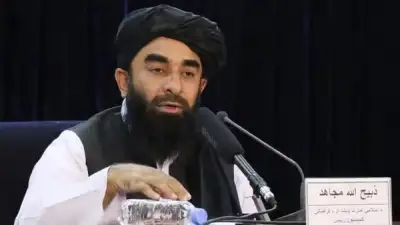
Zabihullah Mujahid, the Taliban’s spokesperson, censored parts of an audio recording of Taliban leader Hibatullah Akhundzada’s Eid speech at the Eidgah Mosque in Kandahar.
Notably, Akhundzada’s voice was cut off at the moment he began criticising the widespread influence of the media among the public.
During the speech, Akhundzada said: “Today, media is in people's pockets and it lies,” but his voice was abruptly muted at that point.
Mujahid published the audio recording on his account on X, formerly Twitter, on Saturday. However, when Akhundzada began addressing media influence, the recording was clearly edited and censored.
Despite the censorship, Afghanistan International has obtained an unedited version of the full speech from Kandahar. In the uncensored audio, Akhundzada is heard discussing the power of the media and responding to criticism regarding the lack of inclusivity in the Taliban government.
In the censored portion, the Taliban leader accused the media of spreading “pure slander” and claimed to have heard a news report that was a “complete lie”, though he did not specify which report or outlet.
Akhundzada also attacked his critics, labelling them “devils.” In response to claims that the Taliban’s administration is not inclusive, he urged listeners to examine the backgrounds of Taliban officials.
The backgrounds of Taliban cabinet members, governors and police chiefs reveal that no non-Taliban individuals are included in the government. The administration has ignored Afghanistan’s political and social diversity. There are no women in leadership roles, and ethnic minorities have been excluded.
Nevertheless, in his speech, Akhundzada stressed that people should focus on the actions of Taliban officials and the direction in which they are leading the country. He concluded by expressing hope that “Allah will protect the regime from propaganda.”
The censorship of Akhundzada’s speech prompted sharp reactions on social media. Some users remarked: “Censorship in the Taliban regime is so extreme that it even silences the voice of its own leader.”

During his Eid speech at the Afghan presidential palace, Taliban Prime Minister Mohammad Hassan Akhund called on religious clerics and scholars to safeguard and defend the group’s rule.
“We must not allow the light of the Islamic regime to be extinguished,” Akhund said, emphasising the need to protect what he described as the foundations of an Islamic system.
He accused the media of spreading “false judgements” about the Taliban and claimed the group’s achievements are being deliberately downplayed. While acknowledging existing challenges, Akhund urged citizens to remain vigilant and not allow adversaries to undermine the regime.
The Taliban leader also encouraged the public to “value the Sharia-based system and the security it brings.”
His remarks come amid mounting criticism from both domestic and international observers over the Taliban’s crackdown on the media and freedom of expression since returning to power in 2021.
According to multiple reports, dozens of media outlets have been shut down over the past four years, and hundreds of journalists have been threatened, detained and forced into exile.

Fatemeh Mohajerani, spokesperson for the Iranian government, has said that under Iranian law, Afghan migrants with valid documents are permitted to reside in the country, while those without documentation will be deported.
“Certainly, the government distinguishes between Afghans with documents and those without,” Mohajerani said.
Iranian domestic media reported Saturday, 7 June, that the spokesperson added: “The government’s focus is on returning undocumented foreigners to their countries and granting residence permits to those who are documented, in accordance with the law.”
According to Mohajerani, the Islamic Republic is determined to deport undocumented Afghan migrants.
These statements come amid growing reports from Afghan citizens who have shared videos with Afghanistan International, claiming that they were arrested and deported by Iranian police despite holding valid visas and legal documents.
The International Organization for Migration (IOM) previously reported that in May, 15,675 Afghan families were forcibly returned from Iran to Afghanistan. Of these, 11,201 families were deported, nearly twice the number recorded in April.
The sharp increase in the return of Afghan migrants from Iran, along with intensified forced deportations from Pakistan, has created serious challenges for Afghanistan. Despite this, the Taliban authorities are cooperating with the Iranian government on the deportation and return of Afghan migrants.

The Russian newspaper Vedomosti has reported that Protey, a Russian company currently under US sanctions, has installed 4G network antennas across Afghanistan.
According to the report, the antennas have been deployed in four provinces and are capable of providing telecommunications services to up to 10 million people.
The report, published Thursday, 5 June, states that St Petersburg-based Protey has established a core 4G network in Afghanistan, marking the first time the company has exported its technology outside Russia.
The network was reportedly developed in partnership with the state-owned telecom giant Rostelecom and is considered the first fully domestic Russian solution designed to replace foreign hardware and software.
Protey entered the Afghan market after major telecom companies such as Ericsson and Nokia exited the country, and Chinese firms including Huawei and ZTE significantly scaled back operations, changes that followed the Taliban’s return to power in 2021.
Alesya Mamchur, Rostelecom vice president, confirmed that the network had been installed in four Afghan provinces, though she did not specify which ones. She added that the infrastructure could serve an estimated 10 million users.
Russian analysts have noted that Protey’s operations in Afghanistan could serve as a launchpad for expansion into other markets in the Global South.
Protey was placed under US sanctions last year for its involvement in sectors deemed to support Russia’s military-industrial base.