Uzbek President Urges International Community To Avoid Isolating Afghanistan
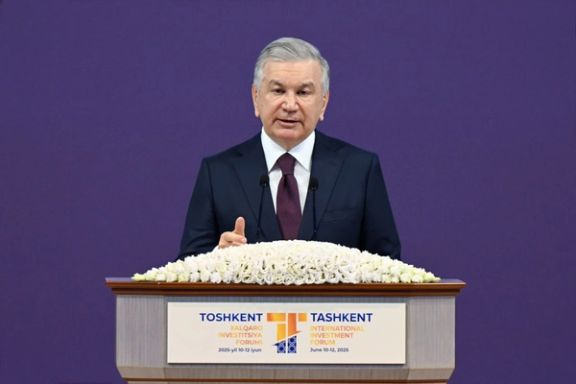
Uzbek President Shavkat Mirziyoyev has called on the international community to prevent Afghanistan’s isolation and to engage in constructive dialogue with the Taliban.

Uzbek President Shavkat Mirziyoyev has called on the international community to prevent Afghanistan’s isolation and to engage in constructive dialogue with the Taliban.
Speaking at the Tashkent Investment Forum, Mirziyoyev underscored the importance of fostering peaceful and sustainable development in Afghanistan, which he said is vital for regional stability and progress.
“Another issue on the global agenda is supporting the peaceful and sustainable development of neighbouring Afghanistan,” Mirziyoyev said, according to the official website of the Uzbek presidency. “Now more than ever, it is important to establish constructive dialogue with the authorities in Kabul and to prevent their international isolation.”
While Uzbekistan has not formally recognised the Taliban administration, it maintains active diplomatic and economic relations with the group, in line with its broader regional engagement strategy.
The Uzbek president stressed that stability and economic growth in Afghanistan are crucial for the long-term development of neighbouring countries.
In a similar appeal made in April, Mirziyoyev urged the international community not to forget Afghanistan, citing its strategic significance and the potential consequences of disengagement.

Alexander Bortnikov, head of Russia’s Federal Security Service (FSB), has warned that ISIS and its affiliates have intensified their operations in Afghanistan, posing a growing threat to regional security.
Speaking at the 18th Meeting of Heads of the Commonwealth of Independent States (CIS) Counterterrorism Agencies in Moscow, Bortnikov said the leadership of international terrorist organisations is increasingly relying on militants active in Afghanistan and Syria. He also highlighted the mobilisation of former prisoners released in Syria, many of whom are citizens of Russia, Central Asia, and the Caucasus.
Bortnikov stressed that CIS member states face rising security threats linked to instability in the Middle East, Africa, Afghanistan, Pakistan, and Central Asia. He pointed to regime change efforts in Syria, the war in Gaza, pressure on Iran, and the ongoing crisis in Libya as key drivers of global Islamic radicalism.
“In the past year alone, CIS intelligence services have prevented 550 terrorist and extremist crimes, identified more than 5,500 individuals linked to terrorism and extremism, and prosecuted over 1,500,” Bortnikov said.
His comments echo recent warnings by Russian Defence Minister Andrey Belousov, who, during a meeting of the CSTO Defence Ministers’ Council, cautioned against the threat of radical groups infiltrating neighbouring countries from Afghanistan. Belousov said more than 20 extremist groups, with over 15,000 fighters, are currently operating in Afghanistan.
In response, the Taliban rejected the claims, stating that such groups were originally formed for intelligence purposes during the US military presence in Afghanistan. The Taliban’s spokesperson’s office insisted that no unauthorised armed groups now exist in the country.
However, the Taliban recently reported conducting a raid against ISIS in Kabul. Spokesperson Zabihullah Mujahid said Taliban forces killed two ISIS members and seized weapons and ammunition during a Monday night operation in the capital’s 15th security district.

The 22nd Oslo Forum is set to take place on Wednesday, 11 June, bringing together foreign ministers and senior officials from across the globe to discuss mediation and conflict resolution in an increasingly complex international landscape.
According to the event’s organisers, this year’s theme — “All Hands on Deck: Mediation in a Changing World” — reflects the urgent need to adapt peacebuilding efforts to an unpredictable and polarised global environment.
The two-day forum is jointly organised by Norway’s Ministry of Foreign Affairs and the Centre for Humanitarian Dialogue (HD). It serves as an informal platform for high-level dialogue, allowing participants to exchange experiences, refine strategies, and explore solutions to some of the world’s most enduring conflicts.
Foreign ministers and officials from countries including Saudi Arabia, China, the Islamic Republic of Iran, Oman, Egypt, Syria, Qatar, and Ukraine are expected to attend.
Norwegian Foreign Minister Espen Barth Eide underscored the importance of mediation in current global affairs, stating: “Mediation and diplomacy are frontline tools for global stability.”
“In an era of rising tensions, fractured alliances, and weakening respect for international law, gatherings like the Oslo Forum are both useful and necessary,” he added.

The Iranian Embassy in Kabul has announced that Noor Jalal Jalali, the Taliban’s Minister of Public Health, met with Iranian Health Minister Mohammad Reza Zafarghandi in Tehran to discuss expanding bilateral cooperation in the health sector.
According to the embassy’s statement, the meeting aimed to strengthen collaboration between the two countries, particularly in healthcare services and the supply of medical equipment and pharmaceuticals.
Jalali arrived in Tehran on Monday and attended the Iran Health 2025 exhibition on Tuesday. During his visit, he also held talks with Saeed Reza Shahmoradi, Director General of the Department of Medical Equipment at Iran’s Food and Drug Administration.
Iranian media reported that Jalali was introduced to Iran’s latest developments and capabilities in medical technology and equipment manufacturing during the visit.
The meeting comes as Iran continues to expand its pharmaceutical exports to Afghanistan. Iranian officials have stated that the country currently supplies approximately 70 percent of Afghanistan’s medicine needs.

The Taliban has claimed responsibility for a raid on what it described as an ISIS hideout in Kabul, saying two members of the militant group were killed during the operation.
Taliban spokesperson Zabihullah Mujahid announced on Tuesday that the raid took place on Monday night in the 15th security district of the Afghan capital. He said Taliban forces discovered and seized a cache of weapons and ammunition at the site.
Taliban sources told Afghanistan International that the operation lasted several hours and involved sustained gunfire. Videos from the area captured the sound of heavy shooting during the raid.
Al-Mirsad, a media outlet affiliated with the Taliban, also reported that two individuals were killed in the raid, citing unnamed sources.
However, doubts have been raised about the nature of the operation. Sarah Adams, a former CIA officer, previously alleged that a compound in the 15th district, claimed by the Taliban to be an ISIS hideout, actually belonged to a Taliban intelligence unit. She described such operations as potentially staged, aimed at garnering approval from the United States and the international community.
The Taliban has not commented on these allegations. Independent verification of the identities of those killed and the circumstances of the raid remains unavailable.

Dozens of protesters were reportedly detained by the Taliban in Afghanistan’s northern Faryab province following a demonstration against the group's police command in Dawlat Abad district, sources told Afghanistan International.
At least four independent sources confirmed that protesters chanted “Long live Dostum”, a reference to Abdul Rashid Dostum, the former vice president and leader of the Junbish-e Milli party, as they rallied on Monday and entered the district’s police command compound.
The protest was sparked by the arrest of several young men involved in a confrontation over the alleged harassment of girls during Eid celebrations in Dawlat Abad. Demonstrators gathered outside the Taliban police command to demand the release of the detainees. In response, Taliban forces reportedly detained more protesters, escalating tensions.
Multiple sources said some protesters forced their way into the police command building, prompting a swift and forceful reaction from Taliban personnel. The district centre has since been placed under lockdown, with Taliban fighters, many in civilian clothing, reportedly conducting house-to-house searches in search of demonstrators.
One source told Afghanistan International that dozens more have been arrested in these ongoing operations, and that residents are now afraid to leave their homes due to fear of arrest.
Video footage obtained by Afghanistan International shows large crowds gathered around the police command building, though the exact number of those detained remains unclear. Estimates vary widely, with one local source claiming around 100 people have been taken into custody, while another source close to the Taliban puts the figure at 35.
The Taliban has yet to issue an official statement on the incident.
