Iran, Pakistan Deport Over 5000 Afghans On World Refugee Day

More than 5000 Afghan migrants were deported from Iran and Pakistan within 24 hours, coinciding with World Refugee Day, the Taliban announced on Friday.

More than 5000 Afghan migrants were deported from Iran and Pakistan within 24 hours, coinciding with World Refugee Day, the Taliban announced on Friday.
According to the commission, a total of 5412 Afghan nationals were returned; 4,440 from Iran and 972 from Pakistan. The returnees re-entered Afghanistan through the Pul-e-Abrisham, Islam Qala, Angoor Ada, Spin Boldak, and Torkham border crossings.
The announcement has sparked fresh concern from international human rights groups. On World Refugee Day, several organisations criticised the ongoing deportations and urged both countries to halt the forced return of Afghan nationals.
Amnesty International called on the Pakistani government to immediately stop deportations and to extend the residency permits of Afghan refugees. The organisation warned that many returnees face the risk of human rights violations, including harassment and persecution by the Taliban upon their return to Afghanistan.
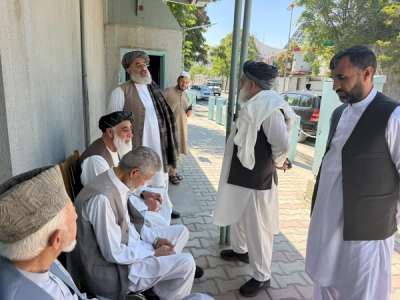

Taliban Interior Minister Sirajuddin Haqqani has stated that the group’s rise to power was not motivated by a desire for dominance or rule.
Haqqani stressed that the group was driven by a commitment to what he described as “jihad” against “infidelity and corruption” and the establishment of Islamic Sharia law.
Speaking at a gathering of local elders in Paktia province, Haqqani said, “Power should not be used for suppression or personal gain.” He added that loyalty to Taliban supreme leader Hibatullah Akhundzada is a fundamental requirement for loyalty to the regime. “If we are not sincere in following orders, we cannot be loyal to this nation and this regime,” he said.
Haqqani, considered one of the Taliban’s most influential figures, has in recent months offered implicit criticism of Akhundzada’s leadership. The Taliban refer to Akhundzada as Amir al-Mu’minin (Commander of the Faithful).
Despite Haqqani’s remarks, the Taliban have been widely accused of using their interpretation of Islamic law to suppress dissent, marginalise women, and curtail civil liberties. The latest quarterly report by UN Secretary-General António Guterres stated that the Taliban’s policies have worsened the country’s humanitarian crisis. The report also documented at least four extrajudicial killings and ten arbitrary arrests of former government officials between February and April, despite the Taliban’s general amnesty announcement.
Haqqani confirmed the Taliban have reduced the number of civil servants due to budgetary constraints, in line with an order reportedly issued by Akhundzada on 13 April mandating a 20 per cent cut in security and government staffing.
At the gathering, Haqqani also outlined plans for development projects in Paktia, including road construction, power facilities, water dams, and public infrastructure. However, he urged residents to remain patient, as funding and implementation timelines remain unclear.
Local elders called for improved education, healthcare, agricultural support, and job creation for young people. Specific requests included rebuilding the Gardez–Patan road, restoring the Nari and Machlaghoo dams, and constructing school buildings.
Afghanistan International recently reported that infrastructure projects launched by Haqqani to connect mountainous areas in Paktia, Paktika, and Khost provinces have stalled due to internal disagreements and a lack of financial resources. These projects were reportedly being financed personally by Haqqani.

The Taliban have publicly flogged 14 individuals, including three women, in Kabul, Parwan and Faryab provinces, after convicting them on charges including extramarital relations, murder, running away from home, and drug-related offences.
In a series of statements issued this week, the Taliban’s Supreme Court said that the punishments were handed down by various provincial courts and included prison sentences ranging from seven months to five years, in addition to public lashings.
In Kabul, the group’s primary court for counter-narcotics sentenced six individuals to between seven and nine months in prison and 10 lashes each for allegedly selling methamphetamine and heroin.
In Parwan province, six people including two women were convicted of extramarital relations and murder. They were each sentenced to prison terms of three to five years and received 39 lashes in public.
In Faryab’s Pashtun Kot district, a man and a woman were publicly flogged, also receiving 39 lashes and prison sentences of eight months to one year. The charges against them included running away from home and “illicit relations,” according to the court’s statement.
The Taliban Supreme Court did not provide information about the legal proceedings or whether the accused were granted access to legal representation or a fair trial.
Despite widespread international condemnation of corporal punishment and torture, the Taliban continue to enforce public floggings, which they claim are in accordance with Islamic Sharia law.

Taliban Deputy Prime Minister for Administrative Affairs, Abdul Salam Hanafi, has called on foreign nations to refrain from interfering in the group’s internal affairs, stating that the Taliban expects the same respect it extends to others.
Speaking during his visit to China, Hanafi emphasised that the Taliban does not interfere in the internal matters of any country and does not allow “any individual or group” to use Afghan soil to threaten other nations.
“We expect the same reciprocity from other countries and urge them not to interfere in our governance,” he said, according to a statement released by the Taliban’s prime minister office on Friday.
Hanafi made the remarks while attending the 9th China-South Asia Expo, where he also expressed the Taliban administration’s interest in expanding cooperation with China and South Asian countries in areas such as mining, energy, transit, technology, and trade.
His comments come shortly after the Taliban unilaterally terminated what it described as its “largest” oil exploration and extraction contract with China. The deal, signed last year in the presence of Taliban Deputy Prime Minister for Economic Affairs Abdul Ghani Baradar and the Chinese ambassador to Kabul, involved the Chinese company Afchin and the Taliban’s Ministry of Mines and Petroleum.
Last week, the ministry announced the termination of the contract, citing the company’s failure to meet its obligations.

Zulala Hashemi, a well-known Afghan singer, has been missing for 15 days and is believed to have been abducted in Kabul, according to her family.
Her husband, Sayed Mohsen Hashemi, told Afghanistan International that he has received no information about her whereabouts despite continuous efforts to locate her. “Zulala left home to visit friends and never returned. Her phone has been switched off, and all attempts to contact her have failed,” he said in a video message on Thursday, 19 June.
Zulala Hashemi gained national recognition after competing in the first round of Afghan Star, a popular singing competition formerly broadcast by TOLO TV. Her success on the show was seen as a significant achievement, especially for a female artist in a male-dominated space.
Hashemi said that his search for his wife has so far been fruitless, and he is beginning to lose hope. Zulala is the mother of a four-year-old son, whose health, the family says, has worsened since her disappearance.
Taliban authorities have not yet commented on the case.

Gulbuddin Hekmatyar, leader of Afghanistan’s Hezb-e Islami party, has warned that the United States risks a collapse similar to that of the Soviet Union if it enters a war with Iran in support of Israel and fails to achieve its objectives.
In a post on X (formerly Twitter) on Thursday, Hekmatyar praised Syria’s stance following Israel’s attack on Iran, describing it as “wise and prudent.” He commended Syrian leadership, particularly Ahmad al-Sharaa, for firmly stating that Damascus would not permit its airspace or territory to be used against Iran.
Hekmatyar has previously warned that if Israel defeats Iran, it may expand its military campaign to other nations, including Pakistan, Türkiye, and Syria.
He called on regional countries to put aside historical grievances and unite against what he described as a “great external enemy.” He urged governments in the region to act with strength, avoid retaliation among themselves, and prioritise collective interests.
Hekmatyar also launched a scathing verbal attack on Reza Pahlavi, son of Iran’s last Shah, accusing him of encouraging the US and Israel to destroy Iran, massacre its population, and even consider nuclear strikes on Tehran.
He concluded his remarks by claiming that signs of America’s internal decline are already visible, particularly in states like California, which he alleged is home to growing separatist movements.