Russia’s Recognition Of Taliban Is a Bilateral Matter, Says Pakistan
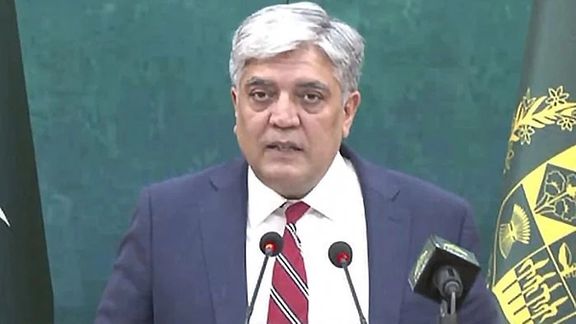
Pakistan’s Ministry of Foreign Affairs has said that Russia’s recent recognition of the Taliban in Afghanistan is a matter strictly between two sovereign states.

Pakistan’s Ministry of Foreign Affairs has said that Russia’s recent recognition of the Taliban in Afghanistan is a matter strictly between two sovereign states.
Speaking at a press briefing, Foreign Ministry spokesperson Shafqat Ali Khan stated, “We have taken note of Russia’s decision. Russia-Afghanistan relations are a matter between two sovereign nations.”
Khan added that Russia has legitimate security interests in the region and underscored Pakistan’s ongoing engagement with Moscow.
“Pakistan enjoys very warm and cordial relations with Russia,” he said. “Both countries are maintaining a positive trajectory and are working to further expand their bilateral cooperation.”
Pakistan has not formally recognised the Taliban administration, though it maintains diplomatic ties and continues to engage with Taliban authorities on security and regional connectivity issues.


More than 500000 Afghan migrants have exited Iran through the Dogharoun border crossing in recent weeks, according to Hossein Jamshidi, governor of Taybad, a town near the Afghan border.
Jamshidi reported that approximately 38000 Afghans are leaving the country daily through Dogharoun, with the number expected to rise further as Iran’s 6 July deadline for undocumented migrants approaches.
“Our assessments indicate that among those who have left via Dogharoun, only 20 percent held valid passports or legal documents,” Jamshidi said. “The remaining 80 percent were residing in Iran without authorisation.”
The Iranian government has intensified deportation measures in recent months, drawing concern from rights groups and Afghan civil society organisations. Many Afghan migrants cite deteriorating conditions under Taliban rule as the reason for seeking refuge in Iran.

The Taliban’s Deputy Prime Minister for Economic Affairs, Abdul Ghani Baradar, has proposed that Afghanistan host the next Economic Cooperation Organization (ECO) summit in Kabul, stating that the Taliban is fully prepared to organise the 18th round of the regional gathering.
Speaking at the 17th ECO Summit on Friday, 5 July, Baradar called on member states to recognise the “political reality of Afghanistan” and to follow Russia’s lead in recognising the Taliban government.
Baradar urged ECO countries to strengthen cooperation with Afghanistan in trade, investment, energy, transportation, agriculture, environmental protection, and climate change mitigation. “The economies of ECO member countries can only reach optimal growth when Afghanistan is an active and dynamic part of the equation,” he said.
Meeting with Kazakhstan’s Prime Minister
On the sidelines of the summit, Baradar held talks with the Prime Minister of Kazakhstan to discuss expanding political, economic, and trade relations. He described Kazakhstan as a key and reliable regional partner.
According to Taliban officials, Kazakhstan’s Prime Minister pledged $500 million in investment for the Torghundi–Herat railway project and expressed interest in increasing fruit imports from Afghanistan and investing in the country’s mining sector.
ECO member states include Afghanistan, Iran, Pakistan, Turkey, Azerbaijan, Kazakhstan, Kyrgyzstan, Uzbekistan, Tajikistan and Turkmenistan.
The Taliban’s growing engagement with ECO leaders follows Russia’s recent decision to formally recognise the Taliban government, signalling a broader push by the group for regional legitimacy and economic integration.

The Hengaw Human Rights Organisation said that the Islamic Republic executed at least 99 prisoners in June, including 10 Afghan nationals, marking a ninefold increase in executions compared to the same period last year.
In a report published on Friday, Hengaw said the executions were carried out on various charges, including political and religious offences, murder, drug-related crimes, rape, and armed robbery.
According to the group, only 19 of the executions were officially acknowledged by Iranian authorities. At least 17 prisoners were reportedly executed in secret, without notifying their families.
The report also highlighted that 16 political prisoners were executed in June on charges of “spying for Israel.”
Hengaw noted that two women were among those executed during the month, one in Qom and another in Ghezel Hesar prison in Karaj. One was convicted of affiliation with religious groups, while the other faced the death penalty for premeditated murder.
The rights group previously reported that at least 617 people, including 40 Afghan nationals, were executed in Iran during the first half of 2025.
Hengaw expressed grave concern over the rise in executions, arbitrary arrests, systemic violence, and other human rights violations across the country. The organisation called on the international community to increase pressure on Iranian authorities to halt the escalating use of capital punishment.

Uzbek President Shavkat Mirziyoyev has expressed his country’s full support for Afghanistan, calling it an integral part of the region and a key player in large-scale economic cooperation and transport connectivity.
Speaking at the 17th Economic Cooperation Organization (ECO) Summit on Friday, 5 July, Mirziyoyev welcomed the participation of a delegation from Afghanistan’s interim government, led by Taliban Deputy Prime Minister for Economic Affairs, Mullah Abdul Ghani Baradar.
He said that after a long pause, a delegation from Afghanistan’s "interim administration" is attending the summit.
This marks the first time in four years that the Taliban have been invited to an ECO heads-of-state summit. The summit was hosted in the city of Khankendi, Azerbaijan.
President Mirziyoyev did not comment on Russia’s recent move to formally recognise the Taliban government.

Abdul Ghani Baradar, Taliban's Deputy Prime Minister for Economic Affairs, has called on member states of the Economic Cooperation Organization (ECO) to follow Russia’s lead and take practical steps toward recognising the Taliban government.
Speaking at the 17th ECO Summit on Friday, Baradar claimed that Russia had acknowledged the Taliban due to what he described as the group's “balanced, economy-focused foreign policy.” He argued that the Taliban administration has created new opportunities for development and regional connectivity.
Baradar said the Taliban are prepared to collaborate with ECO countries on implementing strategic projects across the region. He voiced strong support for the proposed North–South Corridor in Asia, calling it a potential “new chapter” in strengthening economic cooperation and integration among member states.
This marks the first time in four years that the Taliban have been invited to attend an ECO heads-of-state summit. During his remarks, Baradar urged member countries to contribute to the reconstruction and expansion of regional transit routes through Afghanistan. He also proposed that Kabul host the next ECO summit.