• العربية
  • پښتو
  • فارسی
Brand
  • Afghanistan
  • Sport
  • Markets
  • Afghanistan
  • Sport
  • Markets
  • Theme
  • Language
    • العربية
    • پښتو
    • فارسی
  • Afghanistan
  • Sport
  • Markets
All rights reserved for Volant Media UK Limited
volant media logo

Uzbek President Expresses Full Support For Afghanistan At ECO Summit

Jul 4, 2025, 16:06 GMT+1

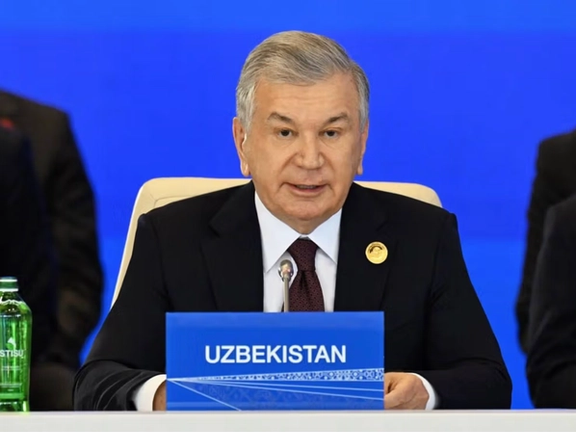
Uzbek President Shavkat Mirziyoyev has expressed his country’s full support for Afghanistan, calling it an integral part of the region and a key player in large-scale economic cooperation and transport connectivity.

Speaking at the 17th Economic Cooperation Organization (ECO) Summit on Friday, 5 July, Mirziyoyev welcomed the participation of a delegation from Afghanistan’s interim government, led by Taliban Deputy Prime Minister for Economic Affairs, Mullah Abdul Ghani Baradar.

He said that after a long pause, a delegation from Afghanistan’s "interim administration" is attending the summit.

This marks the first time in four years that the Taliban have been invited to an ECO heads-of-state summit. The summit was hosted in the city of Khankendi, Azerbaijan.

President Mirziyoyev did not comment on Russia’s recent move to formally recognise the Taliban government.

Most Viewed

Explosions & Aircraft Activity Reported Over Kabul
1

Explosions & Aircraft Activity Reported Over Kabul

2

Nearly 23,000 Militants Operating In Afghanistan, Says Russian Security Chief

3

Afghanistan Instability Is A Direct Regional Security Threat, Says Russia

4

EU Again Calls For Lifting Restrictions On Afghan Women & Girls

5

More Than One Million Added To Afghanistan’s Poor Under Taliban Rule, Says UN

•
•
•

More Stories

Taliban’s Deputy PM Urges ECO Member States To Recognise Group’s Rule

Jul 4, 2025, 15:19 GMT+1

Abdul Ghani Baradar, Taliban's Deputy Prime Minister for Economic Affairs, has called on member states of the Economic Cooperation Organization (ECO) to follow Russia’s lead and take practical steps toward recognising the Taliban government.

Speaking at the 17th ECO Summit on Friday, Baradar claimed that Russia had acknowledged the Taliban due to what he described as the group's “balanced, economy-focused foreign policy.” He argued that the Taliban administration has created new opportunities for development and regional connectivity.

Baradar said the Taliban are prepared to collaborate with ECO countries on implementing strategic projects across the region. He voiced strong support for the proposed North–South Corridor in Asia, calling it a potential “new chapter” in strengthening economic cooperation and integration among member states.

This marks the first time in four years that the Taliban have been invited to attend an ECO heads-of-state summit. During his remarks, Baradar urged member countries to contribute to the reconstruction and expansion of regional transit routes through Afghanistan. He also proposed that Kabul host the next ECO summit.

No Direct Talks Planned Between Putin & Taliban Leaders, Says Russia

Jul 4, 2025, 14:16 GMT+1

Russian President Vladimir Putin currently has no plans to initiate direct contact with Taliban leaders, the Kremlin said on Friday.

Kremlin spokesperson Dmitry Peskov made the remarks in response to a question about whether Putin was preparing for talks with the Taliban leadership.

At present, there are no such plans, Peskov said adding that, however, within the framework of bilateral relations, contacts at various levels will continue.

While Moscow has increased its engagement with the Taliban in recent months, including accepting a Taliban-appointed ambassador, Peskov’s comments indicate that top-level communication remains off the table for now.

Taliban Detains Own Commanders & Civilians Following Clashes In Badakhshan

Jul 4, 2025, 13:31 GMT+1

The Taliban have arrested several of their own local officials in Badakhshan’s Khash district, following recent protests and violent clashes sparked by the group’s efforts to destroy poppy fields in the area.

Informed sources told Afghanistan International on Friday that the detainees include Gul Ahmad Shahin, the Taliban-appointed police chief of Khash; Qari Nawid, head of criminal investigations; and Qari Wajid, another local commander. The three men were reportedly arrested for refusing to suppress protesters and allegedly siding with local residents.

The Taliban have also launched search operations in the district, leading many civilians to flee to the surrounding mountains, according to local sources.

In addition to detaining their own officials, Taliban forces have arrested several residents and community elders, including Mawlawi Roh-ul-Bayan, an influential local cleric. They are accused of organising and encouraging the anti-Taliban demonstrations.

All detainees have reportedly been transferred to Fayzabad, the capital of Badakhshan province. The Taliban’s local administration has not issued any official comment regarding the arrests.

The unrest began earlier this week when Taliban forces attempted to eradicate poppy crops in Khash. The operation triggered a wave of public anger and led to clashes in which at least eight people were killed and dozens wounded, according to eyewitnesses and hospital sources.

On Thursday, the Taliban reportedly arrested at least 37 individuals in connection with the protests. Local sources say the main market in Khash remains closed and that Taliban fighters are mistreating civilians. Residents are reportedly staying indoors for fear of arrest, while Taliban units continue to monitor and patrol the area intensively.

The incident underscores growing tensions between Taliban forces and communities in northern Afghanistan, where local resistance to the group’s policies particularly regarding poppy eradication has been mounting.

Kremlin’s Recognition Of Taliban Could Fuel Geopolitical Tensions, Warns Afghan Leader

Jul 4, 2025, 11:29 GMT+1

Ata Mohammad Noor, former governor of Balkh province has warned that Russia’s recognition of the Taliban could trigger new regional and international tensions.

In a statement issued following reports of the Kremlin’s deepening ties with the Taliban, Noor said such recognition would have consequences beyond bilateral relations, potentially turning Afghanistan into a battleground for renewed proxy conflicts.

He stressed that the legitimacy of any political system must be grounded in the will and consent of the people, not merely through endorsement by foreign governments.

Noor criticised the Taliban for ruling by force, dismantling representative institutions, and violating basic human rights and freedoms. He argued that the group has failed to earn any form of domestic legitimacy.

Drawing parallels with previous Afghan regimes, Noor stated: “Historical experiences, such as the governments of Taraki, Karmal, and Najib (the communist regime leaders) have shown that no level of external support can sustain a regime that lacks national backing.”

He urged regional and global powers to support the Afghan people rather than lending legitimacy to what he described as an imposed and repressive regime.

Taliban Deputy PM, Uzbek President Talk Rail, Energy & Trade Projects

Jul 4, 2025, 10:33 GMT+1

The Taliban announced Thursday that Abdul Ghani Baradar, its deputy prime minister for economic affairs, held talks with Uzbek President Shavkat Mirziyoyev on expanding political and economic cooperation between the two sides.

The meeting took place on 3 July in Khankendi, Azerbaijan, on the sidelines of the 17th meeting of foreign ministers of the Economic Cooperation Organization (ECO), according to a statement from the Taliban’s presidential office.

During the talks, President Mirziyoyev reportedly expressed Uzbekistan’s willingness to invest in key sectors of Afghanistan’s economy, including railway infrastructure, textiles, cement, mining, and electricity.

Both parties agreed to establish a joint working group, led by Baradar and Uzbekistan’s prime minister, to monitor the implementation of future agreements. The working group will meet every three months to assess progress.

According to the Taliban’s statement, Uzbekistan committed to supporting major infrastructure projects in Afghanistan, including the Mazar-e-Sharif–Herat–Kandahar railway line, the construction of textile factories, cement plants, oil refineries, and salt mining operations. Tashkent also pledged to help expand electricity imports to Afghanistan via a 500-kilovolt transmission line extension.

Baradar urged continued engagement between Uzbekistan and the Taliban-led government, emphasising the importance of bilateral trade and transit links.

The Taliban further stated that Uzbekistan had agreed to facilitate the export of Afghan agricultural goods to Central Asia and Russia through Uzbek territory, assist with banking transactions, simplify visa issuance for Afghan nationals, and advance the development of the Termez International Trade Centre.