10,000 Afghan Prisoners Transferred From Iran, Pakistan, Says Taliban

The Taliban’s Ministry of Refugees says nearly 10,000 Afghan prisoners were released from detention in Iran and Pakistan over the past year and transferred back to Afghanistan.

The Taliban’s Ministry of Refugees says nearly 10,000 Afghan prisoners were released from detention in Iran and Pakistan over the past year and transferred back to Afghanistan.
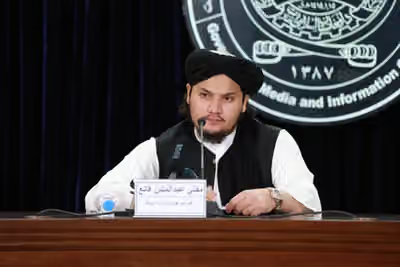
Mahmood-ul-Haq Ahadi, head of policy and planning at the ministry, told a press conference on Wednesday that a total of 9,951 Afghans were repatriated, including 9,541 from Pakistan,most of whom were detained for lacking legal residency documents, and 410 from Iran on various criminal charges.
Ahadi added that efforts to secure the release of other Afghan nationals imprisoned in Iran and Pakistan are ongoing.
In mid-April, a spokesperson for the Taliban’s foreign ministry said approximately 12,000 Afghan citizens remain in detention across Pakistan, Iran, and Türkiye.
Mass Deportation of Migrants from Neighbouring Countries
Kaleem-ur-Rahman Fani, deputy minister for finance and administration at the Ministry of Refugees, said during the ministry’s annual review that migration remains a global challenge and that Afghanistan is among the countries with the highest refugee populations.
He referenced the formation of a high-level commission composed of representatives from 22 ministries and agencies to address the growing issue of Afghan migrants.
“Recently, neighbouring countries Pakistan and Iran have begun the forced deportation of Afghan migrants in clear violation of international norms,” Fani said.
According to the ministry, Iran has expelled at least 1.8 million Afghan migrants in the past three months. During the same period, 184,459 Afghans were forcibly returned from Pakistan.
The Taliban administration has repeatedly criticised the mass deportations, while international organisations have expressed concern over Afghanistan's limited capacity to absorb and reintegrate such large numbers of returnees.

The Taliban has launched a series of house-to-house searches in Tarinkot, the capital of Uruzgan province, targeting former military personnel, local sources told Afghanistan International.
The search operation, which began last week, has so far resulted in the arrest of at least eight former army, police, and national security officers, allegedly on charges of possessing illegal weapons.
Local residents reported on Thursday that the Taliban has been systematically searching the homes of former government security personnel and interrogating family members.
In an earlier raid in the Kherokarez area of Tarinkot, Taliban forces arrested one individual after targeting the residence of a former government official.
According to a statement from the Taliban’s Ministry of Interior, the operation led to the seizure of seven AK-47 rifles, an M-16 rifle, a pistol, six radio communication devices, a night-vision scope, and other military-grade equipment. The ministry said the detainee will be handed over to judicial authorities once investigations are complete.
Three days ago, Taliban forces also raided the home of another former official in Uruzgan, claiming to have confiscated more weapons and military equipment. The group stated that the items had been hidden with the intention of being used in armed resistance.
The Taliban has repeatedly targeted former members of the Afghan security forces, despite earlier pledges of amnesty following its return to power in August 2021. Human rights groups have raised concerns about arbitrary arrests, forced disappearances, and reprisals against ex-security personnel across the country.

Afghan Evac, an advocacy group supporting Afghan refugees, has welcomed US President Donald Trump’s renewed pledge to assist Afghan nationals who worked alongside American forces during the war in Afghanistan.
In a statement issued Wednesday, the organisation praised Trump’s comments, saying Afghan refugees have already demonstrated their commitment to American values through their support for US forces and involvement in human rights efforts.
“We share his desire to ensure the safety and security of American people,” Afghan Evac said, responding to Trump’s remarks about resettling Afghan allies in the United States.
The group also backed Trump’s emphasis on identifying trustworthy individuals, agreeing that “it is indeed possible to distinguish those who are the good ones.”
Afghan Evac stressed that the US government must uphold its previous commitments and ensure that resettlement efforts align with existing support programmes for Afghan allies.
During remarks on Wednesday, Trump reaffirmed his intention to assist Afghans who had worked with the US government and military. “We know the good ones, and we know the ones that maybe aren’t so good,” he said. “We’re going to take care of those people, the ones that did a job [for us], the ones that were told certain things.”
Afghan Evac said a failure to act decisively would be both a political and moral failure for the United States, noting that these individuals stood “shoulder to shoulder” with US forces throughout two decades of war.
In its statement, the organisation urged Trump to use this moment to demonstrate that America is “strongest” when it honours its promises. By supporting Afghan refugees, Afghan Evac added, the president could help reinforce the credibility and moral authority of the US military in future conflicts.

US President Donald Trump has reiterated his commitment to assist Afghan nationals who supported American military and government operations in Afghanistan and are now seeking permanent residency in the United States.
His remarks come in the wake of the Department of Homeland Security’s decision to end Temporary Protected Status (TPS) for certain Afghan migrants. Despite the policy shift, Trump assured that those who were promised protection would be supported.
“We know the good ones, and we know the ones that maybe aren’t so good,” Trump said in response to a question about the fate of Afghan refugees. “We’re going to take care of those people, the ones that did a job [for us], the ones that were told certain things.”
Trump also renewed his criticism of the US withdrawal from Afghanistan, calling it “one of the most disgraceful episodes” in American history. He described the withdrawal as a scandal and reiterated previous pledges to help evacuate Afghan allies, including those stranded for years in the United Arab Emirates following the Taliban’s return to power in 2021.
While Trump did not outline a specific policy or detailed mechanism for how his administration would assist Afghan asylum seekers, he claimed that approximately 90 percent of those seeking permanent residency in the US would be eligible for assistance under his leadership.
Criticism Over Past Policies
Trump’s renewed support for Afghan allies comes in contrast to the restrictive immigration measures his administration implemented during his presidency, many of which adversely affected Afghan nationals. His stance drew criticism from veterans’ groups and advocates for Afghan partners, who argue that the Trump administration ended key resettlement programmes and failed to act on earlier promises.
The Biden administration has also faced scrutiny over its handling of Afghan resettlement. In May, the State Department announced the closure of the Office of the Coordinator for Afghan Relocation Efforts, the office responsible for overseeing the relocation of eligible Afghans, including applicants for Special Immigrant Visas (SIVs) and refugee status.
Adding to the uncertainty, US Secretary of Homeland Security Kristi Noem recently declared the end of TPS for Afghan nationals. Noem cited improved security conditions in Afghanistan as justification, a move that refugee advocates say could put thousands at risk of deportation to a country still plagued by human rights abuses and political instability.
According to US immigration data, more than 14,000 Afghan nationals currently in the United States, many of whom arrived through irregular migration routes via Latin America, could now face removal.
Humanitarian Concerns and Political Pushback
Allison Hooker, US Under Secretary of State, told the House Foreign Affairs Committee on 23 June that the administration values its Afghan partners and is actively exploring ways to reform and improve immigration pathways.
However, Democratic Representative Julie Johnson of Texas criticised what she described as contradictions between official statements and government action. “Tens of thousands of Afghans who worked with our forces during the 20-year war were promised a pathway [to American citizenship] and fully vetted, but are now stranded and waiting,” she said. “They face retribution for believing in America’s promises.”
Advocacy groups have warned that deporting Afghan nationals could result in detention, torture, or even death, particularly for those previously affiliated with US and allied forces. Calls continue from human rights organisations, veterans’ groups, and lawmakers for a clear, humane, and consistent policy to honour America’s commitments to its Afghan allies.

The Taliban has detained the editor-in-chief of Tawana news agency on charges of receiving foreign funding and publishing material critical of the regime, according to statement by the group’s Ministry of Propagation of Virtue and Prevention of Vice.
The Taliban alleges that the editor accepted financial support from the United Nations Assistance Mission in Afghanistan (UNAMA), the UN’s cultural agency UNESCO, and the Islamic Republic of Iran. The ministry claims the funds were used to “bring women out of their homes under the pretext of work” and to produce “negative reports” about the Taliban government.
The ministry has also accused the editor of “moral corruption” and “espionage,” alleging that he secretly submitted reports to what it called “anti-Islamic media outlets” in exchange for thousands of dollars. A video of the detainee’s purported confession was later released by Taliban officials.
However, international human rights groups and independent observers warn that such confessions are often obtained through coercion, intimidation, or torture, and lack credibility under international legal standards.
The Ministry claimed the media outlet operated as a “centre for foreign espionage and moral corruption,” and that the accused admitted to receiving funding for religious and cultural projects, while producing critical material and sending it to international media.
Further charges include promoting gender mixing, distributing what the Taliban labels “harmful” religious texts, and attempting to undermine the regime through media reports. No independent evidence has been presented to substantiate the allegations.
Daricha, a Taliban-affiliated outlet, reported that additional individuals linked to similar organisations have also been detained, though no details were provided.
The Ministry for the Propagation of Virtue, which functions as police, prosecutor, and judge, has sweeping authority over social and public life. International organisations have described the ministry’s enforcement of so-called virtue laws as a systematic campaign of repression, particularly targeting women and dissenting voices.
In recent weeks, the Taliban has intensified its crackdown on journalists and women’s rights advocates. On Tuesday, the Afghanistan Journalists Center reported that Taliban authorities had detained at least seven journalists in Kabul and other provinces over the past three weeks. A total of 15 journalists are currently being held in Taliban custody.
Since returning to power in August 2021, the Taliban has imposed strict curbs on press freedom and expression. Journalists and media workers have been regularly arrested, threatened, and in some cases tortured, often on vague or unsubstantiated charges such as espionage or moral misconduct.
International human rights and press freedom organisations have condemned the Taliban’s actions, calling them blatant violations of international law and fundamental human rights. They continue to call for the immediate release of detained journalists and the restoration of media freedoms in Afghanistan.

Iran has deported at least 1.8 million Afghan migrants over the past three months, according to the Taliban-run Ministry of Refugees and Repatriation.
The announcement comes amid growing concern over Afghanistan's capacity to absorb the mass return of its citizens.
Abdul Rahman Rashid, the Taliban's deputy minister for technical affairs at the ministry, made the remarks during a press conference on Wednesday, as part of the ministry’s annual performance briefing.
Rashid also reported that 184,459 Afghan nationals have been forcibly repatriated from Pakistan so far this year, and an additional 5,134 were deported from Türkiye.
Speaking at the Taliban’s media centre in Kabul, Rashid estimated that around six million Afghan migrants remain in host countries, while approximately 2.5 million people are internally displaced within Afghanistan.
He claimed the Taliban administration has established at least 38 residential settlements for returnees across 29 provinces. Surveys have reportedly been completed for 29 of these sites, with assessments still underway in the remaining nine.
Despite these claims, large-scale deportations continue. The Taliban’s High Commission for Addressing Migrant Issues reported that Iran is currently expelling nearly 10,000 Afghans each day.
At the same time, reports from Pakistan indicate that authorities have resumed the detention and deportation of Afghan migrants in parts of Islamabad.
International organisations have repeatedly warned that Afghanistan, under Taliban rule, lacks the infrastructure and resources to manage the reintegration of such vast numbers of returnees.