Iran Deports 1.8 Million Afghan Migrants In Three Months, Says Taliban Official

Iran has deported at least 1.8 million Afghan migrants over the past three months, according to the Taliban-run Ministry of Refugees and Repatriation.

Iran has deported at least 1.8 million Afghan migrants over the past three months, according to the Taliban-run Ministry of Refugees and Repatriation.
The announcement comes amid growing concern over Afghanistan's capacity to absorb the mass return of its citizens.
Abdul Rahman Rashid, the Taliban's deputy minister for technical affairs at the ministry, made the remarks during a press conference on Wednesday, as part of the ministry’s annual performance briefing.
Rashid also reported that 184,459 Afghan nationals have been forcibly repatriated from Pakistan so far this year, and an additional 5,134 were deported from Türkiye.
Speaking at the Taliban’s media centre in Kabul, Rashid estimated that around six million Afghan migrants remain in host countries, while approximately 2.5 million people are internally displaced within Afghanistan.
He claimed the Taliban administration has established at least 38 residential settlements for returnees across 29 provinces. Surveys have reportedly been completed for 29 of these sites, with assessments still underway in the remaining nine.
Despite these claims, large-scale deportations continue. The Taliban’s High Commission for Addressing Migrant Issues reported that Iran is currently expelling nearly 10,000 Afghans each day.
At the same time, reports from Pakistan indicate that authorities have resumed the detention and deportation of Afghan migrants in parts of Islamabad.
International organisations have repeatedly warned that Afghanistan, under Taliban rule, lacks the infrastructure and resources to manage the reintegration of such vast numbers of returnees.
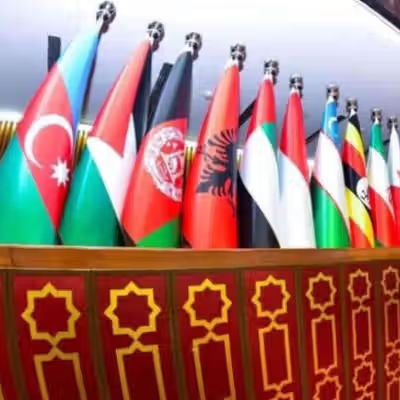

A longtime aide to Taliban Interior Minister Sirajuddin Haqqani has criticised group’s governance, warning that power cannot be maintained through coercion alone urging Taliban leaders to give the Afghan people freedom to judge their rulers.
Abdullah Raihan, who served for more than two decades as a close assistant to Haqqani and now identifies as a journalist, made the remarks in a written commentary published on Wednesday.
“We must do what we believe in, but the people should be given the freedom to judge the legitimacy of the government,” Raihan wrote, directly addressing Taliban officials. “Our goals are greater; minor issues should not prevent us from achieving our major objectives.”
Raihan cautioned against labelling those who express emotional attachment to Afghanistan’s former tricolour national flag as traitors. “Perhaps we have not yet served this nation with the honesty and sacrifice it truly deserves,” he wrote.
Acknowledging the country’s long history of struggle, Raihan argued that Afghanistan’s challenges cannot be resolved within four years and called on Taliban leaders to use this time to improve governance. “The people of Afghanistan have endured hardship for over a century,” he said. “Everything cannot be fixed in just four years. The people need time, and the leadership must seize this opportunity.”
Khalid Zadran, spokesperson for the Taliban police in Kabul, described Raihan in his memoir, 15 Minutes, as one of Haqqani’s most trusted comrades during the war against the former Afghan government. He referred to Raihan as a “devoted companion,” noting his leadership of the Manba al-Jihad media studio, which produced several pro-Taliban films including Karwan-e-Ghaziyan and Lashkar-e-Badri.
Despite his former role, Raihan’s recent commentary reflects a more conciliatory tone. “It doesn’t matter to me who supports which flag and why. What matters is that the message of truth and justice behind the white flag reaches the hearts of the people,” he wrote. “More importantly, this fractured and downtrodden nation must unite under one flag and live with dignity.”
He also urged Taliban leaders to reflect on past mistakes and to earn public trust through action. “When we prove our beliefs in practice and strengthen the foundations of the system, this country will no longer face collapse,” he wrote. “But that requires effort, sacrifice, and determination.”
Raihan’s statement came a day after Afghanistan’s National Flag Day. In recent years, the Taliban has detained and allegedly tortured numerous citizens for expressing support for the former national flag, highlighting the deepening divide between the regime and sections of Afghan society.

While Afghan women and girls face severe restrictions under Taliban rule, foreign female tourists are freely visiting museums, walking city streets, and exploring historical sites, freedoms denied to local women.
Jackie Birov, a 35-year-old American tourist, told the Associated Press she was touched by the hospitality of Afghans during her visit. “I’m very aware that I have a lot more freedom than local women,” she said, referring to the contrasting experiences of foreign and Afghan women.
Tourism in Afghanistan remains a niche industry, attracting only a few thousand visitors annually, most of whom are adventure travellers. However, organised tours from countries including China, Greece, the Netherlands, and the United Kingdom are gradually increasing.
Despite facing global condemnation over its restrictions on women and widespread human rights abuses, the Taliban is working to expand the tourism sector, seeing it as a potential source of revenue and a way to reshape its international image.
Tourist visas, typically single-entry and valid for up to 30 days, have become more accessible. The resumption of commercial flights to and from Kabul, with regular routes to cities like Dubai and Istanbul, has also made travel to the country easier.
The Taliban’s lenient approach toward foreign tourists has drawn particular interest from female travellers. In response, some tour operators have begun offering women-led tours designed specifically for female visitors.
Somaya Moniry, a 24-year-old tour guide, told the Associated Press that she hopes to present a different perspective of Afghanistan.
While tour companies emphasise the economic benefits of attracting foreign visitors, some critics argue that travel to Afghanistan under Taliban rule is ethically problematic. They point to the stark contrast between the freedoms granted to foreign women and the severe limitations placed on Afghan women and girls.
Under Taliban policies, Afghan girls are barred from education beyond grade six, prohibited from working, and restricted from entering parks or dining at restaurants. The disparity has led many to view the regime’s hospitality toward tourists as a reflection of its double standards.

Nearly five million people across Afghanistan have been impacted by climate-related disasters so far this year, the International Organization for Migration (IOM) said on Wednesday.
In a statement posted on the social media platform X, the IOM reported that widespread flooding and avalanches in the first three months of 2025 triggered mass displacement and worsened humanitarian conditions across the country.
According to the agency, approximately 175,000 people were internally displaced during the first quarter, with 79 precent of those displacements linked to climate events and natural disasters. An additional 396,000 people were forced to migrate due to related pressures.
The United Nations said rural communities have borne the brunt of the devastation, with many losing their homes and struggling to access safe drinking water.
The IOM highlighted that food insecurity remains the most pressing concern, with 47 percent of affected communities identifying food shortages as their greatest challenge.
Afghanistan ranks among the ten countries most severely impacted by the effects of climate change, which include prolonged droughts, irregular rainfall, flooding, and declining water resources.
Earlier this year, Richard Bennett, the UN Special Rapporteur on human rights in Afghanistan, warned that the country is facing intensifying climate shocks and accelerating environmental degradation.

The Taliban has accused the United Nations of losing its credibility and independence, following the organisation’s continued refusal to recognise the group as Afghanistan’s legitimate representative.
Speaking in an interview with a local pro-Taliban radio station, spokesperson Zabihullah Mujahid claimed the UN operates under the influence of Western powers and no longer functions as a neutral international body.
“If the United Nations were truly independent, it would not allow someone who represents no one to occupy Afghanistan’s seat,” Mujahid said. “On whose behalf is the current representative there, and based on which principles and protocols?”
The Taliban has consistently demanded control over Afghanistan’s UN seat since seizing power in August 2021. Mujahid described the UN’s refusal to grant the seat to the group as “inappropriate and shameful”, asserting that the current mission head “speaks against Afghanistan’s security, stability and progress”.
The seat is currently held by Naseer Ahmad Faiq, a senior diplomat from the former government. Faiq represents Afghanistan at UN Security Council meetings and other sessions, and has regularly condemned the Taliban’s human rights violations, including the arbitrary detention of women and girls, killings of former security personnel, and the activities of terrorist groups operating within the country.
The UN has maintained that recognition of the Taliban-led administration is contingent on measurable changes to its policies, particularly in regard to education, women’s rights, and the treatment of ethnic and religious minorities.
Despite sustained international pressure, the Taliban has continued to enforce strict interpretations of Sharia law. In recent days, the group’s so-called morality police have reportedly detained dozens of women and girls across Kabul in a widening crackdown on female freedoms.
Compounding the diplomatic impasse, the International Criminal Court (ICC) has issued arrest warrants for senior Taliban leaders on charges related to gender-based persecution and apartheid.
The Taliban has rejected calls for reform, insisting it will not compromise on its ideological framework to gain international recognition.

The Taliban have forcibly evicted residents of a village in Bamiyan province following a legal ruling in favour of Kuchi nomads, according to local sources.
Residents of Rashk village in Punjab district were ordered to leave their homes after a Taliban court decision awarded land rights to the nomadic group. Local sources told Afghanistan International that Taliban forces, accompanied by Kuchis, locked 25 homes and expelled their occupants.
The eviction took place on Monday during a visit by the Taliban’s deputy interior minister for security affairs. A delegation comprising male and female Taliban police officers and judicial staff travelled to the village and instructed residents to vacate their properties.
Sources said the delegation entered the village alongside Kuchi tribespeople, forcibly removed residents’ belongings, and padlocked their homes.
Images obtained by Afghanistan International show household items dumped outside and armed Taliban members speaking with locals.
One source said the displaced families are now living in dire conditions, spending nights outdoors and unable to return to their homes.
Another source reported that male members of the affected families had left the village in advance to avoid being coerced into signing documents legitimising the forced eviction.
The land dispute between villagers and the Kuchis dates back to the 1970s. Locals say the case was reopened after the Taliban regained power in 2021, and allege that the Taliban have repeatedly arrested villagers involved in the dispute.
Sources also claim that the legal process was biased, with some court sessions reportedly held without the presence of Rashk villagers. Appeals and complaints submitted by residents were allegedly ignored.
A resident told Afghanistan International that the villagers had been given a 15-day deadline to leave their homes before the eviction was enforced.