• العربية
  • پښتو
  • فارسی
Brand
  • Afghanistan
  • Sport
  • Markets
  • Afghanistan
  • Sport
  • Markets
  • Theme
  • Language
    • العربية
    • پښتو
    • فارسی
  • Afghanistan
  • Sport
  • Markets
All rights reserved for Volant Media UK Limited
volant media logo

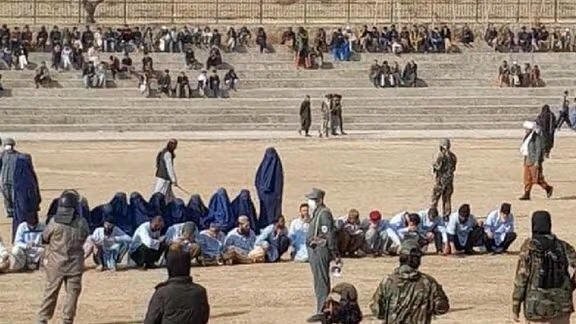
Taliban Publicly Flogged More Than 80 People Across Afghanistan In Past Month

Aug 10, 2025, 09:14 GMT+1

The Taliban’s Supreme Court says 31 people have been publicly flogged in the past week across six provinces, bringing the total number punished in the past month to 81 men and women nationwide.

In its weekly report released Saturday, the court said the latest floggings took place in Maidan Wardak, Kabul, Zabul, Kapisa, Baghlan and Kunduz provinces. It did not provide details about the identities of those punished or the specific charges against them.

Separate court statements earlier in the week said 14 people, including one woman, were publicly punished in Kabul and Zabul on charges of selling and trafficking alcohol, narcotic pills and engaging in extramarital relationships.

The Taliban also said 10 people were flogged in Kabul and Maidan Wardak for theft and drug offences, while eight others were punished in Kabul and Kapisa for narcotics trafficking.

According to the Supreme Court’s figures, 81 people have been publicly flogged across Afghanistan over the past month.

Despite condemnation from international human rights organisations, which classify corporal punishment as torture, the Taliban continues to carry out public floggings, saying they are in accordance with its interpretation of Islam.

Most Viewed

EU Parliament Approves Resolution Urging Sanctions Against Taliban Leaders
1

EU Parliament Approves Resolution Urging Sanctions Against Taliban Leaders

2

Senior Taliban Delegation Visits Turkmenistan

3

Kabul Military Airport Hit In Rocket Attack, Claims Anti-Taliban Group

4

Russia & China Raise Alarm Over Terrorism Threat In Afghanistan

5

More Than 300 Afghans Released From Pakistani Prisons

•
•
•

More Stories

Taliban Raids Shut Down In-Home Beauty Salons in Kabul, Threatening Women With Arrest

Aug 8, 2025, 14:38 GMT+1

Taliban morality police have been raiding homes in parts of the Afghan capital to shut down in-home beauty salons, destroying equipment and threatening female beauticians and their families with arrest, residents told Afghanistan International.

Nadia (name changed), a resident of Kabul’s District 4, said Thursday that running a beauty salon from her home had been her family’s sole source of income for more than two years.

“I am the sole breadwinner of my family. I pay the rent, buy food, and cover my children’s expenses,” she said. “After the Taliban shut down beauty salons in the city, I moved my work home, but now they say even working from home is haram and I must stop.”

According to Nadia, Taliban enforcers threatened to imprison her husband if she continued. The pressure, she said, has sparked domestic violence. “My husband was terrified. He said we had to go back to our native province. But our financial situation is so bad, I refused. He became angry, took our daughters to the village, and threatened to divorce me.”

The Taliban ordered the nationwide closure of women-run beauty salons in July 2023, a move that the Chamber of Commerce and Industries says left around 60,000 women jobless. Some women in Kabul and other provinces continued operating discreetly from their homes, but the Taliban’s Ministry for the Propagation of Virtue and Prevention of Vice has barred such work, even inside private residences.

Humaira, a resident of the Ahmad Shah Baba area, said Taliban morality officers entered her home, smashed her salon equipment, and warned her to stop working.

“We live in a rented house, and my husband is sick. If I don’t work, who will pay the rent and buy milk for my baby?” she asked.

Earlier reports from Sar-e-Pul province indicated that Taliban forces had conducted house-to-house inspections to close down in-home salons operated by women.

Taliban Restrict Women’s Movement In Panjshir Without Burqa, Say Residents

Aug 8, 2025, 12:55 GMT+1

Residents of Panjshir province say the Taliban has intensified restrictions on women’s movement, reportedly preventing those not wearing a burqa from travelling freely and subjecting them and those accompanying them to harassment and violence.

Speaking to Afghanistan International on Friday, several residents reported that Taliban morality police have established new checkpoints across the province, particularly targeting women not dressed in the full-body chadari (burqa).

“In Panjshir today, women are being pulled out of vehicles at checkpoints and harassed for not wearing a chadari,” one local resident said. “Drivers are even beaten for transporting women without one.”

A resident of Rokha district confirmed that Taliban forces have been aggressively confronting women over dress code violations and intimidating the public in recent days.

In addition to the crackdown on women’s dress, locals say the Taliban has also escalated efforts to restrict mobile phone use. Both men and women have reportedly been warned not to carry smartphones, and several residents say the warnings have become increasingly forceful.

“We were planning to travel to Kabul,” one resident said, “but the Taliban stopped us because the women in our group weren’t wearing burqas, even though they were fully covered.”

Local sources say the Taliban began enforcing these new measures on Thursday and that the situation has worsened since.

The reported crackdown in Panjshir mirrors similar actions recently seen in Kabul, where Taliban authorities have arrested women in various districts for what they claim is “improper hijab.”

Taliban Orders Evictions In Kabul’s Police Township, Residents Say

Aug 5, 2025, 17:37 GMT+1

The Taliban has ordered dozens of families living in Kabul’s Police Township to vacate their homes, claiming their property documents are invalid, according to sources speaking to Afghanistan International.

Residents of approximately 250 homes have reportedly been told to leave or risk having their properties seized. Taliban officials have not issued any public statement regarding the evictions.

Sources say Taliban representatives warned that any refusal to comply would result in the confiscation of homes and belongings. Several residents told Afghanistan International Pashto that Taliban forces have been inspecting homes in the area for the past month and have established a committee to oversee the process.

One resident said the Taliban had offered vague or unacceptable justifications for the evictions, with some told simply: “You are young; you must vacate your home.” He alleged that the group intends to replace current residents with Taliban members.

Police Township was established in 1984 on 181 hectares of land with funding from the former Ministry of Interior. The area is home to hundreds of families, many of whom are relatives of police officers killed during the presidency of Mohammad Najibullah, Afghanistan’s former head of state.

Residents say they have lived in the township for nearly four decades. Some claim the Taliban has threatened them not to speak to media outlets or human rights organisations and not to file formal complaints.

One resident said: “The Taliban are banging on our doors, forcing out our women and children, and seizing our possessions. This is not just oppression, it is a silent genocide.”

He provided documents showing his family had lived in the township for over 30 years and held legal ownership of their apartment. Nevertheless, he said Taliban officials told him: “You are from Panjshir, this place is not for you.”

Taliban Arrests Six Kabul University Students Over Alleged Promotion Of ‘Atheistic Ideas’

Aug 5, 2025, 16:29 GMT+1

The Taliban’s Ministry for the Propagation of Virtue and Prevention of Vice has announced the arrest of six students from Kabul University, accusing them of promoting “indirect atheistic ideas.”

Saif-ul-Islam Khyber, spokesperson for the ministry, said the students had been under surveillance for showing “clear signs of ideological deviation” and were detained following an internal investigation.

In a post on X on Tuesday, Khyber said the ministry had taken “practical measures” over the past two months against what it described as various intellectual and cultural movements. He also claimed that three individuals promoting “foreign ideologies” had been arrested during this period.

Khyber warned that “no one will be allowed to question the group’s religious values under the Islamic system.”

The ministry did not release further information regarding the identities or affiliations of the detained students.

In a separate incident on 29 June, the Taliban arrested two employees of the cultural-religious organisation Nama Rasana in Kabul, accusing them of promoting atheism, Christianity, and feminism.

Since taking power in August 2021, the Taliban has cracked down on religious minorities and dissenting beliefs. Human Rights Watch has warned that the group's policies have turned Afghanistan into a "nightmare" for religious freedom and fundamental human rights.

According to the organisation, the Taliban has committed widespread violations against religious minorities and individuals whose beliefs diverge from the group’s strict interpretation of Islam. Communities including Shias, Sufis, Ahmadis, Hindus, Sikhs, and Christians remain under threat of violence, harassment, and persecution.

In May 2024, the United States Commission on International Religious Freedom issued a warning about the worsening state of religious freedom in Afghanistan, noting that the Taliban continues to enforce its rigid interpretation of Sharia and suppresses the right to freedom of religion or belief.

Int'l Community Failing To Address Taliban Rights Abuses, Says Rights Group

Aug 5, 2025, 14:05 GMT+1

Human Rights Watch (HRW) has stated that the United Nations member states failing to take effective action against widespread human rights violations in Afghanistan, four years after the Taliban returned to power.

In a report released ahead of the fourth anniversary of the Taliban’s takeover of Afghanistan, HRW warned that the group has intensified its repression of women and girls and continues to commit grave abuses with impunity. The report, titled “Afghanistan: Relentless Repression Four Years into Taliban Rule”, outlines a deteriorating human rights and humanitarian crisis.

“The fourth anniversary of the Taliban takeover is a grim reminder of the gravity of the Taliban’s abuses, particularly against women and girls,” said Fereshta Abbasi, HRW’s Afghanistan researcher. “The Taliban’s abhorrent acts should compel governments to support efforts to hold the Taliban leadership and all those responsible for serious crimes in Afghanistan to account.”

The report highlights the Taliban’s sweeping restrictions on women and girls, including bans on education, employment, participation in public life, and freedom of movement. HRW said these policies have also obstructed access to humanitarian aid and essential healthcare services.

HRW criticised the international community, particularly UN member states, for inaction. It recalled that in September 2024, a coalition of Afghan and international human rights groups urged the UN Human Rights Council to establish an independent international accountability mechanism for Afghanistan. Despite these calls, no such mechanism has been implemented.

The rights organisation is now urging the European Union to include in its upcoming annual resolution to the Human Rights Council a proposal for the creation of a comprehensive accountability mechanism for Afghanistan.

The report also underscores the worsening humanitarian situation. HRW described Afghanistan as facing one of the “world’s worst humanitarian crises,” exacerbated by cuts in donor funding and the mass deportation of Afghan migrants from neighbouring countries. Iran and Pakistan have expelled approximately two million Afghans in recent months, placing additional pressure on fragile aid operations.

HRW warned that reductions and suspensions in international aid, particularly from the United States, are having catastrophic consequences, especially for women and girls. The group noted a rise in malnutrition among children and the decline of online education programmes for women and girls, which had become a critical resource amid Taliban-imposed restrictions.