Afghans To Protest Taliban In 14 Cities Worldwide
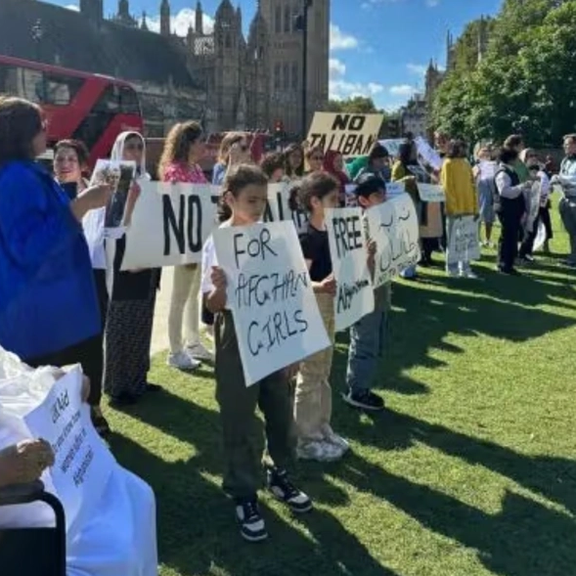
Afghan protesters are set to hold demonstrations in 14 cities across the globe from Thursday to Sunday to show solidarity with women in Afghanistan.
Afghan protesters are set to hold demonstrations in 14 cities across the globe from Thursday to Sunday to show solidarity with women in Afghanistan.
The rallies will take place in 10 countries, including Germany, Norway, the United States, Switzerland, the Netherlands, France and others, with participants opposing the Taliban and its policies.
Marking the fourth anniversary of the Taliban’s return to power, organisers have called on people in various countries to gather at designated locations.
Protests are planned in Vienna, Darmstadt, Berlin, Munich, Düsseldorf, Hamburg, Oslo, Washington, Geneva, Amsterdam, Madrid, Toronto, São Paulo and Paris.
The four-day demonstrations, running from 14 to 18 August, will denounce the Taliban’s continued rule and its restrictions on women.
Human Rights Watch has accused the United States of pursuing refugee policies that contradict its own findings on human rights abuses in Afghanistan.
In a statement, the organisation said the US State Department’s 2024 annual report on Afghanistan contains credible information about widespread violations, including arbitrary arrests, torture, mistreatment and executions, and acknowledges that the country remains a “dangerous” place.
However, HRW said Washington’s actions are inconsistent with these findings, noting that the US has moved to revoke Temporary Protected Status (TPS) for thousands of Afghan refugees. The US has taken similar steps against refugees from Haiti, Venezuela, Honduras, Nepal and Nicaragua.
TPS is granted to people in the United States who cannot safely return to their home countries due to severe human rights conditions, natural disasters, war or unrest.
In April, the Department of Homeland Security announced it was ending TPS protections for thousands of Afghans. Earlier, a federal judge authorised the process to terminate TPS for Afghan and Cameroonian migrants.
On Tuesday, the State Department released its 2024 rights report, detailing severe restrictions on women, arbitrary detentions, extrajudicial killings, and the Taliban’s repression of civil liberties and free expression. HRW said these findings should compel Washington to protect, not expel, vulnerable Afghans.
Ismail Khan, an Afghan leader, has said in a message marking the fourth anniversary of the fall of Herat to the Taliban that the group’s actions over the past four years demonstrate the “legitimacy of the resistance” by its opponents.
Ismail Khan described the fall of Herat as the result of “complex conspiracies and political deal-making,” after which Afghanistan’s major provinces fell one after another.
Herat was captured by the Taliban on 12 August, four years ago today. In his message, Ismail Khan wrote that before the city’s fall, the “Southwest People’s Resistance Movement” had been formed, and its forces had taken part in the defence of the city. However, he said, the course of events led to a “dangerous regression.”
He also described the fall of Kabul as “the end of a multi-layered intelligence project,” paid tribute to those killed during that period, and called for efforts “by every possible means” to establish a “justice-based” order.
Four years after the Taliban’s takeover of Afghanistan, families of those who plunged to their deaths while clinging to a departing US military aircraft say the trauma of that day will never fade.
In interviews with Agence France-Presse, relatives of the victims recalled the chaos of 16 August 2021, when thousands of Afghans swarmed Kabul airport after the city fell. Some, desperate to flee, clung to the fuselage of a US military plane as it took off.
Images and videos from that day showed several people falling from the aircraft mid-flight, footage that spread rapidly around the world.
Among the victims was 18-year-old Shafiullah Hotak, who had hoped to become a doctor but was working due to a lack of money for tuition. Influenced by rumours that Americans were evacuating Afghans, he told his parents that morning that he was going to America, before leaving for the airport with 50 Afghanis in his pocket.
The airport was full of families holding any scrap of paper they thought might help them leave. "Shafiullah had hope. He said that if he made it to the United States, I could stop working, that he would repay us for everything we had done for him," recalled his mother, Zar Bibi Hotak.
"I gave him his ID card and he left. Then we heard he was dead."
Relatives recognised his photo on Facebook, posted by witnesses at the airport. His body was later found on the roof of a house several kilometres from the airport.
The body of 24-year-old Fida Mohammad Amir was found in similar circumstances. His father, Payenda Mohammad Ebrahimi, said Fida despised the Taliban and left home that day pretending he had a dental appointment. Hours later, a stranger at the airport answered his phone to say Fida had fallen from the aircraft.
Zakir Anwari, whose brother Zaki was crushed under the wheels of a plane at the airport, blamed the crew for not stopping. "The planes have cameras... the pilot knew what he was doing, that it was dangerous, he could have stopped," he said.
A US military spokesperson has said the crew decided to depart as quickly as possible because the aircraft was surrounded by hundreds of Afghan civilians.
Residents of eastern Nangarhar province who were displaced by Islamic State-Khorasan (IS-K) fighting under the former Afghan republic say the Taliban have failed to deliver on promises to rebuild their destroyed homes, and infrastructure.
Civilians from Haska Mina, Achin, Spin Ghar, Kot, Naziyan and Dur Baba districts told Afghanistan International that clashes during the previous government left their homes, roads, farmland, mosques and health centres in ruins. Many remain without shelter nearly four years later.
The residents say both the former administration and the Taliban pledged reconstruction but no action has been taken. They also report that past fighting destroyed markets, halted economic activity and caused major financial losses.
Displaced families from Haska Mina said Taliban migration officials told them last year that foreign aid agencies would rebuild their areas, but they have seen no follow-up.
Some now live in camps in Kabul or in Jalalabad city, while others have returned to their devastated home areas, struggling to survive among the ruins.
Local estimates put the number of families displaced by the conflict at around 23,000. Many had fled to Pakistan but returned after Islamabad intensified deportations of Afghan migrants.
More than 6 million Afghan migrants live in Iran, including over 3 million without valid residency documents, according to figures cited by the state-run Fars News Agency.
The outlet, citing official statistics, said more than 1.14 million Afghan migrants have been deported to date. It described the presence of around 3 million undocumented Afghans as “a complex challenge with security, economic and social dimensions.”
Nader Yarahmadi, head of the Interior Ministry’s Office for Foreign Nationals and Migrants, said that by March 2024 Iran had about 2 million undocumented migrants, with a further 2.034 million added by March 2025.
Interior Minister Eskandar Momeni said the country can no longer accommodate more migrants without legal status. He claimed that over 1.1 million Afghans have left Iran during the period, more than 70 per cent of them voluntarily.
A spokesperson for Iran’s Law Enforcement Command said the policy on undocumented migrants has not changed and enforcement operations are ongoing. “Identifying undocumented migrants, arresting individuals suspected of cooperating with hostile groups, and preventing the entry of people using false identities remain priorities,” the spokesperson said.
Iranian analysts predict the deportations will continue due to economic and security pressures but say their success will depend on cooperation from the Taliban and international organisations.
Separately, Iran’s Minister of Health said Afghan patients without valid residency documents are not eligible for health insurance coverage.
