• العربية
  • پښتو
  • فارسی
Brand
  • Afghanistan
  • Sport
  • Markets
  • Afghanistan
  • Sport
  • Markets
  • Theme
  • Language
    • العربية
    • پښتو
    • فارسی
  • Afghanistan
  • Sport
  • Markets
All rights reserved for Volant Media UK Limited
volant media logo

Taliban Interior Minister Reaffirms Commitment To Doha Agreement

Aug 15, 2025, 13:29 GMT+1

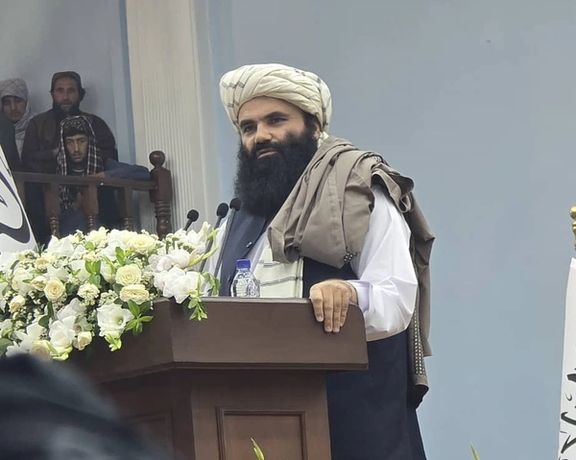
Taliban Interior Minister Sirajuddin Haqqani says the group remains committed to the Doha Agreement, rejecting allegations that Afghanistan has become a hub for international terrorism.

Speaking Friday at a ceremony marking the fourth anniversary of the Taliban’s return to power, Haqqani accused unnamed individuals of making such claims to advance their own personal interests. “If anyone has a problem with the current system, our door for dialogue is open, but they must resolve their internal issues themselves,” he said.

Haqqani did not identify any country or person, though his remarks appeared directed at Pakistan, which has repeatedly accused the Afghan Taliban of harbouring Tehreek-e-Taliban Pakistan (TTP) militants.

A recent UN expert report said the Taliban are providing a safe environment for foreign terrorist groups in Afghanistan, posing a serious threat to the security of Central Asia and beyond. The report claimed that several al-Qaeda-linked training camps are operating in the country.

Pakistan’s foreign ministry has alleged that Baloch militants and the TTP receive financial and logistical support from Afghan soil, stressing that Islamabad expects the Taliban to take decisive action against such groups.

Haqqani also urged Afghans living abroad to return, promising they could live “with dignity” and would not face questioning over their past activities.

The Doha Agreement, signed on 29 February 2020 between the Taliban and the United States, led to the withdrawal of international forces from Afghanistan and the collapse of the Western-backed Afghan government. Under the deal, the Taliban pledged that Afghan territory would not be used to threaten regional or global security and would not serve as a safe haven for terrorists. The agreement also called for intra-Afghan dialogue between the Taliban and other political and social groups.

In recent months, Taliban spokespersons have said the Doha Agreement applied to a specific phase and is no longer the group’s guiding framework.

Most Viewed

EU Parliament Approves Resolution Urging Sanctions Against Taliban Leaders
1

EU Parliament Approves Resolution Urging Sanctions Against Taliban Leaders

2

Senior Taliban Delegation Visits Turkmenistan

3

Russia & China Raise Alarm Over Terrorism Threat In Afghanistan

4

Kabul Military Airport Hit In Rocket Attack, Claims Anti-Taliban Group

5

More Than 300 Afghans Released From Pakistani Prisons

•
•
•

More Stories

Taliban Leader Removes ‘Acting’ Designation From All Government Posts

Aug 15, 2025, 11:30 GMT+1

Taliban leader Hibatullah Akhundzada has ordered the removal of the “acting” designation from all positions in the group’s administration, marking the fourth anniversary of its return to power.

In a statement released Friday, Akhundzada directed ministers and officials to stop using the term when referring to the Taliban government. Since the cabinet was announced in September 2021, its members have served as “acting” ministers, a title Taliban spokesperson Zabihullah Mujahid said in June was retained for political reasons.

“All ministers and cabinet members should avoid using the word ‘acting,’” Akhundzada said in the message, urging officials to “serve the Sharia system and Muslims.”

He described the Taliban’s return to power on 15 August 2021 as Afghanistan’s “liberation from American occupation and its allies” and claimed the country now enjoys nationwide security and has been freed from “corruption, oppression, land usurpations, narcotics, theft, looting, and plunder” under Sharia law.

Akhundzada, who has never appeared in public and communicates only through written and audio statements, also praised what he called the “sacred Sharia system” established since the end of the war.

The Taliban refer to 15 August as “Victory Day,” while many Afghans mark it as a “Dark Day” in the nation’s history.

Four years ago, then-President Ashraf Ghani fled to Uzbekistan, and later the United Arab Emirates, as the Taliban entered Kabul, sealing the collapse of the Western-backed Afghan Republic and its military. In the weeks prior, the group had already seized control of most major cities.

Since taking power, Akhundzada has issued decrees imposing sweeping restrictions, particularly on women and girls. Human rights groups have described the Taliban’s policies as a form of “gender apartheid.”

The Taliban have barred girls from attending school beyond grade six, closed universities to women, banned most forms of female employment, and prohibited women from travelling without a male guardian.

UN Admits Taliban Interference In Afghan Aid Delivery Following US Watchdog Report

Aug 15, 2025, 10:40 GMT+1

The United Nations has acknowledged that the Taliban interfere in the distribution of humanitarian aid in Afghanistan, responding to a report by the SIGAR that accused the group of diverting international assistance for its own benefit.

In a statement on Thursday, the UN said it takes the allegations “extremely seriously” and has implemented strict safeguards to protect aid deliveries.

SIGAR’s report, released Wednesday, alleged that Taliban officials have used force to seize aid and redirect it to serve their own interests. The watchdog estimated that only 30 to 40 per cent of aid sent to Afghanistan reaches the people most in need.

The report also claimed that the Taliban, in collusion with some UN officials, extort humanitarian projects. According to SIGAR, UN officials have demanded bribes from companies and NGOs seeking agency contracts, with payments calculated as a percentage of the contract value, allegedly ranging from 5 to 50 per cent.

Speaking to AFP, the UN Assistance Mission in Afghanistan (UNAMA) described aid distribution in the country as “extremely complex” and said it is aware of Taliban attempts to interfere with and restrict humanitarian work. The mission insisted, however, that it has “strong safeguards” in place to ensure assistance reaches intended recipients.

Based on interviews with 90 current and former US officials, UN officials, and Afghan aid workers, SIGAR said the Taliban “use every means at their disposal, including force” to control aid flows, directing them to areas they choose rather than those identified by donors. The report accused the Taliban of ethnic bias in distribution, favouring Pashtun-majority areas while neglecting minority communities.

Taliban Spokesperson Accuses UN Of Espionage & Crisis Fabrication

Aug 15, 2025, 09:53 GMT+1

Taliban spokesperson Zabihullah Mujahid has accused the United Nations of acting as a “spy” organisation and serving the interests of certain countries, dismissing its reports on Afghanistan’s humanitarian and economic situation as unreliable and “crisis-making.”

In an interview with Shamshad TV, Mujahid rejected international assessments of poverty and humanitarian needs in Afghanistan, insisting that Afghans have “found their own path” and that statistics from such bodies should not be trusted.

International agencies have repeatedly warned of a deepening humanitarian crisis in Afghanistan, with an estimated 23 million people in need of aid. Mujahid dismissed those figures, portraying them as part of a broader effort to misrepresent conditions in the country.

Citing the ongoing crisis in Gaza, the Taliban official claimed the UN’s inability to address that situation underscores its ineffectiveness. He alleged that the organisation engages in lobbying and manufacturing crises rather than serving humanity.

Addressing the issue of the Taliban’s lack of international recognition, Mujahid argued that foreign governments seek a dependent Afghanistan led by their proxies and compliant with their demands; a condition, he said, the Taliban will not accept.

His remarks came shortly after the US Special Inspector General for Afghanistan Reconstruction (SIGAR) alleged that the Taliban, in collusion with UN officials, had been diverting international aid.

World Must Resist Efforts To Normalise Taliban, UN Experts Warn

Aug 14, 2025, 17:13 GMT+1

On the fourth anniversary of the Taliban’s takeover of Afghanistan, UN human rights experts accused the group of gender-based persecution, widespread human rights violations, and disregard for international law.

The experts urged the world to resist any attempt to normalise the Taliban’s rule.

In a statement issued Thursday, the experts called for Taliban leaders to be held accountable, voicing alarm over the situation of women and girls, public executions, arbitrary arrests, repression of the media and human rights defenders, and discrimination against ethnic, religious, and gender minorities.

“Operating without legitimacy, the Taliban enforces an institutionalised system of gender oppression, crushes dissent, exacts reprisals, and muzzles independent media while showing outright contempt for human rights, equality and non-discrimination,” the statement read.

The experts said the Taliban’s system of discrimination and gender persecution amounts to a crime against humanity. They welcomed the issuance of arrest warrants for Taliban leaders and pledged support for all accountability efforts.

They also warned about executions, corporal punishment, mistreatment in detention facilities, enforced disappearances, restrictions on religious freedom, the targeting of minorities, and a rise in internally displaced persons.

“The situation in Afghanistan is dire,” the experts said. “But it must not be regarded as a lost cause. The international community must resist the narrative that the current situation under Taliban rule is inevitable or irreversible. Another future is possible.”

The experts urged a comprehensive approach to improving conditions, including criminalising gender apartheid, bolstering civil society, increasing humanitarian funding, and advancing the Sustainable Development Goals.

They also stressed the need to protect Afghan refugees and internally displaced persons, saying this support is critical as Pakistan and Iran intensify deportations.

Change in Afghanistan, they said, must be led by its people, warning that each day of delay “strengthens the Taliban’s oppressive grip.”
Taliban Inaugurate $117 Million Pashdan Dam In Herat

Aug 14, 2025, 15:54 GMT+1

The Taliban have inaugurated the $117 million Pashdan Dam in Herat province, a project with a storage capacity of 54 million cubic metres of water. The dam has the ability to generate two megawatts of electricity, and the potential to irrigate 13,000 hectares of farmland.

At the opening ceremony in Karukh district on Thursday, Taliban spokesperson Zabihullah Mujahid said that after ensuring security and enforcing Islamic Sharia, the group’s priority is the economy.

Several senior Taliban officials attended the event, including Deputy Prime Minister for Economic Affairs Abdul Ghani Baradar and Minister of Energy and Water Abdul Latif Mansoor. Mansoor said the dam was built with “domestic funding and without reliance on foreign aid.”

Baradar described the Pashdan Dam as vital for Herat, saying its operation would help reduce the effects of drought and address farmers’ challenges.

“We want to manage our water resources safely while also giving others their fixed rights,” he said. “Our goal in water management is to strengthen the country’s economy, and we consider water management a key measure to reduce poverty, unemployment, and migration.”

Baradar added that over the past four years, the Taliban had “achieved many accomplishments in implementing Islamic Sharia and in political and economic fields.”

The Pashdan Dam, located about 25 kilometres from Herat city, was first launched in 2011 and was expected to be completed within three years. Construction was repeatedly delayed by insurgency, but the Taliban resumed work on the project in 2024.

The project has drawn concern from Iran, whose officials have called the dam a threat. An Iranian water industry spokesperson described Afghanistan’s “unilateral” use of the Harirud River as a violation of Iran’s customary water rights.