Unidentified Drone Crashes In Maidan Wardak Province

A drone crashed on Thursday in Maidan Wardak province, sources close to the Taliban said.

A drone crashed on Thursday in Maidan Wardak province, sources close to the Taliban said.
According to the sources, the unmanned aircraft went down in Maidan Shahr, the provincial capital. The origin of the drone remains unclear.
Taliban members circulated images on social media showing the wreckage of an overturned drone lying on a snow-covered hillside, with Taliban fighters seen standing around the remains.
The cause of the crash has not yet been determined, and Taliban officials have not issued an official statement on the incident.
Taliban authorities have repeatedly acknowledged that Afghanistan’s airspace is not fully under their control.
In Aqrab, Taliban spokesperson Zabihullah Mujahid said US drones continued to conduct surveillance flights over Afghanistan. He added that American drones have been operating in Afghan airspace since the Taliban’s return to power, entering through some neighbouring countries and violating Afghanistan’s airspace.
Previously, Pakistan carried out drone strikes in parts of Khost and Nangarhar provinces, according to local officials.
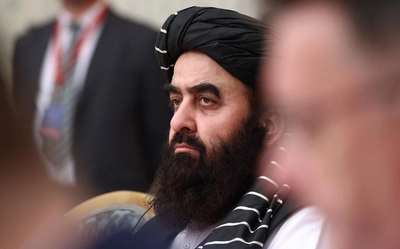
Taliban leader Hibatullah Akhundzada has reshuffled 25 officials, including provincial governors, corps commanders and senior local officials, in a move that further centralises control within the interior and defence ministries.
Taliban spokesperson Zabihullah Mujahid said the changes were ordered by Akhundzada. Under the reshuffle, Qari Gul Haidar Shafiq was appointed governor of Bamyan, while former Bamyan governor Abdullah Sarhadi was named governor of Jawzjan. The governor of Sar-e Pol was also replaced.
Ahmad Shah Dindost, former commander of the 205th Al-Badr Corps, was appointed governor of Sar-e Pol. Andar Gul Abdullah, formerly chief of staff of the 201st Khalid bin Walid Corps, was named deputy governor of Laghman.
Akhundzada also approved three new appointments in Kandahar, including a district chief, a commissioner and a military commander, and authorised 15 additional changes within the defence ministry.
Further reshuffles were made within the corps structure. The former Sar-e Pol governor was appointed commander of the 205th Al-Badr Corps, while the former deputy of Panjshir’s special brigade became deputy commander of the same corps.
Two civilian officials were also assigned to military posts. A former deputy minister for rural development was appointed chief of staff of the 217th Omari Corps, while the former head of housing and urban development in Helmand was named commander of the 2nd Infantry Brigade of the 205th Al-Badr Corps.
The appointments underscore the Taliban’s emphasis on loyalty, religious affiliation and wartime backgrounds over professional or technical expertise, and highlight the limited role of Kabul-based ministers in key decision-making.

The Taliban said six people were executed during the 2025 calendar year under orders issued by the group’s leader, while at least 1,118 others were publicly flogged by Taliban courts across Afghanistan.
Hamdullah Fitrat, the Taliban’s deputy spokesperson, said in a statement posted on X on Thursday that the executions were carried out in the provinces of Farah, Nimruz, Badghis and Khost after court rulings and approval by the Taliban leader. He said the punishments were imposed under the principle of retribution, or qisas.
According to the figures released by Fitrat, Taliban courts flogged 1,118 people over the past year on charges described as “un-Islamic acts”. These included drug trafficking and use, theft, sodomy, adultery, the use of counterfeit currency, illicit relationships and highway robbery.
Fitrat also said Taliban courts reviewed 241,799 criminal and civil cases during the year.
International organisations repeatedly condemned executions and public punishments carried out by the Taliban in 2025, particularly public floggings.
The United Nations has called for an immediate halt to what it described as inhuman punishments, including executions and corporal punishment. The UN special rapporteur on human rights in Afghanistan, Richard Bennett, has said public executions violate international human rights standards and has urged an end to the use of the death penalty.
In statements issued throughout 2025, Amnesty International criticised what it described as injustice, the absence of clear legal frameworks and the lack of fair trial guarantees, calling for increased diplomatic pressure to end rights-violating judicial practices in Afghanistan.
In its 2025 reports, Human Rights Watch warned of intensified repression and widespread violations of fundamental rights under Taliban rule, describing the judicial system as a tool of repression.
Since returning to power in August 2021, the Taliban have executed at least 12 people in the provinces of Farah, Laghman, Ghazni, Jowzjan, Badghis and Nimruz, often in public and in the presence of large crowds.
The most recent execution took place in Khost province in December 2025, according to Taliban officials.

The Taliban’s Supreme Court said on Thursday that a man in northern Balkh province was publicly flogged with 39 lashes after being convicted of selling alcoholic beverages.
According to the court, a primary court in Balkh also sentenced the man to one year and 10 months in prison.
The Taliban describes public flogging as the “implementation of sharia” law and routinely carries out corporal punishment against individuals convicted by its courts.
A recent report by the United Nations found that over a three-month period between August 1 and October 31, 2025, the Taliban publicly flogged at least 215 people across several provinces. Those punished included 44 women and 171 men.
Despite sustained opposition from international organisations to corporal punishment, torture and intimidation, the Taliban have continued to enforce public floggings since returning to power.

The US State Department has said that Zalmay Khalilzad does not represent the United States, following his recent meeting with Taliban Foreign Minister Amir Khan Muttaqi in Kabul.
In comments to Afghanistan International on Wednesday, the department said Khalilzad is not a US government employee and that his recent activities are carried out in a personal capacity.
The Taliban’s Ministry of Foreign Affairs said on Sunday that Khalilzad, the former US special envoy for Afghanistan, had arrived in Kabul and met Muttaqi.
After the meeting, Muttaqi said that engagement between the Taliban and the United States had effectively entered a new phase following the withdrawal of foreign forces and the end of the war in Afghanistan.
The Taliban’s decision to receive Khalilzad at the level of foreign minister suggested the group views him as a potential intermediary, relying on his experience and contacts to help improve relations between the Taliban and Washington.
However, the US State Department dismissed such assumptions. Speaking to Tajuddin Soroush, a reporter for Afghanistan International, a spokesperson said Zalmay Khalilzad is not an employee of the US government and therefore does not represent it.
The spokesperson added that all of his activities are undertaken in a personal capacity.
Khalilzad has previously travelled to Afghanistan with US officials to help secure the release of American prisoners held by the Taliban.
According to the Taliban, Muttaqi told Khalilzad that opportunities exist in several areas to expand relations between the two sides and that sustained dialogue could help advance those efforts.

The Taliban’s Committee for the Prevention of Land Grabbing has ordered the cancellation of all lease and investment contracts linked to Mohammad Mirza Katawazai, a former deputy speaker of Afghanistan’s House of Representatives.
According to documents obtained by Afghanistan International, the order, issued by the Taliban commission, targets contracts held by Katawazai and his business partners and marks the latest move by the authorities against figures associated with the former Afghan government.
The letter, dated December 31 and signed by Abdul Hakim Sharae, head of the Taliban’s Commission for the Prevention of Land Grabbing, accuses Katawazai of corruption, land grabbing, and involvement in drug, gold and foreign currency smuggling.
The document instructs the Oil and Gas Directorate to immediately cancel all lease and investment contracts with Katawazai and his partners and to submit a report on the actions taken to the commission. It further states that all Taliban departments are required to cooperate fully in implementing the order.
According to the letter, all contracts concluded with Katawazai, as well as those involving his sons, brothers, cousins and other partners, must be annulled. It also says an arrest warrant has been issued for Katawazai and that he is now under judicial pursuit.
Last year, the Taliban arrested 20 associates of Katawazai on charges of “forging land documents,” according to sources. They said the arrests were carried out on the orders of the Taliban’s justice minister and that the individuals were transferred to prison.
Reports indicate that Katawazai has close ties to Sirajuddin Haqqani, the Taliban’s interior minister, and to figures linked to that faction within the Taliban. Abdul Hakim Sharae is regarded as an opponent of Haqqani and is believed to have sought to curb the financial networks and influence associated with him.
