Kabul Retirees Protest Again After Four Years Without Pensions

Retirees in Kabul staged another protest on Saturday, demanding payment of pensions they say have been withheld for four years.

Retirees in Kabul staged another protest on Saturday, demanding payment of pensions they say have been withheld for four years.
The group gathered outside the General Directorate of the Pension Fund, accusing the Taliban of ignoring their repeated demonstrations and failing to address their claims.
Abdul Wasi, one of the protesters, said he has lived without pay since 2021 and has no idea how much longer he must wait. He accused pension officials of deliberately delaying payments and evading responsibility.
The retirees said they timed their latest protest with the fourth anniversary of Taliban rule, hoping their appeals would reach the group’s leadership. Former government employees warned they will continue demonstrations until their pensions are restored.
More than 160,000 retirees regularly received pensions before the Taliban takeover, but the system has since been halted. In December 2023, Taliban leader Hibatullah Akhundzada issued an eight-article decree instructing retirees to apply to special courts to claim benefits. The process has yet to be implemented, and no payments have been made.
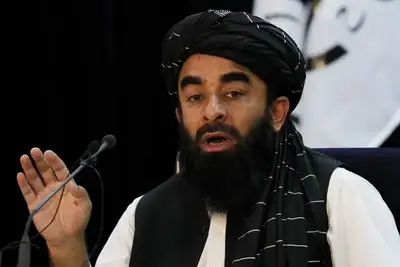

The Taliban’s Ministry of Refugees and Repatriation said Farid Mamundzay, the final ambassador of Afghanistan’s former government in New Delhi, has returned to Kabul and met with Mawlawi Abdul Kabir.
In a statement, the ministry said Mamundzay praised the Taliban’s cooperation and described Afghanistan’s current security situation as significant for the country’s future.
Abdul Kabir reportedly told him that following the Taliban’s declaration of a “general amnesty,” no one would be questioned over past roles and that “no one would dare to do so.”
However, international human rights organisations have repeatedly challenged Taliban assurances, documenting cases in which former soldiers and officials have been detained, tortured or killed. Rights groups say many employees of the former government were forced to flee Afghanistan after the Taliban seized power in 2021.

The UN Refugee Agency (UNHCR) has warned that funding to support Afghan families returning from Iran and Pakistan is rapidly running out, leaving many facing an uncertain future.
In a statement on Sunday, the agency said returnees were struggling to rebuild their lives amid growing humanitarian needs inside Afghanistan.
UN Secretary-General spokesperson Stéphane Dujarric said that 1.7 million Afghans have returned from the two neighbouring countries since the start of this year. He noted that most had limited ties to local communities and were finding it difficult to secure shelter and livelihoods.
Citing the UN Office for the Coordination of Humanitarian Affairs (OCHA), Dujarric stressed that additional funding for Afghanistan remains urgent. OCHA had already warned in June that aid operations in the country were facing a severe budget shortfall.

Pakistani officials and a broad group of Afghan opposition figures, including young leaders, women’s rights activists, and political representatives, are set to gather in Islamabad for a two-day conference on August 25–26.
The event, titled “Towards Unity and Trust,” will be the first public meeting of Afghanistan’s diverse political factions hosted in Pakistan since the Taliban’s return to power in 2021. It is organised by the South Asian Strategic Stability Institute in collaboration with Women for Afghanistan, which described the initiative as academic and trust-building rather than political.
According sources who spoke to Afghanistan International, participants will include Geneva-based Afghan envoy Nasir Ahmad Andisha; former economy minister Mustafa Mastoor; women’s rights activist and ex-MP Fawzia Koofi; Habib-ur-Rahman Hekmatyar son of Hizbe Islami leader; Hussein Yasa, spokesperson for the National Resistance Council for Salvation of Afghanistan; Zahra Joya, founder of Rukhshana Media; and Mawlawi Abdullah Qarluq, former governor of Takhar.
The Taliban and their allies have opposed the gathering, but sources said Islamabad has stressed that the group does not represent all Afghans. “This could mark a fundamental change in Pakistan’s stance, showing that Islamabad now wants to view Afghanistan not through the lens of one group, but as it really is,” one informed source told Afghanistan International.
Khalilzad Criticises Conference
Former US envoy to Afghanistan Zalmay Khalilzad criticised Pakistan’s hosting of the meeting, warning that some participants back the violent overthrow of the Taliban. On X, he called the move “immature, irresponsible and unfortunate,” describing it as a provocation that would deepen mistrust between Kabul and Islamabad.
He added he would view it the same way if the Taliban hosted Pakistanis seeking to topple their country’s military-led government.
Women’s Rights Groups Welcome Initiative
Fawzia Koofi welcomed the meeting, calling it an opportunity to build trust between Afghans and Pakistanis. She stressed the importance of including women, political figures and civil society in shaping Afghanistan’s future, noting that Afghan women live under “one of the most repressive realities in the world today.”
Responding indirectly to Khalilzad’s criticism, she wrote on X: “Some former diplomats object, is it because they want to be the architects of our country’s destiny forever? Isn’t it time to let us craft what is good for us?”
Taliban–Pakistan Relations Strained
The conference comes amid growing tension between Pakistan and the Afghan Taliban. Islamabad has accused Kabul of harbouring fighters from Tehreek-e-Taliban Pakistan (TTP), which has escalated cross-border attacks; claims the Taliban deny.

A senior adviser to former Afghan president Ashraf Ghani has claimed that secret annexes to the 2020 Doha Agreement between the United States and the Taliban outlined the transfer of power, sidelining the Kabul government in the process.
Fazl Mahmood Fazli, who also headed the Office of Administrative Affairs under Ghani, made the remarks in an article for Afghanistan International titled “From the 1990s to Taliban Oppression: Lessons from Afghanistan’s Political Failures and the Way Forward.”
Fazli wrote that prior to the collapse of the republic in August 2021, Washington prevented Afghan air force transport and combat aircraft sent abroad for maintenance from returning home. By July of that year, some Afghan officers had already been told they and their families would be relocated to the United States, he said.
Citing these moves, Fazli argued the republic order's downfall was primarily political, not military, because “ownership of the system did not rest with Afghans.” He said the government had been marginalised during the Doha negotiations, while “warlords” speculated in foreign capitals about their future roles in a new Taliban-led order.
He also noted that just two months before the fall, more than 100 American logistics contractors left Afghanistan without handing over responsibilities, creating an abrupt supply crisis for Afghan security forces.
While acknowledging that the Ghani administration could have sought internal consensus, Fazli maintained such efforts were futile, given the absence of widely accepted laws and political foundations and the overwhelming influence of the United States.

Four years after the Taliban’s return to power, more than half of Afghanistan’s population is in need of life-saving assistance, the United Nations said Friday.
UN Secretary-General’s spokesperson Stéphane Dujarric told reporters that Afghan women and girls remain especially vulnerable under Taliban restrictions barring them from education, employment and public life. He described aid directed at women and girls as a critical lifeline.
Dujarric also warned that the return of 1.7 million Afghans from Iran and Pakistan since the beginning of the year has sharply increased humanitarian needs. Most returnees, he said, have limited ties to local communities and are struggling to find shelter and livelihoods.
The UN Central Emergency Response Fund (CERF) has allocated $10 million to support returnees, while additional funding from the Afghanistan Humanitarian Fund is under review.
Citing the UN Office for the Coordination of Humanitarian Affairs (OCHA), Dujarric said more humanitarian funding for Afghanistan remains urgent. OCHA had already warned in June that operations in the country face severe budget shortfalls.