Taliban Seeks Joint Commission With China To Boost Trade
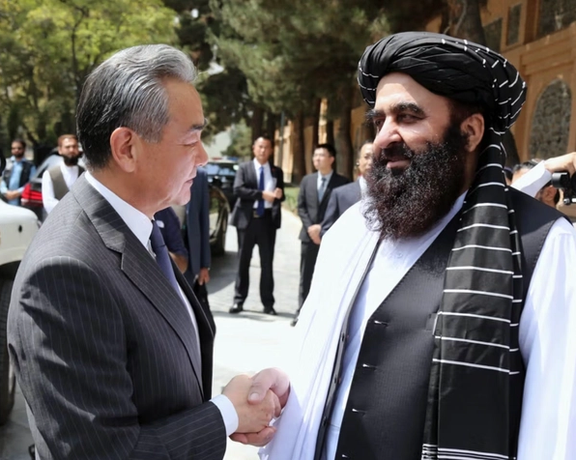
The Taliban said Wednesday that its foreign minister, Amir Khan Muttaqi, has proposed creating a joint technical commission with China to expand economic cooperation.
The Taliban said Wednesday that its foreign minister, Amir Khan Muttaqi, has proposed creating a joint technical commission with China to expand economic cooperation.
Muttaqi made the request during talks in Kabul with Chinese Foreign Minister Wang Yi, held on the sidelines of a trilateral summit with Pakistan.
The Taliban Foreign Ministry said the meeting covered transit cooperation, banking ties, and efforts to balance trade. Muttaqi described China as a “good commercial partner” and expressed hope that trade between the two countries would grow significantly in the near future. He also assured that Afghan soil would not be used against neighbouring states.
According to the Taliban, Wang Yi said Beijing views relations with Afghanistan as developing and highlighted the importance of expanding cooperation in multiple sectors. He added that China is working with Taliban authorities to boost exports, remove barriers to Afghan agricultural products, and integrate Afghanistan into regional transit projects.
The Taliban statement said Wang pledged Chinese support for Afghanistan’s economy and promised practical steps this year on mining projects, including surveying and extraction of mineral resources.
The trilateral talks in Kabul also brought together Pakistan’s foreign minister, Ishaq Dar, who separately met Muttaqi to discuss bilateral issues. A Taliban spokesperson earlier said the three-way meeting would focus on strengthening political, economic, and regional cooperation.

Civil organisations representing Afghanistan’s Turkic communities say the Taliban have demolished the statue of renowned poet and scholar Alisher Navai in Mazar-e-Sharif.
They condemned the act as part of what they described as the Taliban’s ongoing “anti-cultural and identity-erasing” agenda.
In a joint statement issued Wednesday, 20 organisations said the demolition was “a blatant attack on the collective memory of the people and a part of Afghanistan’s shared identity.” They warned that the destruction of cultural symbols and historical heritage was harming the country’s history and diversity.
The groups urged UNESCO, international cultural institutions, and human rights defenders to take urgent steps to protect Afghanistan’s heritage.
Alisher Navai, a prominent poet, scholar and politician of the Timurid era, had been commemorated with the statue about 17 years ago by the municipality of Mazar-e-Sharif.
Reports of partial damage to the statue had surfaced earlier, but local activists said it has now been destroyed completely. Taliban officials have not commented.
The demolition has sparked strong reactions on social media. Abdulhanan Arslan, an Uzbek literature professor at Kabul University, described the act as “unfair” and called for transparency.
Over the past four years, the Taliban have repeatedly removed monuments and images of mujahideen leaders and other urban symbols across the country.
Coinciding with the fourth anniversary of the Taliban’s return to power, the Afghanistan War Commission in the US Congress released its second report on the United States’ 20-year war in Afghanistan.
US officials emphasised that the roots of failure in the war lay in strategic weaknesses rather than tactical shortcomings.
The Afghanistan War Commission is an independent body established by the US Congress in 2021.
Dependency of Afghan Institutions
According to the report, despite US policy promoting the independence of Afghan institutions, they remained overly dependent. This outcome contradicted Washington’s stated plan. The Commission noted that US financial, technical, and security assistance was delivered through mechanisms that, whether intentionally or not, fostered dependency within Afghan institutions. Yet, US policy had identified Afghan self-reliance as a key condition for ending the war.
The report added that capacity-building methods, often relying on parallel delivery systems led by contractors, US agencies, and military units, sidestepped Afghan officials. This approach may have weakened Afghanistan’s sovereignty and contributed to lasting institutional fragility.
The Commission is examining how, with the beginning of the US troop withdrawal, this institutional dependency affected the situation. According to the report, the same reliance was evident in Afghanistan’s security institutions, which depended on external support systems and lacked the ability to operate independently.
As peace talks in Doha began, the US gradually reduced support to Afghan security forces, undermining their ability to confront the Taliban.
The Late Start of Peace Talks
The report also addressed the failure of peace negotiations. Talks with the Taliban, it said, began far too late, only after the US had already minimised its troop presence. By then, Washington no longer had the leverage needed to pressure the Taliban.
The report recalled that in the early years of the war, the US viewed the Taliban and al-Qaeda as inseparable. It pointed to missed opportunities to engage the Taliban after their removal from power.
Overall, US policy in Afghanistan was described as ambiguous: the US initially invaded to fight terrorism and destroy al-Qaeda but soon shifted to state-building. At first, Afghans welcomed US involvement, but over time dissatisfaction grew.
Pakistan’s Double Standard
Citing former Afghan and US officials, the report highlighted Pakistan’s double standard. While Islamabad cooperated by opening transit routes for US forces and suppressing al-Qaeda, it consistently denied the existence of Taliban sanctuaries on its soil throughout the 20-year US presence. This undercut counterterrorism efforts and thwarted international objectives in Afghanistan.
The Commission referenced President Joe Biden’s justification for the US withdrawal, questioning: if the US could ensure its security without a military presence in Afghanistan and prevent another 9/11-style attack, why did it support the Afghan government for two decades?
According to the report, the decision to withdraw eroded Afghan forces’ confidence, emboldened the Taliban, and, with Ashraf Ghani’s flight, allowed the Taliban to seize Kabul without firing a shot.
After deciding to withdraw fully, Biden stated that the threat from Afghan soil had been neutralised, arguing that the US could pre-empt threats without maintaining troops in the country.
Afghan and US Perspectives
The Commission interviewed dozens of former Afghan and US officials. Afghans told the Commission that in the early years, the international presence created hope for training and progress, but this optimism later faded. They believe the US avoided key steps to sustain the Afghan state, especially by failing to pressure Pakistan, which used the Taliban as a proxy force.
They added that after 9/11, US policy viewed Afghanistan as an “ungoverned space” and overlooked existing local governance structures, such as community councils, in favour of a centralised model. Early Afghan optimism was replaced with the perception of “America’s war,” as dependency deepened. Deeper issues, such as national identity, political Islam, and governance models, were never meaningfully addressed. Reforms often catered more to international optics than Afghan needs, ignoring local experiences, especially in areas like women’s rights.
Conflicting Priorities
According to the report, military priorities often clashed with the missions of USAID and the State Department, undermining a whole-of-government approach. Within the Department of Defense and among allies, the lack of a unified command structure, unclear end goals, and contradictory missions, ranging from counterinsurgency to counterterrorism, allowed regional commanders to shape priorities more than any coherent top-down strategy.
Political Division and Fragility
The report also addressed corruption, political disunity, and public discontent. The 2014 presidential election sowed division and doubts about the legitimacy of the future government, prompting significant US diplomatic intervention.
Highlighting the ambiguity of US policy, the report noted that while the United States reduced both its military and civilian presence, it simultaneously signed agreements pledging long-term support to Afghanistan. Some US civilian and military officials said that in the United States the mission in Afghanistan was either never fully understood or forgotten.
Systemic Corruption
The report stated that corruption and impunity became defining features of the post-Taliban government, fuelling widespread public discontent. Civilian casualties from US night raids and airstrikes further inflamed anger.
For two decades, Afghanistan ranked among the most corrupt countries in the world.
Douglas Lute, a former US official, said: “I believe the roots of our failure in Afghanistan lay at the strategic level, not at the tactical level where our troops, intelligence officers, diplomats, and development officers on the ground sacrificed in the toughest conditions.”
David Sedney, former Deputy Assistant Secretary of Defense for Afghanistan, Pakistan, and Central Asia, said: “We sought an Afghanistan that would not be a home for terror, one where Americans and our allies would be safer, and in which the Afghan people would have the future they deserved.
He added: “For why we failed there is no simple, easily identifiable answer. There is no single villain. There is no one policy error, which, if gotten right, would have led to success.”
Terror Groups Regrouping
Four years after the US withdrawal, according to independent international organisations, Afghanistan has once again become a safe haven for terrorist groups. Recently, UN experts warned that ISIS-Khorasan poses a serious threat to the US and Europe. Al-Qaeda, the Taliban’s ally and the original cause of America’s 20-year war in Afghanistan, is attempting to regroup and revive itself.
At least 71 people, including 17 children, were killed when a passenger bus carrying Afghan migrants deported from Iran collided with a truck and a motorcycle on a highway in western Afghanistan, officials said Tuesday.
The crash happened Monday on the Herat–Islam Qala road in Guzara district, Taliban authorities said. The bus, travelling from Islam Qala toward Kabul, burst into flames after hitting a motorcycle and then a fuel truck. Three survivors were critically injured.
Taliban police blamed the accident on the bus driver’s “high speed and recklessness.” Mohammad Yousuf Saeedi, spokesman for the Taliban-appointed governor of Herat, told Agence France-Presse the passengers had recently been expelled from Iran and were en route to Kabul.
Iran has deported hundreds of thousands of Afghans this year, many of whom are temporarily housed in camps near the Islam Qala border crossing before being transferred to other provinces.
Traffic accidents are common in Afghanistan, where roads remain damaged by years of war, driving rules are rarely enforced, and poorly maintained vehicles crowd major highways. Last year, 52 people were killed in two separate crashes involving a fuel tanker and a truck on a central Afghan highway.
Pakistan’s Foreign Ministry said Tuesday that Foreign Minister Ishaq Dar will travel to Kabul on Wednesday for trilateral talks with his Chinese and Taliban counterparts focused on counterterrorism and trade.
The ministry said Dar will also meet separately with Taliban Foreign Minister Amir Khan Muttaqi to discuss bilateral issues.
The Taliban’s Foreign Ministry confirmed that Chinese Foreign Minister Wang Yi will attend the meeting, which marks the second trilateral engagement this year after a May session in Beijing.
The talks come as Pakistan prepares to host a gathering of Afghan opposition figures in Islamabad in the coming days, a move the Taliban has opposed but which analysts say underscores Islamabad’s pressure on the group over its policies and ties to anti-Pakistan militants.
Former Afghan president Hamid Karzai said the future of Afghanistan’s freedom and independence depends on access to education.
In a message marking the 106th anniversary of Afghanistan’s independence, Karzai said national strength stems from “unity and an educated workforce.” He stressed that such strength is only possible if both boys and girls are given equal opportunities to study.
Karzai urged Afghan youth to pursue education with determination and compete in gaining knowledge and expertise, saying this would secure a brighter future for the nation.
The Taliban, who returned to power in 2021, barred girls above sixth grade from attending school just months after seizing control. Their sweeping restrictions on women over the past four years have drawn sharp criticism from the international community and human rights organisations.
The Taliban’s refusal to ease curbs on women has prevented their administration from securing international recognition. So far, Russia is the only country to have formally recognised the regime.