Taliban Confirms New Pakistani Airstrikes On Kabul

The Taliban confirmed new Pakistani airstrikes on Kabul. However, Khalid Zadran, the Taliban’s police spokesperson in Kabul, said in a post on X that the situation in the capital was normal.

The Taliban confirmed new Pakistani airstrikes on Kabul. However, Khalid Zadran, the Taliban’s police spokesperson in Kabul, said in a post on X that the situation in the capital was normal.
Earlier, sources told Afghanistan International that loud explosions and gunfire were heard across Kabul early on Monday, as clashes between the Taliban and Pakistan continued.
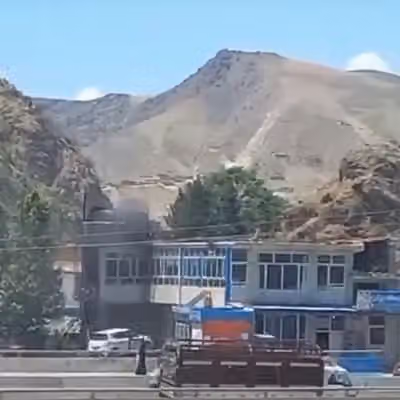
The latest wave of clashes between the Taliban and Pakistan has entered a fifth day, with fighting continuing along the Durand Line.
Evening of 24 February
Taliban forces launched what they described as large-scale retaliatory attacks on Pakistani border posts and positions along the frontier, mainly in eastern and south-eastern Afghanistan.
The Taliban said the operation was in response to earlier Pakistani airstrikes, particularly those carried out on 21 February, which Islamabad said targeted sanctuaries of Tehreek-e-Taliban Pakistan inside Afghanistan. The United Nations confirmed that civilians were among the casualties.
Pakistan described the Taliban’s attacks as unjustified and a miscalculation and responded with what it called an immediate and forceful reply.
Early Morning of 25 February
Pakistan’s armed forces launched extensive air operations against Taliban positions inside Afghanistan.
The strikes, carried out mainly by fighter jets and drones, targeted what Pakistan described as Taliban military sites from Kabul to Kandahar, the group’s traditional stronghold.
In Kabul, areas in the west and around the city, including ammunition depots and Taliban facilities in Darulaman and Pul-e-Charkhi, were reportedly struck.
Kandahar, home to Taliban leader Hibatullah Akhundzada, was also hit, along with other border provinces.
Pakistan named the operation “Ghazb lil Haq” and described it as a direct response to Taliban attacks. Khawaja Muhammad Asif, Pakistan's defense minister, declared what he called an open war against the Taliban, saying Pakistan’s patience had run out and accusing the group of acting as a proxy for India.
Taliban spokesperson Zabihullah Mujahid confirmed that Pakistan had bombed sites in Kabul, Kandahar and Paktia Province. The Taliban said they had launched retaliatory operations along the Kandahar and Helmand Province axes and in eastern border areas, claiming to have seized or destroyed several Pakistani posts and inflicted heavy losses.
The Taliban later said they were ready for negotiations while continuing to resist.
26 February
Taliban forces resumed intensified attacks along the Durand Line, particularly in Khost, Nangarhar, Paktika and Kunar Provinces.
A Taliban official in Khost said attacks had begun on Pakistani posts in the districts of Zazi Maidan, Ali Sher and Terezai, claiming several posts were captured or destroyed.
Pakistan responded with air and artillery strikes on Taliban positions in border areas. Reports indicated renewed bombardment in Nangarhar and around Kabul, though less intense than the previous day.
The United Nations and Russia urged both sides to implement an immediate ceasefire and turn to diplomacy, as concerns mounted over civilian harm.
In the following days, exchanges of fire and retaliatory strikes continued along the frontier. Pakistan said it had inflicted heavy casualties on Taliban forces and destroyed dozens of their bases. The Taliban made similar claims regarding Pakistani forces.
On March 2, Kabul residents again reported Pakistani aircraft overhead and reciprocal Taliban fire. The situation remains fragile, with many border crossings closed and diplomatic efforts by regional and international actors ongoing to prevent further escalation.
Disputes over casualty figures and damage have made independent verification of the full extent of the fighting difficult.
Local sources in Herat Province told Afghanistan International that fighter aircraft were seen patrolling the skies over the province on Sunday night.
At the same time, a Taliban official reported an attack on Pakistani positions at the Angoor Ada border crossing in the Barmal district of Paktika Province.
Ahmadullah Muttaqi, head of information and culture for the Taliban in Herat, posted a video on X that he said showed the group’s forces attacking Pakistani positions at Angoor Ada. The footage appears to show Taliban fighters using heavy weapons at night against what were described as Pakistani military posts.
Residents of Herat said drones remained in the province’s airspace and that gunfire was heard for several minutes.
A source near the Islam Qala crossing said at least two explosions were heard following the aircraft activity. Taliban authorities have not commented on the identity of the aircraft or the cause of the reported gunfire in the province.
Attaullah Tarar, Pakistan’s minister for information and broadcasting, said that by 9 a.m. on Saturday at least 331 militants had been killed and more than 500 wounded in recent clashes.
In a statement posted on X on 28 February, Tarar said those killed included members of the Afghan Taliban, Tehreek-e-Taliban Pakistan and other armed groups.
He said Pakistani forces had destroyed 104 Taliban bases, seized 22 others and disabled 163 tanks and armoured vehicles.
Tarar added that airstrikes had been carried out at 37 locations inside Afghanistan.
According to Pakistani officials, the operations took place in the provinces of Nangarhar, Kandahar and Paktia , as well as in parts of Pakistan’s Chitral District.
The European Union has urged the Taliban to prevent militant groups from using Afghanistan as a base, warning that rising tensions with Pakistan could have serious regional consequences.
In a statement issued on Saturday, the EU expressed concern over escalating tensions between the Taliban and Pakistan, saying Afghan territory must not be used to threaten or attack other countries.
The bloc called on the Taliban authorities to take effective action against all militant groups operating in Afghanistan and to ensure the country’s territory is not used against neighbouring states.
The statement warned that continued tensions could have serious implications for the wider region and urged both sides to de-escalate immediately and halt hostilities.
Pakistan has repeatedly alleged that groups opposed to it, including Tehreek-e-Taliban Pakistan and some Baloch separatist organisations, operate from Afghan territory. The Taliban have consistently denied the claims. The United Nations Security Council has also previously expressed concern about militant groups using Afghanistan as a base.
The EU further called on both parties to engage in dialogue and stressed that international law, including humanitarian law, must be fully respected by all sides. It said the protection of civilians and civilian infrastructure must be ensured and that all possible measures should be taken to prevent further harm.
Earlier, the United States voiced support for Pakistan’s counterterrorism efforts, while China also said it backs Pakistan in combating terrorism.
As tensions escalate between the Taliban and Pakistan, Bakhtiyor Saidov, Uzbekistan’s foreign minister, held a telephone conversation with Amir Khan Muttaqi.
According to a statement from the Taliban’s Foreign Ministry, Saidov stressed that diplomacy is the only solution to the conflict.
Muttaqi said the Taliban’s recent security measures were carried out solely to defend Afghanistan’s sovereignty, territorial integrity and airspace.
He added that the Taliban believe in resolving disputes through understanding and negotiation, but warned that they consider defence of the country’s territory to be their legitimate right in the event of any aggression.
The Taliban statement also said the Uzbek foreign minister described diplomacy as the only effective way to manage the current situation and expressed readiness to play a practical role in future efforts.