Taliban Sign Deal To Generate 10,000 Megawatts Of Power
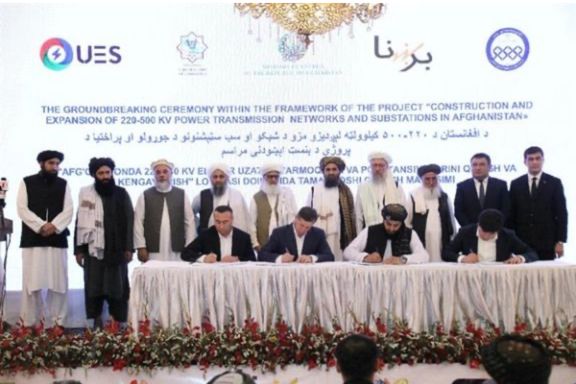
Afghanistan’s state-owned electricity company, Breshna, now under Taliban control, said Saturday it has signed agreements with private firms to generate 9,407 megawatts of power.
Afghanistan’s state-owned electricity company, Breshna, now under Taliban control, said Saturday it has signed agreements with private firms to generate 9,407 megawatts of power.
The signing ceremony, held at Kabul’s Intercontinental Hotel, was attended by the energy ministers of Uzbekistan and Turkmenistan and the head of Tajikistan’s electricity company.
The office of Abdul Ghani Baradar, the Taliban’s deputy prime minister, said work on projects agreed with Uzbekistan also began Saturday.
According to Breshna, the projects include boosting the capacity of the 500-kilovolt Surkhan–Pul-e-Khumri transmission line, expanding the Dasht-e-Alwan and Arghandi substations, and extending the 220-kilovolt line to the Sheikh Mesri substation in Nangarhar.
Afghanistan imports most of its electricity, primarily from Uzbekistan, Tajikistan and Iran. The reliance has led to shortages and lengthy power cuts, particularly in some seasons. Four years into Taliban rule and despite repeated promises, shortages persist, with some areas receiving electricity for only 12 hours a day.
The Taliban’s Ministry of the Propagation of Virtue and Prevention of Vice announced Friday that it had arrested Sufi leader Ibrahim Gailani, a senior figure in the Qadiri order, along with several of his followers.
Saif Khyber, a ministry spokesperson, accused Gailani of “misusing Sufism” and said the group was carrying out “practices contrary to Sharia under the cover of religion.”
The ministry said it was responsible for the “intellectual and ideological reform of society” to prevent the spread of “false ideas and misguided beliefs.” In a statement, it added: “Every faithful Muslim is obliged to protect society from practices that contradict the principles of Sharia and the Hanafi school of jurisprudence.” The statement also claimed that Afghanistan is an Islamic country where all citizens are Muslims and followers of the Hanafi school.
That assertion does not reflect the country’s religious diversity. Afghanistan is also home to Shia Muslims, Ismailis, and Hindu and Sikh minorities. Since returning to power in August 2021, the Taliban has revoked official recognition of other faiths and sects.
Khyber published a letter on his social media account on X, bearing Gailani’s signature, in which he pledged not to engage in “acts of vice” and to align his conduct with Sharia. The letter stated Gilani would “have no right to complain” if he violated the pledge. It is unclear whether he was released after signing the letter.
The ministry warned it would not allow the “misuse of religion or Sufism” for acts deemed contrary to Islamic law.
Over the past four years, the Taliban has cracked down on individuals accused of following Salafism or holding beliefs that contradict its ideology. In some regions, residents have reported being forced to convert.
Who is Ibrahim Gilani?
Sayed Mohammad Ibrahim Gailani, known as Pir Ibrahim Baba, is the nephew of Pir Sayed Ahmad Gailani, former head of the Qadiri Sufi order. His lineage traces back to the prominent Sufi Abdul Qadir Gailani, founder of the Qadiri order.
Sayed Ahmad Gailani, a former jihadist leader, served as head of the High Peace Council during Afghanistan’s National Unity Government before his death in January 2017.
The Taliban previously detained Ibrahim Gailani in July 2022 in Paktia province.
Nearly half of Afghan men are enforcing the Taliban’s Propagation of Virtue and Prevention of Vice law on their families, according to a new report by the UN Human Rights Office.
The report, released Saturday, said the controversial law is being implemented not only by Taliban officials but also through social pressure from relatives, neighbours and community leaders. A UN survey found that enforcement by male family members has doubled over the past year, rising from 22 precent to 44 precent.
The Taliban has also expanded its official enforcement network, recruiting more than 2,300 morality police with broad authority to detain people accused of violations. These enforcers, with offices across Afghanistan, strictly monitor citizens’ behaviour, dress and public conduct.
The UN report, to be presented to the Human Rights Council, said the law has deepened gender discrimination, entrenched submission within families and spread fear throughout society.
The report stated that the Vice and Virtue law reflects the Taliban leadership’s determination to impose their vision of a pure Islamic system across the country.
The Human Rights Office warned that the law has formalised the Taliban’s strict interpretation of Islam and sharply restricted personal freedoms, particularly for women. Victims of gender-based violence, it said, face “severe obstacles” in seeking justice, while Taliban officials have also been implicated in cases of forced marriage.
The report noted that Afghans continue to face overlapping crises, including economic collapse, unemployment, limited access to healthcare and the effects of climate change. The return of more than two million migrants in the past six months has further strained resources, worsening what the UN described as an already dire humanitarian situation.
The Taliban governor’s office in Nangarhar has warned aid organisations not to photograph women or take actions that could provoke public “sensitivities” while assisting earthquake survivors.
In a statement issued Saturday, the office urged aid groups to fully respect “Afghan and Islamic values” during relief work. “It is strongly advised that during aid distribution to earthquake victims, taking photos of women should be strictly avoided,” the statement said.
The office did not define “sensitivities,” but restrictions enforced by the Taliban’s Ministry for the Propagation of Virtue and Prevention of Vice have made it nearly impossible for male aid workers to assist women. Under Taliban rules, men cannot provide help to women who are not relatives or even speak to them.
Because of the Taliban’s restrictions on women’s employment, few female aid workers have been able to reach Kunar and Nangarhar to provide assistance.
Local sources in Kunar told Afghanistan International that at least six pregnant women have died in hospitals since the earthquake because of a lack of female medical staff and inadequate facilities.
Despite broad pledges of support, basic aid particularly medical assistance has yet to reach many affected areas, leaving residents struggling, the sources said.
Residents said Taliban restrictions have led to men being prioritised in rescue and treatment efforts, while women often had less opportunity to seek care.
“There are very few female medical teams, and many women died because unrelated men were not allowed to pull them from under the rubble,” a health official in Kunar said. “By the third day, some families were forced to send women with midwifery training into quake-hit areas.”
A representative of the UN Development Programme in Afghanistan warned that Taliban restrictions on women’s work have slowed recovery efforts after the earthquake.
Pakistan’s Foreign Ministry said Friday that Taliban Defence Minister Mullah Yaqoob’s criticism of Pakistan’s security forces cannot obscure the presence of militant sanctuaries in Afghanistan.
In a statement, the ministry described Yaqoob’s recent comments as a repetition of taunts and jibes and said: “Whatever the statement issued from the other side, it cannot mask the seriousness of this issue,” It added that the Taliban cannot deny the presence of anti-Pakistan militants on Afghan soil.
The ministry reiterated that sanctuaries for militant groups, particularly Tehreek-e-Taliban Pakistan (TTP), remain a “serious concern” and said the matter has been raised “with utmost seriousness” in high-level discussions between Taliban and Pakistani officials.
It said the continued presence of militants in Afghanistan is a major issue disrupting bilateral relations and a “main obstacle” to greater engagement. Pakistan urged the Taliban to address what it called a “very serious issue.”
Yaqoob said in a recent television interview that Pakistan blames Afghanistan for attacks on its soil to hide the weaknesses of its security forces. He argued that the attacks occur hundreds of kilometres from the Afghan border. He also acknowledged that tense relations between the neighbours are harming both countries.
International organisations estimate that about 6,000 Pakistani Taliban fighters are currently based in Afghanistan, where TTP militants and other extremist groups are reported to receive training.
Roza Otunbayeva, the UN Secretary-General’s special representative for Afghanistan, has concluded her mission, the United Nations said Friday.
Otunbayeva, who also headed the UN Assistance Mission in Afghanistan (UNAMA), met with Taliban refugee minister Abdul Kabir in Kabul for a farewell meeting. Kabir thanked her for her efforts during her tenure and praised the UN’s work in the country.
The Taliban’s Ministry of Refugees said the meeting was held to mark the end of her assignment. According to the ministry, Otunbayeva reaffirmed the UN’s commitment to humanitarian aid, noting that 25 UN teams have been deployed to quake-hit areas and will begin distributing relief once assessments are complete.
The UN Security Council has announced that Otunbayeva’s mandate ends in September. She will deliver her final report at a council session on Afghanistan this month, where a civil society representative and the UN High Commissioner for Human Rights are also expected to speak.
During her meeting with Kabir, Otunbayeva highlighted a $23 million project to address migration challenges in northern Afghanistan, with a second phase planned for Nimroz and Farah provinces.
Kabir reiterated that the Taliban have formed a committee to coordinate relief for earthquake victims and called for closer cooperation between international agencies and Taliban authorities. He also said his ministry has drafted a strategy to address the root causes of migration, pending technical review.
International organisations, however, continue to deliver aid through humanitarian partners rather than directly through the Taliban, citing sanctions and concerns about misuse. Reports have indicated that the Taliban have diverted or seized portions of humanitarian assistance.
UN Secretary-General António Guterres appointed Otunbayeva as his special representative in September 2022. She previously served as president of Kyrgyzstan from 2010 to 2011 and held several terms as the country’s foreign minister.
