Iran Army Chief Inspects Afghan Frontier Border-Sealing Project

Iran’s army chief, Gen. Amir Hatami, inspected progress this week on a project to seal parts of the country’s border with Afghanistan, state media reported.

Iran’s army chief, Gen. Amir Hatami, inspected progress this week on a project to seal parts of the country’s border with Afghanistan, state media reported.
The visit took place in Taybad, a district near the frontier. The project covers 300 kilometres of the eastern border, of which more than 135 kilometres have been completed. It includes concrete walls, fencing, barbed wire, watchtowers and electronic and optical surveillance systems.
Hatami praised Iranian border guards for their role in carrying out the plan.
Iran shares a 945-kilometre border with Afghanistan, spanning the provinces of Khorasan Razavi, South Khorasan and Sistan-Baluchestan. Military officials say the project is aimed at strengthening security and countering potential threats along the frontier.
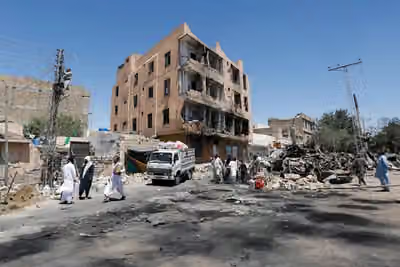

Nearly 5 million mothers and children in Afghanistan are suffering from malnutrition as the country’s hunger crisis deepens, the World Food Programme said Friday.
Rania Dagash, WFP’s deputy regional director, warned that overlapping crises have pushed millions of Afghans to the brink of collapse.
The agency has forecast that by 2025, acute malnutrition will reach its highest recorded level in Afghanistan, with more than 4.7 million children and women requiring urgent treatment. UN figures show that every 10 seconds a child in the country becomes malnourished.
Afghanistan’s health system collapsed after the Taliban takeover in 2021, with hundreds of clinics closing. The crisis has been compounded by cuts in US aid and repeated natural disasters, including floods and earthquakes, leaving millions without access to food and healthcare.
Humanitarian agencies have repeatedly appealed for sustained international support, warning that without immediate action, Afghanistan faces a worsening emergency that could claim countless young lives.

The Taliban has cut fibre optic internet in Herat, adding the western province to the growing list of areas where broadband services have been shut down, sources told Afghanistan International on Thursday.
Local residents said the outage began on 18 September. The Taliban-appointed governor of Herat has reportedly ordered money exchangers and businesses to obtain special permits to access the internet, with wireless connections restricted to registered phone numbers.
The Committee to Protect Journalists said earlier this week that fibre optic internet had already been blocked in nine provinces.
The shutdowns began in Balkh province and were carried out under a direct order from Taliban leader Mullah Hibatullah Akhundzada.

The Taliban’s Ulema council in Balkh has introduced new restrictions on funeral rites as part of a decree issued by the group’s leader, Hibatullah Akhundzada, limiting wedding, mourning and pilgrimage ceremonies.
The clerics have banned funeral gatherings in places other than the deceased’s home and prohibited the participation of women except for immediate relatives.
At a recent meeting with community elders, hotel owners and government representatives, the clerics said preparing food by the deceased’s family during the first three days of mourning is “discouraged” and ordered that neighbours should provide meals for mourners instead.
The council also banned traditional almsgiving on the third day, Fridays, the 40th day and death anniversaries. It instructed that donations for the poor should instead be distributed before funeral prayers.
According to the decision, distributing Qurans, household items or other goods at mourning ceremonies is prohibited. Placing cloths inscribed with Quranic verses on coffins has also been banned.
Akhundzada issued his decree in March, ordering an end to what he called “extravagance” and “un-Islamic expenses” in weddings, funerals and post-pilgrimage ceremonies.
The Balkh clerics warned hoteliers, local elders and officials that violations of the order will be prosecuted.
The ban on funeral gatherings in venues other than private homes comes after some citizens, lacking space, had used hotels or city funeral halls to host services.
The Taliban has already shut down women’s mourning halls across the country as part of its broader restrictions on women.
Despite the new limitations, Taliban leaders have themselves attended high-profile funerals, including those of former refugees minister Khalil Haqqani and Pashto poet Mutiullah Turab in Nangarhar, where senior officials made prominent appearances.

Taliban intelligence forces have detained several protesters in Mazar-e-Sharif after demonstrations erupted over the planned demolition of shops, sources told Afghanistan International.
Witnesses said the arrests began when Taliban forces detained Dawood Kalantar, a shopkeeper who joined Tuesday’s protest. Other shopkeepers who went to inquire about him were also taken into custody.
Residents said the protest broke out after Taliban officials attempted to demolish stores in the city’s auction market. Shopkeepers resisted, arguing that the Taliban had collected taxes from the same businesses for years but were now seeking to destroy them without notice.
Several shopkeepers said the properties have been in their families for more than four decades and demanded that the Taliban provide alternative business sites before carrying out demolitions. They warned that hundreds of families would lose their livelihoods if the shops were destroyed.
Haji Zaid, spokesperson for the Taliban governor in Balkh, said the demolition was ordered under a decision by Taliban authorities in Kabul, which had contracted the land to be redeveloped into a commercial market. He said local officials were holding talks with the protesters to address their concerns.

Taliban Defence Minister Mullah Yaqoob Mujahid said the group’s main priority in its dealings with Washington is the lifting of US sanctions.
In an interview with Al Jazeera, Mujahid said Taliban relations with the United States are primarily focused on political and economic issues. He recently travelled to Doha, where he expressed solidarity with Qatar and met local officials.
The United States lists the Taliban as a “global terrorist organisation,” and several of its senior leaders remain under sanctions. Washington froze Afghanistan’s central bank assets after the Taliban seized power in 2021 and has said normalising ties depends on fundamental changes in the group’s human rights record.
Taliban leaders have repeatedly demanded recognition from foreign governments, including the United States, and pressed for sanctions relief. So far, only Russia has formally recognised the group.
Since March, US delegations have visited Afghanistan at least twice. Visitors have included Adam Boehler, presidential envoy for hostage affairs, and Zalmay Khalilzad, Washington’s former special representative for Afghanistan. Talks with Taliban officials have focused largely on the release of American hostages.
the Taliban defense minister reaffirmed the group’s commitment to the Doha Agreement, saying Afghan soil would not be used to threaten other countries. He also highlighted efforts to build a conventional army, claiming “significant steps” had already been taken.