• العربية
  • پښتو
  • فارسی
Brand
  • Afghanistan
  • Sport
  • Markets
  • Afghanistan
  • Sport
  • Markets
  • Theme
  • Language
    • العربية
    • پښتو
    • فارسی
  • Afghanistan
  • Sport
  • Markets
All rights reserved for Volant Media UK Limited
volant media logo

Taliban Army Chief Warns Of ‘Several-Fold’ Response To Any Aggression

Dec 18, 2025, 15:21 GMT+0

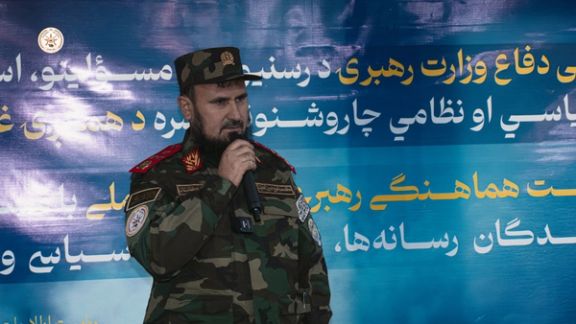
Fasihuddin Fitrat, the Taliban’s army chief, has said the group will respond “several times over” to any aggression against Afghanistan and is seeking to equip its forces with modern weapons.

In a statement issued on Thursday, the Taliban Ministry of Defence said Fitrat met with media representatives, political analysts and a number of Taliban officials to discuss coordination and strengthen cooperation.

At the meeting, Fitrat said Taliban forces had shown “no hesitation whatsoever” over the past four years in defending and protecting Afghanistan. He said the Taliban army is standing on its own feet and working to modernise its capabilities.

“We are striving to build an army equipped with modern weapons to defend the country’s territory under any circumstances,” Fitrat said. “Our army has proven to the people that anyone who looks at this land with ill intent will face a firm and courageous response, and it has also been proven to neighbouring countries that any aggression against Afghanistan will be met with a several-fold response.”

Fitrat did not name any specific country.

After the withdrawal of US forces from Afghanistan, large quantities of advanced US military equipment were left behind and later taken over by the Taliban. The US Department of Defense has estimated the value of this equipment at more than $7 billion, including military vehicles, advanced weapons, biometric devices and other matériel.

Investigations by Afghanistan International show that over the past four years the Taliban have been involved in more than 150 clashes with Pakistani border forces. The Taliban have also clashed on several occasions with Iranian border guards.

Most Viewed

Pakistan Hosts Regional Meet On Afghanistan Without Taliban
1

Pakistan Hosts Regional Meet On Afghanistan Without Taliban

2

Taliban Ignore Afghanistan’s Interests By Backing Militants, Says Pakistan Army Chief

3

United Nations Delivers Education Kits To Four Million Afghan Children

4

European Parliament To Review Petition On Gender Apartheid, Taliban Status

5

Taliban Leaders In South-West Hold Security Meet In Kandahar

•
•
•

More Stories

Taliban Publicly Flog 18 Individuals In Kabul

Dec 18, 2025, 14:06 GMT+0

The Taliban Supreme Court said at least 18 people in Kabul have been publicly flogged on charges related to drug trafficking and sales.

In a statement issued on Thursday, the court said the Kabul primary counter-narcotics court sentenced the individuals to between 10 and 39 lashes and prison terms ranging from seven months to three years. The charges included selling and trafficking tablet K, methamphetamine, hashish and alcoholic beverages.

Data compiled by Afghanistan International show that over the past 10 days, the Taliban have flogged at least 70 people nationwide, including nine women.

According to a United Nations report presented to the Security Council last week, the Taliban flogged at least 215 people, 44 women and 171 men, across various provinces during the three-month period from August 1 to October 31.

Despite repeated criticism from international organisations over the use of corporal punishment and the treatment of detainees, the Taliban have continued to carry out public floggings across Afghanistan.

Taliban Opposition Fronts Carried Out 116 Attacks, Says UN

Dec 18, 2025, 13:03 GMT+0

The United Nations Security Council says Taliban opposition groups carried out 116 attacks between January and July 2025, but that the violence remains sporadic and does not pose a serious threat to Taliban rule.

In its report, the Security Council said the National Resistance Front (NRF) claimed responsibility for 73 attacks during the period, while the Afghanistan Freedom Front (AFF) claimed 43.

The report noted a sharp decline in the number of attacks compared with 2024, when the AFF claimed 83 attacks and the NRF claimed 261.

The NRF and the AFF are armed groups opposed to the Taliban that emerged after the group returned to power in Afghanistan in August 2021. Both groups have since claimed responsibility for numerous attacks targeting Taliban forces and facilities.

As the UN report was released, the AFF on Thursday reported a new attack on a Taliban checkpoint in the northern city of Kunduz. The group said the guerrilla attack took place at about 6:30 p.m. on Wednesday, December 17, near a contracted fuel tanker close to Kabul Port in Kunduz.

According to the AFF, two Taliban members were killed and another was wounded in the attack. The Taliban have not commented on the claim.

Earlier, the United Nations Assistance Mission in Afghanistan (UNAMA) reported that between February 1 and the end of April 2025, the NRF and the AFF carried out a combined total of 72 attacks against the Taliban. UNAMA said the NRF claimed responsibility for 56 of those attacks, while the AFF claimed 16.

Taliban Have Sidelined Thousands Of Tajik & Uzbek Fighters

Dec 18, 2025, 11:18 GMT+0

The United Nations Security Council says the Taliban have dismissed thousands of their Tajik and Uzbek fighters, particularly in provinces with large Tajik and Uzbek populations.

It follows a 20 percent reduction in the group’s security forces.

In its latest report, the Security Council said the Taliban reduced their forces because of a budget crisis. The report noted that the order to cut personnel was issued by the Taliban leadership and that, after its implementation, the highest number of dismissals occurred in provinces where a significant share of Taliban fighters were Tajik or Uzbek.
Previously, a Taliban spokesperson had said the group was downsizing its forces because of what he described as “organisational inflation.”

Concerns Over Ethnic Impact

While the UN report does not explicitly state that dismissals were carried out on the basis of ethnicity, it said the concentration of layoffs in Tajik- and Uzbek-majority provinces has raised concerns about the ethnic implications of the decision.

According to the report, after Badakhshan, the highest number of dismissals was recorded in Kapisa, Parwan and Takhar provinces, where many Tajik and Uzbek Taliban fighters are based.

ISKP Expanding Activities Using Artificial Intelligence

The report said the 20 percent reduction in Taliban security forces comes at a time when the group faces continued security threats, particularly from Islamic State–Khorasan (ISKP).

According to the UN, ISKP has expanded its training and propaganda activities by using modern tools, including artificial intelligence. The group has reportedly used such technology to produce instructional materials, including guides on making improvised explosive devices. The UN sanctions monitoring team warned that this development, combined with Taliban force reductions, could create new security challenges for Afghanistan.

The report said the Taliban have carried out counter-ISKP operations since the beginning of 2025, but described ISKP as “resilient,” with the threat continuing.

Taliban Denials and Counterterrorism Efforts

The UN said the Taliban often deny the presence of ISKP in Afghanistan and accuse neighbouring countries of supporting the group. At the same time, despite claiming to have suppressed ISKP, the Taliban have regularly sought external counterterrorism assistance to combat the group.

The report also said more than 20 international and regional terrorist organisations are currently active in Afghanistan, including al-Qaida, Tehreek-e-Taliban Pakistan (TTP), the Turkistan Islamic Party, the Islamic Movement of Uzbekistan and Jamaat Ansarullah.

According to the report, the Taliban have absorbed some former fighters from various extremist groups into local security forces, raising concerns about ideological alignment and infiltration.

The UN said advanced weapons and equipment have reached militant groups through cross-border smuggling and black markets, and noted reports of drone attacks on Pakistani military facilities.

The report added that the Taliban are seeking technical assistance to develop drone capabilities and establish what it described as a “low-cost air force.” Some countries have reported possible involvement of al-Qaida-linked envoys in the mass production of drones in Logar and Kabul.

Despite these concerns, the UN said Afghanistan’s overall security situation has become more stable compared with previous periods. However, it described the presence of terrorist groups in the country as the “primary challenge” to lasting stability.
Taliban Leader’s Decrees Not Enforced Uniformly Across Afghanistan, Says UN

Dec 18, 2025, 10:19 GMT+0

A new report by the United Nations Security Council says decrees issued by Taliban leader Hibatullah Akhundzada are not implemented uniformly across Afghanistan.

The report stated that powerful figures within the group, including members of the Haqqani network, able to act independently.

Ethnic Discrimination

The UN sanctions monitoring committee reported to the Security Council that the Taliban treat non-Pashtun citizens more harshly than Pashtuns.

The report added that relative stability in Afghanistan has largely been achieved at the cost of widespread human rights violations and internal repression.

Afghanistan Losing $1 Million a Day Due to Pakistan Border Closures

The UN Security Council said Afghanistan is losing about $1 million a day as a result of border closures following clashes between the Taliban and Pakistan.

The report warned that if underlying issues are not addressed, there is a risk of further escalation and a possible intensification of military confrontation between Pakistan and the Taliban.

Taliban Not Seeking Popular Support

The Security Council’s latest report said the Taliban believe their fate is tied to governing power and are not seeking public approval or popular support.

The report said that while the Taliban seek international recognition, they have failed to respond to the concerns and views of the international community.

According to the UN, the Taliban have continued to consolidate control, and their authority remains largely unchallenged. While a degree of peace and stability exists in the country, the report said this situation does not benefit all segments of society. Women, girls and some minority groups have been particularly affected under Taliban rule.

Foreign Terrorist Groups Active in Afghanistan

The UN Security Council said Taliban claims that no terrorist groups operate in Afghanistan are “not credible.”

The sanctions monitoring committee said a wide range of countries consistently confirm that terrorist groups remain active in Afghanistan.

According to the report, member states say groups including Islamic State–Khorasan (ISKP), Tehreek-e-Taliban Pakistan (TTP), al-Qaida, the Turkistan Islamic Party, Jamaat Ansarullah, the United Mujahideen of Pakistan and other groups maintain a presence in the country.

The report added that Tehreek-e-Taliban Pakistan has carried out numerous attacks against Pakistan from Afghan territory.

More Than 4.5 Million Afghan Migrants Deported From Iran and Pakistan

The UN Security Council said that since October 2023, more than 4.5 million Afghan migrants, mostly from Iran and Pakistan, have been forcibly returned to Afghanistan.

The report said efforts by the international community to assist and support returnees have been hampered by Taliban restrictions on women.

Taliban, Kyrgyz Firms Sign $165M In Trade Deals

Dec 17, 2025, 16:42 GMT+0

The Taliban’s Ministry of Commerce and Industry said trade memorandums of understanding worth $165 million were signed during the visit of Kyrgyzstan’s Minister of Economy, Bakyt Sydykov, to Kabul.

In a statement issued on Wednesday, the ministry said the agreements were concluded between private sector companies from Afghanistan and Kyrgyzstan.

According to the statement, the memorandums were signed following a “Business Networking” meeting hosted in Kabul after the visit of the Kyrgyz economic delegation. The meeting brought together private sector representatives from both countries for talks covering gold, pharmaceuticals, telecommunications, mining and energy, logistics and transport, banking, agriculture and livestock.

Speaking at the meeting, Taliban Minister of Commerce and Industry Nooruddin Azizi described economic relations with Kyrgyzstan as important. He said the two countries are economically complementary, with Afghanistan located at the crossroads of South and West Asia and Kyrgyzstan serving as a gateway to Central Asia and Eurasian economic markets.

Azizi said the signing of a cooperation roadmap and trade memorandums provides an operational framework for expanding economic ties between Afghanistan and Kyrgyzstan. He also described the opening of a Kyrgyz Trade House in Kabul as a bridge linking private sector actors in both countries.

The Ministry of Commerce and Industry had earlier announced that Kyrgyzstan opened its Trade House in Kabul during the delegation’s visit, calling the move an important step towards strengthening and institutionalising trade and economic relations between the two countries.