
Pakistan’s Ministry of Information and Broadcasting said in a statement that the attack on the Wana Military College in South Waziristan had been carried out by Afghan nationals and that US-made weapons were used in the assault.
In the statement issued Thursday, the ministry said the attack “was planned and controlled from Afghanistan,” adding that “all foreign nationals involved in the attack were Afghan.”
According to the statement, the weapons and equipment used by the militants had also been supplied from Afghanistan.
The ministry claimed that Tehreek-e-Taliban Pakistan (TTP) had refrained from claiming responsibility for the assault due to pressure from the Taliban, saying that if the TTP accepted responsibility, the Afghan Taliban “would come under pressure from Pakistan and other countries.”
The Pakistani government also said the attack had been carried out at the request of India’s intelligence agency, asserting that the identities of the attackers confirmed their links to handlers inside Afghanistan.
Earlier, Pakistan’s interior minister had also claimed that the attackers involved in the Islamabad bombing and the Wana military college assault were Afghan nationals. He said that under such circumstances, “negotiation with the Taliban has no meaning.”
The Taliban have denied any involvement in militant attacks inside Pakistan. The Taliban’s Foreign Ministry has condemned both the suicide bombing in Islamabad and the attack on the Wana Military College.

The Taliban have signed a memorandum of understanding with Uzbekistan to export Afghan agricultural products by air, as border crossings with Pakistan remain closed amid heightened tensions.
Haji Zaid, spokesperson for the Taliban governor in Balkh, said Afghan produce would be exported through Uzbekistan’s air corridors to markets in Central Asia, South Asia and Europe.
In a post on X on Thursday, he said Afghan agricultural products such as pomegranates, figs, vegetables and other seasonal fruits would be transported “through Uzbekistan’s air routes to markets in Central Asia, South Asia, European countries and Uzbekistan.” He added that the relevant agreements on air exports had been signed with Uzbekistan.
Zaid said arrangements had also been made with Afghan traders to export meat to Uzbekistan and that the process had already begun. He noted that Taliban authorities in Balkh were working to make Uzbekistan’s air corridor a viable alternative route for Afghan businesses.
The move comes after recent border clashes between the Taliban and Pakistan prompted Islamabad to close all crossings with Afghanistan.
On Wednesday, the Taliban urged Afghan traders to seek alternative trade and transit routes instead of relying on Pakistan. The group said the closure of the crossings had harmed traders and created difficulties for local markets and ordinary citizens.
The head of the Afghanistan–Pakistan Joint Chamber of Commerce told Afghanistan International that the Pakistani route remained Afghanistan’s closest commercial corridor despite current tensions. Khan Jan Alokozay called on both Pakistan and the Taliban to separate trade from politics and work toward a solution.
Yousaf Afridi, head of the Khyber Pakhtunkhwa Chamber of Commerce, said Afghanistan and Pakistan were economically interdependent and should keep commercial ties insulated from political disputes.
The Taliban’s Finance Ministry said it will stop processing customs duties on medicines imported from Pakistan after the next three months, following an order from the group's deputy prime minister.
The announcement came a day after Mullah Abdul Ghani Baradar, the deputy prime minister for economic affairs told medicine importers to settle all commercial dealings with Pakistan within that period and to use alternative routes for imports.
In a statement issued Thursday, the ministry said the decision was intended to prevent the import of low-quality medicines and that, after the three-month deadline, “medicines imported from Pakistan will not be processed for customs duties.”
The ministry said it planned to provide additional facilities for importing higher-quality medicines through alternative routes.
Baradar told Afghan traders and industrialists on Wednesday that they must settle their accounts with Pakistan within three months. He added that, because of what he described as the poor quality of Pakistani imports, exports and imports “should be carried out through alternative routes.”
With rising tensions along the border, Pakistan has closed all crossings with Afghanistan. Baradar told Afghan traders that Pakistan had previously closed trade routes, particularly during the fruit season, and said that if Pakistan wished to reopen the crossings now, it would need to provide guarantees ensuring the routes would not be shut again. He emphasised that Afghanistan’s exports and imports “must be conducted through alternative routes.”
Economic analysts say Afghanistan is able to conduct trade independently through other corridors in line with international law.
Anwar ul-Haq Ahadi, a former Afghan finance minister, told Afghanistan International that Afghanistan could use the Iran route and the Lapis Lazuli Corridor as long-term alternatives for exports and imports.
Another former finance minister, Hazrat Omar Zakhilwal, said transit for a landlocked country was “neither a gift nor a privilege,” but a legal right under international law and bilateral agreements. He said no country could revoke another’s transit access because of political tensions or disputes.
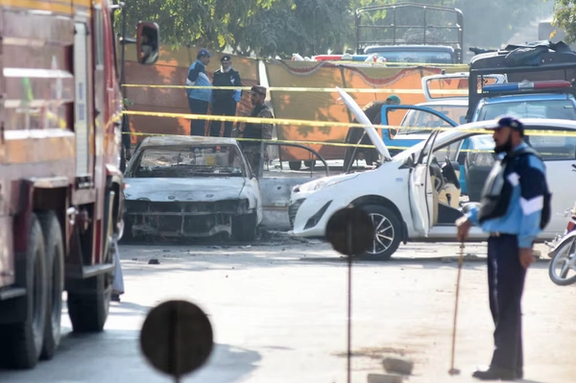
Pakistan’s Interior Minister Mohsin Naqvi said both the suicide attacks in South Waziristan and Islamabad had been carried out by Afghan nationals. Naqvi said on Thursday that it had been confirmed the attackers had come from Afghanistan and had carried out the assaults.
He had earlier said the militants involved in the attack on the Wana Military College had been in contact with their organisers in Afghanistan.
The interior minister did not provide further details about the identities of those involved in the recent suicide bombings.
On Monday, militants attacked the Wana Military College in South Waziristan, resulting in at least three deaths.
On Tuesday, a suicide bombing near the Islamabad Judicial Complex killed at least 12 people and wounded 27 others. Jamaat-ul-Ahrar, a splinter faction of Tehreek-e-Taliban Pakistan (TTP), claimed responsibility for that attack.
Although no group has claimed responsibility for the Wana attack, Pakistan’s army attributed it to TTP.
The Rawalpindi Counter Terrorism Department on Thursday arrested seven suspects who officials said had facilitated the suicide bombing at the Islamabad Judicial Complex.
A day after the attack in Islamabad, Pakistan’s prime minister told Parliament that India and the Afghan Taliban had been involved in the terrorist attack in Pakistan.
Defence Minister Khawaja Asif also warned that Pakistan might take military action inside Afghanistan. He rejected the Afghan Taliban’s condemnation of the attack, describing it as not genuine.
Asif said Pakistan would present evidence of Afghan Taliban involvement in recent incidents to mediating countries such as Qatar and Turkiye.
In an interview with Geo News, he said Pakistan would not leave what he called aggression unanswered and would deliver a decisive response.
Pakistan’s Defence Minister Khawaja Asif said the country was prepared to confront what he described as a two-front war involving India and the Afghan Taliban, following a suicide attack in Islamabad that left 12 people dead.
Asif said Pakistan was ready and equipped to face challenges on both its eastern border with India and its western border with Afghanistan. He told the television channel Hum News that he viewed the Afghan Taliban as acting as a proxy force for India.
He said Pakistan had defeated India in the first round of conflict and believed it would do so again, adding that the country had no choice but to fight on both fronts.
When asked whether this situation would make Pakistan’s borders more vulnerable referencing a comment by India’s National Security Adviser Ajit Doval, who had said Delhi should engage Pakistan through proxies, Asif responded that Pakistan was indeed facing a two-front threat from India and Afghanistan and reiterated his claim that Afghanistan was acting on India’s behalf.
The minister said Pakistan was ready to face both borders and believed divine support had helped the country previously and would do so again.
He said he supported negotiations with the Taliban and backed dialogue, but argued that talks required sincerity and genuine intent. He said this did not mean Pakistan would accept being pushed to the outskirts of Islamabad and then be asked to negotiate under such circumstances.
After the suicide attack in Islamabad, Asif said hope for successful negotiations with the Taliban was misplaced, given the environment. He said the authorities in Kabul were capable of preventing attacks in Pakistan and argued that bringing the conflict to Islamabad amounted to a message from Kabul, one that he believed Pakistan was capable of answering.
Three rounds of talks between Pakistan and the Taliban have taken place in recent weeks. The first round in Doha resulted in agreement on a temporary ceasefire, while the second and third rounds in Istanbul ended without progress.
Pakistan accuses the Afghan Taliban of harbouring Tehreek-e-Taliban Pakistan (TTP) and allowing the group to launch attacks from Afghan territory. The Taliban denies the allegation.
Russian President Vladimir Putin has endorsed the establishment of a United Nations regional centre for Central Asia and Afghanistan in Kazakhstan, according to a new comprehensive strategic partnership agreement signed with Kazakh President Kassym-Jomart Tokayev at the Kremlin.
The agreement, signed on Wednesday outlines expanded cooperation between the two countries. Article 10 of the document, published on the Kremlin’s website, said both sides welcomed the creation of the UN Regional Centre for the Sustainable Development Goals (SDGs) in Kazakhstan, viewing it as a promising platform for advancing long-term, mutually beneficial regional development projects.
Tokayev announced earlier this year that the SDG centre had opened in Almaty with the support of the UN Secretary-General and partner countries.
UN Secretary-General António Guterres travelled to Kazakhstan, where he signed an agreement with Kazakh officials finalising the centre’s establishment. The United Nations confirmed the centre’s opening shortly afterwards.
During the ceremony, Tokayev said Kazakhstan remained committed to supporting the people of Afghanistan through humanitarian assistance, educational initiatives, trade development and food-security programmes.
Guterres said at the centre’s launch that Afghanistan formed an integral part of the future of Central Asia.