Araghchi, Muttaqi Discuss Pakistan–Taliban Tensions In Phone Call
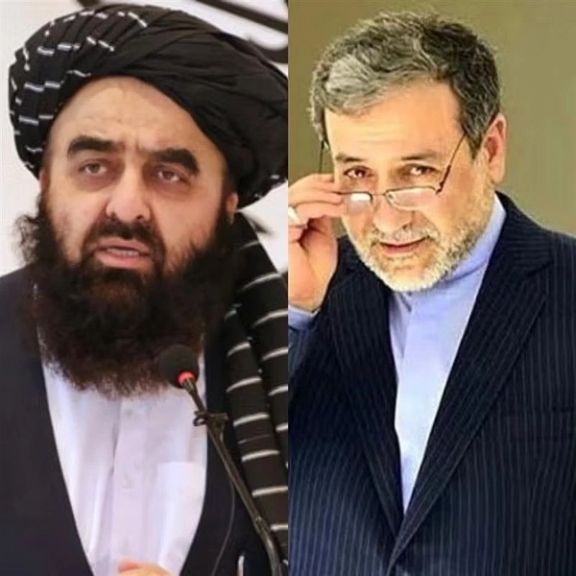
Iran’s foreign minister, Abbas Araghchi, and the Taliban’s foreign minister, Amir Khan Muttaqi discussed recent developments in relations between Pakistan and the Taliban.
Iran’s foreign minister, Abbas Araghchi, and the Taliban’s foreign minister, Amir Khan Muttaqi discussed recent developments in relations between Pakistan and the Taliban.
According to Iran’s Foreign Ministry, Araghchi stressed the need for peace and stability among regional countries. He also highlighted the importance of strengthening consultations and coordination to advance joint cooperation across the region.
Muttaqi, thanking Iran for its diplomatic efforts, said the Taliban welcomed regional dialogue and consultations.
The call took place a day after Araghchi announced Iran’s efforts to convene a regional meeting aimed at easing tensions between Islamabad and the Taliban. He said Iran had been working in recent days to help establish calm between the two sides and hoped these efforts would yield meaningful results.
Pakistan’s Foreign Ministry has also welcomed Iran’s proposal, saying Pakistan has a strong case regarding cross-border terrorism and is prepared to cooperate with Tehran in any mediation process.

Two eyewitnesses said n Monday that the Taliban publicly flogged nine people at Sheikh Mati Stadium in Qalat, the capital of Zabul province, on charges described as adultery and theft.
According to the witnesses, the Taliban had ordered local residents to gather at the stadium to observe the punishment.
They said Taliban court officials, along with personnel from military and civilian offices, were also present.
Despite international condemnation of corporal punishment and torture, the Taliban continues to carry out public floggings, saying the practice is part of enforcing “Islamic Sharia.” Thousands of people have been detained and punished in this manner since the group’s return to power.
Human rights organisations say the Taliban judicial system lacks impartiality and that defendants are routinely denied basic legal protections, including access to defence lawyers. Rights experts warn that public corporal punishment fuels fear and intimidation across Afghan society.
A 17-year-old girl identified as Farkhunda has died under what sources describe as suspicious circumstances in Kabul, roughly six weeks after her marriage.
Sources told Afghanistan International that her body was found on Saturday, 15 November, at her husband’s residence in Golbahar Centre. The Taliban confirmed her death but said she died of a stroke.
According to the sources, Farkhunda had married a 17-year-old boy in Kabul a month and a half earlier. Afghanistan International has reviewed photos and videos from their wedding ceremony. Some sources said the husband had been reluctant to marry but agreed under family pressure. Others claimed the husband’s family are business partners of Taliban officials and wield significant influence within the group’s administration.
Taliban police spokesperson Khalid Zadran wrote on X on Monday that Farkhunda’s family had reported she suffered a stroke. He rejected descriptions of the death as suspicious, saying investigators had not found any evidence of foul play and that no complaint had been filed by the family. He added that an investigation is continuing.
Women’s rights activists have challenged the Taliban’s account and called for an independent inquiry by international organisations.
Under the UN Convention on the Rights of the Child, anyone under 18 is considered a child regardless of marital status, parenthood or economic circumstances.
News of Farkhunda’s death has prompted widespread reactions on social media.
Batool Haidari, a university professor, wrote on X that killings of women and young people were increasing under Taliban rule.
Women’s rights activist Huda Khamosh said on Facebook that the death was “not mysterious,” describing such characterisations as attempts to conceal a murder.
Another X user, Akhzrati, linked the case to forced marriages, calling them a “death trap for young girls.”
Khadija Ahmadi, another social media user, wrote that the incident reflects the broader situation of women in Afghanistan” without rights, without a voice, and a victim of a brutal patriarchal system.” She said the value of women’s lives had fallen to its lowest point under Taliban rule.
Some users have described Farkhunda’s death as an act of femicide.
The Taliban’s Foreign Ministry says a high-level Tajik delegation has met with Foreign Minister Amir Khan Muttaqi in Kabul.
According to a ministry statement issued on Monday, the two sides discussed strengthening ties across multiple areas, with a particular focus on diplomatic relations and economic cooperation.
The ministry said Muttaqi highlighted what he described as the longstanding and historic relationship between Afghanistan and Tajikistan, adding that the Taliban seeks to expand friendly relations with Dushanbe. He said relations were improving in several sectors and expressed hope for further progress in the near future.
The statement noted that the Tajik delegation, comprising senior security and foreign ministry officials, conveyed Tajikistan’s commitment to deepening cooperation and emphasised the potential for broader collaboration.
The visit is seen as unusually high-profile given Tajikistan’s limited engagement with the Taliban in recent years. Earlier, Yusuf Wafa, the Taliban-appointed governor of Balkh and a figure close to Taliban leader Hibatullah Akhundzada, travelled to Dushanbe at Tajikistan’s invitation, where he requested the transfer of Afghanistan’s embassy to Taliban control.
The Taliban did not clarify whether the embassy issue was discussed during the Kabul meeting.
Tajikistan is among the Central Asian states that have maintained minimal diplomatic contact with the Taliban since 2021. Afghanistan’s embassy in Dushanbe remains under the control of representatives of the previous Afghan government and is currently headed by Zahir Aghbar, a known opponent of the Taliban. Tajikistan also continues to host figures aligned with the National Resistance Front. By contrast, the Afghan consulate in Khorog operates directly under the Taliban Foreign Ministry.
The statement said both sides agreed on the importance of continuing such meetings and exchanges in the future.
Russia has announced that the Shanghai Cooperation Organisation (SCO) Council of Heads of State will convene on 17–18 November in Moscow.
The summit, chaired by Russian Prime Minister Mikhail Mishustin, will focus on expanding trade, economic, investment, cultural and humanitarian cooperation.
According to the prime minister’s office, in addition to SCO member states, high-level representatives from dialogue partners, observer countries, the Commonwealth of Independent States (CIS) and the Eurasian Economic Union have been invited to attend.
The SCO, founded in 2001, includes Russia, China, India, Kazakhstan, Kyrgyzstan, Tajikistan, Pakistan, Iran and Uzbekistan as full members. Belarus joined the organisation on 4 July 2024. Afghanistan and Mongolia hold observer status, while dialogue partners include Azerbaijan, Armenia, Bahrain, Egypt, Cambodia, Qatar, Kuwait, the Maldives, Myanmar, Nepal, the United Arab Emirates, Saudi Arabia, Türkiye and Sri Lanka.
It remains unclear whether the Taliban will send a representative to the summit. Mongolia, unlike the Taliban, has previously participated in SCO meetings as an observer state.
In its statement, the Russian prime minister’s office said heads of state and delegates will discuss the SCO’s development strategy through 2035 during the two-day gathering. The summit is expected to place particular emphasis on expanding cooperation in the digital economy, energy, green industry, artificial intelligence, science and innovation, education, culture, tourism, healthcare, sport and youth exchanges.
Pakistan’s Foreign Ministry says it welcomes Iran’s proposal to mediate between Islamabad and the Taliban, stressing that Pakistan has a strong case on cross-border terrorism and is ready to cooperate with Tehran in any mediation effort.
Responding on Sunday to a question about Iran’s offer to host a regional meeting aimed at easing tensions between Pakistan and the Taliban, Foreign Ministry spokesperson Tahir Hussain Andrabi said Pakistan appreciates the initiative.
He described Iran as a “brotherly, friendly country” and said Pakistan consistently supports resolving disputes through dialogue and diplomacy. Andrabi said Iran could play an important role in efforts to address cross-border militancy.
He added that mediation is usually resisted by parties with a weak political or legal position, but argued that Pakistan’s case regarding terrorism originating from Afghanistan is “very strong.”
Relations between the Taliban and Pakistan have deteriorated in recent weeks amid disputes over Tehreek-e-Taliban Pakistan (TTP) and Pakistani airstrikes. Iran’s Foreign Minister Abbas Araghchi recently announced plans for a regional meeting to help de-escalate tensions.
Earlier this month, a third round of talks between Pakistan and the Taliban in Istanbul ended without progress, with negotiators failing to reach agreement on steps to curb cross-border militancy. The talks were initiated after border clashes between the two sides in October.
The tensions have drawn in other regional actors as well. Türkiye’s president and several neighbouring leaders have previously urged both sides to resolve their disagreements through dialogue.