Spanish Foreign Minister Rules Out Recognition Of Taliban
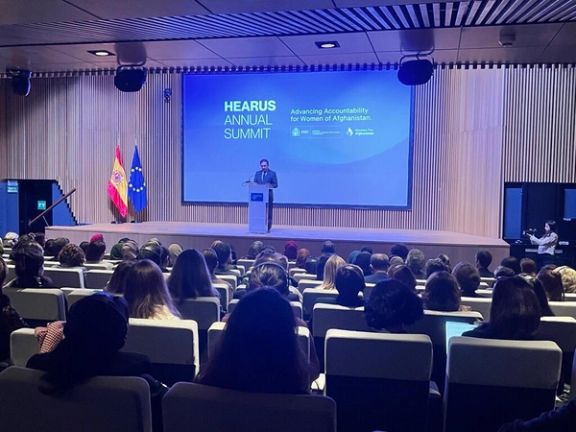
Spain’s Foreign Minister José Manuel Albares said on Friday, 12 December, that his country will not recognise the Taliban, stressing that the group’s government is not legitimate.
Spain’s Foreign Minister José Manuel Albares said on Friday, 12 December, that his country will not recognise the Taliban, stressing that the group’s government is not legitimate.
Speaking at a gathering of Afghan activists in Madrid, Albares said Spain remains firmly committed to the rights of Afghan women and that genuine peace cannot be achieved without their participation.
The third special conference on Afghan women, titled “Hear Us,” opened on Friday in Madrid. Richard Bennett, the UN Special Rapporteur on Human Rights in Afghanistan, along with several human rights activists, is among the speakers.
In his opening remarks, Albares said any future based on progress requires the inclusion of women and reaffirmed Madrid’s support for the rights of Afghan women.
He described the past four years in Afghanistan as devastating for women and warned that failure in their struggle would weaken equality not only in Afghanistan but beyond its borders.
Albares also said the Taliban’s actions in Afghanistan would be reviewed and that the group must be held accountable.
The conference’s first session was held on Thursday. Two previous rounds of the meeting were organised in Spain and Albania, focusing on supporting the struggle of Afghan women.

In August 2007, a Pakistani helicopter transferred about 27 detainees to Dera Ismail Khan before proceeding to Wana. One of the detainees on board was Khalil-ur-Rahman Haqqani.
Last year, on December 11, he was killed by an ISIS suicide bomber inside his ministry, yet the ambiguous aspects of that incident remain unclear even after one year.
August 2007 was a defining moment for Khalil-ur Rahman Haqqani, as he was released as part of a major hostage-taking and prisoner-exchange deal orchestrated by Tehreek-e-Taliban Pakistan (TTP). Following his release, he returned to the battlefield.
After negotiations failed between a 21-member jirga of the Mehsud tribe, led by former Pakistani parliamentarian Maulana Merajuddin Mehsud, and the TTP regarding the exchange of captured soldiers and detainees, TTP leader Baitullah Mehsud killed three captured Pakistani soldiers when the Afghan and Pakistani Taliban were not released. Their bodies were dumped on the Wana–Jandola road. Mehsud warned: “If you do not release the prisoners, we will give you such gifts every day.”
One of the TTP’s key demands was the release of Khalil-ur Rahman Haqqani and other members of the Haqqani Network.
After the killing of the soldiers, the Pakistani government agreed to negotiations. Talks between the Pakistan army and the TTP were held in Dila, South Waziristan, led by Mawlawi Muawiya Wazirgi, the TTP’s head of economic affairs. Under the deal, the army released several tribal elders from Waziristan, along with 43 Taliban leaders, including Khalil-ur-Rahman Haqqani, Nasiruddin Haqqani, Amir Khan Haqqani, two brothers of Akhtar Mohammad Osmani, and Malai Khan Zadran.
The dramatic capture of 350 Pakistani soldiers by 20 Taliban fighters in South Waziristan, and the subsequent release of a large group of Haqqani Network members in exchange, strengthened public suspicions that the entire episode was a jointly planned operation to secure the release of senior Haqqani leaders. At the time, US forces posed a significant threat of capturing Haqqani Network members and transferring them to Bagram or Guantanamo prisons.
Khalil-ur-Rahman Haqqani, who was killed last year on December 11 by an ISIS suicide bomber inside the Taliban’s Ministry of Refugees and Repatriation, had been arrested by Pakistani forces in 2003 and imprisoned. From guesthouses linked to the Haqqani Network in Peshawar including Board, University Town, Hayatabad, Kohat Road and Chamakani he commanded fronts against Afghan and US forces in Afghanistan. Known as “Haji Lala,” he led the Peshawar-based wing of the Haqqani Network. Since the days of the Afghan jihad, he maintained close ties with Pakistan’s intelligence services as well as with the country’s political, religious and militant groups.
Khalil-ur-Rahman Haqqani was the brother of the Haqqani Network’s founder, Mawlawi Jalaluddin Haqqani, and the uncle of Sirajuddin Haqqani, the Taliban’s current interior minister. He was considered one of the most influential members of the network, often handling tribal mediation and coordination among communities.
He also played a decisive role in expanding the Haqqani Network’s influence in Afghanistan.
In February 2011, the US Treasury Department added his name to its sanctions list and announced a $5 million bounty on him.
On February 9 the same year, the United Nations, under Paragraph 2 of Resolution 1904 (2009), listed Khalil-ur-Rahman Haqqani for maintaining close ties with al-Qaeda and Osama bin Laden. He was accused of playing a key role in transferring the families and members of al-Qaeda and other foreign militants from Shahi Kot, Paktia, Paktika and Khost provinces into Waziristan.
Haqqani’s Position Within the Taliban Structure
Khalil-ur-Rahman Haqqani was considered one of the most active ministers during the Taliban’s second rule, serving as minister of refugees and repatriation. The ministry’s most important responsibility was overseeing the return of millions of Afghan refugees who, after decades of war, were facing mass expulsions from Iran and Pakistan. According to Taliban sources, during his tenure he managed the forced deportation and return of nearly 1.5 million Afghan refugees, a mission the Taliban viewed as a major political achievement.
Alongside his cabinet role, the senior Haqqani played a key part in expanding the influence of the Haqqani Network. He was regarded as Sirajuddin Haqqani’s “right hand” because of his strong connections with tribal elders, tribal structures and hard-line factions within the Taliban. Through jirgas and mediation efforts in Khost, Paktia and Paktika, he helped build an environment of support for the Taliban, a contribution seen as vital to consolidating the group’s authority.
During his tenure, delegations of tribal elders from Afghanistan’s southern provinces were sent to northern regions to strengthen intertribal relations and to fill the ideological gap in Taliban governance by reinforcing the Haqqani Network’s influence through tribal legitimacy.
Haji E’tibar, a 71-year-old who fought alongside Khalil-ur-Rahman Haqqani against the government during the rule of President Mohammad Najibullah, told Afghanistan International–Pashto that Khalil Haqqani played a key role in the fall of Khost province during the Soviet-backed Najibullah regime in the late 1980s. He was also a close aide to Mawlawi Jalaluddin Haqqani, and when the Haqqani Network captured numerous tanks during the war, it was under Khalil-ur-Rahman Haqqani’s leadership that an armoured battalion was formed.
Expanding the Haqqani Network’s influence, maintaining relations with the Taliban’s central leadership and generating legitimacy for the Taliban through tribal structures were among the roles in which Khalil Haqqani was deeply involved.
A member of the Taliban-controlled Centre for Regional Studies, speaking on condition of anonymity, told Afghanistan International–Pashto that after the fall of the Taliban’s first regime in the 1990s, Khalil-ur-Rahman Haqqani worked to maintain and expand the Haqqani Network’s bases in North Waziristan. He managed the transfer and accommodation of foreign fighters, an effort described as crucial for al-Qaida and other global jihadist networks.
The source said: “As I recall, during the Taliban’s first rule, Khalil Haqqani had very close relations with Osama bin Laden, al-Hassami and several other al-Qaida members. He was one of their most trusted individuals.”
Securing supply routes for the Haqqani Network, procuring weapons and equipment, and managing financial resources were areas in which Khalil Haqqani played a decisive role. His activities were heavily focused in Pakistan’s urban areas, where he maintained an extensive network of contacts and operations.
The research centre member added: “His relationships with tribes in Pakistan dated back to the jihad era. He had strong ties with Sunni tribes in Kurram Agency, while at the same time maintaining cooperative relations with Pakistani state institutions. The Kurram Agreement, which aimed to end sectarian conflict, secured strategic locations for the Haqqani Network. These achievements were the direct result of Khalil Haqqani’s mediation and influence.”
The Kurram Agreement and Sectarian Conflicts
Khalil-ur-Rahman Haqqani and Ibrahim Haqqani played a decisive role in a 2008 agreement aimed at easing sectarian tensions in Kurram district of Khyber Pakhtunkhwa. Under the agreement, sectarian clashes subsided temporarily, allowing the Haqqani Network to establish itself in several strategic areas of Kurram.
According to a report by Afghanistan International–Pashto, the Pakistani military, together with Ibrahim Haqqani and Khalil-ur-Rahman Haqqani, played a significant role in brokering the agreement and expanding their influence among the local population. Shiite and Sunni communities deposited 40 million Pakistani rupees as surety and accepted several additional conditions and restrictions.
The Haqqanis persuaded Sunni tribes to withdraw from the conflict and, in return, gained access to supply routes from Shiite-majority areas into Afghanistan.
In the first week of December 2010, another three-day jirga was held involving Khalil-ur-Rahman Haqqani, several Tehreek-e-Taliban Pakistan commanders, tribal elders and local Pakistani officials. Haqqani again played a decisive role in the gathering.
Based on the jirga’s decisions, Afridi tribal elders from the Jamrud, Sra Kamar, Takhta Beg and Ghundi areas committed to cooperating with Khalil-ur-Rahman Haqqani and agreed not to obstruct supply routes.
The jirga enabled both the Haqqani Network and the Taliban to recruit young men from local religious seminaries and to use existing supply routes with greater confidence.
Another outcome of the Jamrud jirga was the recruitment of Tehreek-e-Taliban Pakistan fighters for the Haqqani Network’s insurgency in Afghanistan. Young men from seminaries in the Afridi, Orakzai and Tirah areas joined TTP ranks and, with the support of the Haqqani Network, carried out attacks and operations inside Afghanistan.
Leadership in Social and Political Engagements
In August 2021, as the Taliban entered Kabul and the republican government was nearing collapse, Khalil-ur-Rahman Haqqani was among the Taliban representatives who held direct talks with senior government officials and political leaders. According to Taliban sources, the aim was to prevent an escalation of fighting, minimise bloodshed during the fall of Kabul and facilitate a smoother transfer of power.
Reports indicate that Khalil-ur-Rahman Haqqani attended several meetings inside the presidential palace and held discussions with influential political figures. He conveyed messages to former President Ashraf Ghani through Hamid Karzai and Dr Abdullah Abdullah.
In his final interview, he claimed that former Balkh governor Atta Mohammad Noor had assured him of cooperation with the Taliban if they took control of Afghanistan. He also spoke respectfully of the late Ahmad Shah Massoud and expressed a willingness to meet his son, Ahmad Massoud.
Khalil-ur-Rahman Haqqani sought to prevent any potential armed resistance to the Taliban.
Despite these political efforts, he was critical of Taliban leader Mullah Hibatullah Akhundzada’s policies. Before his death, he openly criticised the leader’s approach during a visit to Kandahar. For this reason, some analysts view his assassination as the result of internal divisions within the Taliban.
The killing of Khalil-ur-Rahman Haqqani by ISIS during the Taliban’s second rule dealt a significant blow to the group, particularly as the Taliban publicly deny the presence of ISIS in Afghanistan and claim to have eliminated it.
A year after his death, Taliban authorities have not disclosed the findings of their investigation or identified those responsible for the attack. One of the central mysteries surrounding the incident is how the suicide bomber entered the ministry building undetected and why the security scanner was not functioning at the time. Although the Taliban officially attributed the attack to ISIS and the group claimed responsibility, the circumstances of the killing remain unclear.
Mohammad Reza Bahrami, director general for South Asia at Iran’s Ministry of Foreign Affairs, has said the purpose of an upcoming regional meeting on Afghanistan in Tehran is to facilitate an exchange of views among the special representatives of participating countries.
Earlier, the spokesperson for Iran’s Foreign Ministry confirmed that Tehran would host a regional meeting next week on “developments related to Afghanistan.” Referring to recent tensions between the Taliban and Pakistan, Esmail Baghaei said: “We hope this meeting can play an effective role in strengthening cooperation and reducing tensions.”
However, Bahrami said that despite the escalation in relations between Islamabad and the Taliban, mediation is not on the agenda for the Tehran meeting.
According to Iranian state media, Bahrami said: “Our goal in this meeting is to create space for exchanging views and presenting perspectives among the special representatives of Afghanistan’s neighbouring countries.” He added that the Islamic Republic seeks to “strengthen convergence and mutual understanding regarding relevant developments.”
Bahrami said Afghanistan can play an important role in regional connectivity, economic development and the strengthening of regional security, and that the countries of the region share common interests in this regard.
Iran had previously expressed willingness to mediate between the Taliban and Pakistan.
At a gathering of religious clerics in Kabul, Taliban Foreign Minister Amir Khan Muttaqi said that, according to decisions and fatwas issued by the assembly, Afghans must not engage in military activity outside Afghanistan.
Muttaqi said the Taliban has the authority to take action against Afghans who disobey this order, based on the assembly’s recommendations.
Speaking on Wednesday at the clerics’ conference, he said the gathering had offered “the best recommendations” to the Afghan people and the Taliban administration. He added that under the assembly’s ruling, anyone who “from near or far” commits aggression against the Taliban would make “jihad against them” obligatory for the people.
The Taliban foreign minister said leaders and elders of the administration have pledged that Afghan soil will not be used to harm any country. He said the clerics’ assembly also emphasised this point, stating that obeying it is necessary for everyone.
Muttaqi stressed that, under the assembly’s decisions, safeguarding the system is not solely the duty of officials and security institutions but “an obligation for Muslims” to protect the Taliban administration. He said clerics have always advised leaders to maintain unity among themselves and to shield the system from internal divisions.
Tahir Andrabi, spokesperson for Pakistan’s Foreign Ministry, previously said the clerics’ meeting and its decisions are not enough; Hibatullah Akhundzada, the Taliban leader, must provide Pakistan with a written assurance. He added that Islamabad has not yet received the resolution from the assembly.
Andrabi said that while the gathering could be a positive step in counterterrorism efforts, Pakistan wants a written guarantee from both the Taliban administration and Mullah Hibatullah.
Rahmatullah Najib, head of the Taliban negotiation team, said on 12 November that during the Istanbul talks, the Pakistani delegation demanded a fatwa from Hibatullah against fighting in Pakistan. According to him, the Taliban delegation responded that Hibatullah does not issue fatwas. Pakistan must submit its request to the Darul-Ifta and should not expect fatwas to be issued according to its wishes.
The Taliban flogged 215 people including 44 women and 171 men across Afghanistan between 1 August and 31 October this year, according to a UN report presented to the Security Council on Wednesday.
The report also states that Taliban officials carried out the eleventh public execution during the same period, in Badghis Province.
The United Nations said unexploded ordnance continued to kill and injure civilians, reporting that eight civilians, including six children, were killed and 29 others wounded over the three-month period. At least one person in Afghanistan is killed or injured daily by explosive remnants of war, according to the report.
The UN noted that activities such as surveying, mine clearance, explosive-ordnance risk education and victim assistance decreased by 42 per cent this year compared with the same period last year due to budget cuts.
Between July and September, around 160 violations of children’s rights were documented, affecting at least 90 children, including 17 girls. These violations included the killing and maiming of children, denial of humanitarian access and attacks on schools and health facilities.
The report found that during the three-month period, the Taliban subjected Afghan citizens to arbitrary detentions and long prison sentences for what they described as violations of the law on the propagation of virtue. Scrutiny by the Taliban’s Ministry for the Propagation of Virtue and Prevention of Vice within the education sector intensified, with reports indicating that 51 subjects such as civic values and human rights were removed from the school curriculum, while dozens more were flagged for review under the Taliban’s interpretation of Islamic principles.
In the health sector, Taliban restrictions significantly reduced women’s access to medical treatment and training during this period. Male dentists were banned from treating female patients.
Regarding prisons, the UN said that despite the release of some detainees, the total number of prisoners under Taliban rule has reached its highest level, estimated at 30,000 to 32,000.
Rise in Security Incidents and Continued Killings of Former Security Forces
Georgette Gagnon, UNAMA’s acting chief, wrote in her quarterly report to the Security Council that the organisation recorded 2,737 security incidents between 1 August and 31 October, a 14.7 per cent increase compared with the same period last year.
Anti-Taliban armed groups claimed responsibility for 41 security incidents in Baghlan, Helmand, Herat, Kabul, Kandahar, Kunduz, Nimroz, Panjshir and Takhar provinces, of which 19 were verified. These groups include the Afghanistan Freedom Front, the National Resistance Front, the National Battle Front, the National Mobilisation Front, the Islamic Liberation Front of the Afghan People and the Afghanistan Liberation Movement. The UN did not specify which claims were verified.
Despite these incidents, the report noted that opposition armed groups have not posed a “serious challenge” to Taliban authority.
Decline in Islamic State–Khorasan (ISKP) Attacks
The UN said ISKP attacks decreased in number and scope between 1 August and 31 October. It reported that on 12 August, ISKP claimed two of its fighters arrested for theft were taken from Kunduz prison and killed in custody. On 13 August, Taliban forces killed an ISKP commander, and on 15 August ISKP said it executed a man in Nangarhar accused of informing for the Taliban.
Border Clashes
The report documented several border incidents involving Pakistan, Iran and Tajikistan.
On 13 August in Nangarhar Province, Pakistani forces and Taliban fighters clashed over new Taliban security posts. In Kunar Province, Pakistani forces fired mortar rounds into Afghanistan.
On 6 August, Taliban border police clashed with Pakistani forces in Badakhshan over the construction of a border post.
Taliban forces and Tajik border police exchanged fire on 25 August and 24 October.
On 29 August in Kunar, two separate incidents were reported: one involving exchanges of fire that caused property damage, and another involving artillery shells fired from Pakistan.
UNAMA wrote that on 30 August, Taliban forces and Iranian border guards exchanged fire after reports that Iranian forces had beaten Afghans attempting to cross the border, briefly closing the crossing.
Further incidents on 5, 14 and 16 September in Kunar saw mortar and small-arms fire from Pakistan destroy a private home, kill livestock and damage other property.
Clashes With Pakistan
Pakistan continues to claim that the Afghan Taliban are sheltering TTP fighters inside Afghanistan, an allegation the Taliban deny.
UNAMA documented airstrikes and drone activity across Afghanistan between 1 August and 31 October. Surveillance drones were observed over several districts in Ghazni, Helmand, Kabul, Kandahar, Khost, Logar, Nangarhar, Paktia and Parwan.
Airstrikes on 11 August in Nuristan and on 27 August in Khost, Kunar and Nangarhar targeted areas allegedly housing TTP members, resulting in civilian casualties.
Increased drone activity was reported on 14 September in Khost, 17 September in Paktika and Paktia, 23 September in Kandahar and 30 September in Kunduz.
The UN said reports indicate airstrikes on 9 October targeted TTP leader Noor Wali Mehsud in Kabul, though he is believed to have survived. Another TTP-linked figure, Hafiz Bahadur Gul, was reportedly targeted in an airstrike in Paktika on 10 October.
The report noted that after the Taliban Ministry of Defense launched an operation, several border clashes and airstrikes occurred between 10 and 18 October in provinces bordering Pakistan, including Spin Boldak in Kandahar and parts of Kabul. Two rocket explosions in Kabul’s District 4 on 15 October caused multiple casualties.
Heavy Civilian Casualties in Taliban–Pakistan Fighting
Gagnon said that between 10 and 17 October alone, at least 50 civilians were killed and 453 others injured in clashes between Taliban and Pakistani forces. Most casualties were caused by airstrikes and cross-border shelling in Spin Boldak and Kabul.
According to the report, the Taliban intelligence directorate informed UNAMA in writing that the 15 October attacks caused “extensive civilian casualties” and violated Pakistan’s earlier commitment to refrain from further strikes.
Continued Arrest, Torture and Killing of Former Security Personnel
UNAMA documented at least six killings, 24 arbitrary detentions and six cases of torture or ill-treatment of former security personnel and government officials between 1 August and 31 October.
Restrictions and Security Incidents Affecting UN Staff
The UN reported 63 safety and security incidents directly affecting its staff. It said restrictions on UN activities increased after the Taliban leader issued a strict order banning Afghan female UN staff from entering office premises.
UNAMA wrote that Taliban Ministry of Defense personnel were stationed outside the UN Operations Centre in Kabul to block the entry of Afghan female staff, and similar measures were taken near the “Baron” compound in Kabul.
Following the Taliban religious scholars’ gathering in Kabul, Tahir Andrabi, spokesperson for Pakistan’s Foreign Ministry, said the resolution from the meeting has not yet reached Islamabad.
He said the gathering could be a positive step in the fight against terrorism, but Islamabad wants a written guarantee from the Taliban and Mullah Hibatullah.
Speaking at his weekly briefing on Thursday, Andrabi said Pakistan welcomes anti-terrorism positions, adding that any review of the resolution depends on receiving its official copy.
Nearly 1,000 pro-Taliban religious scholars from various Afghan provinces met in Kabul on Wednesday, 10 December, and declared in a resolution that no Afghan citizen should participate in battles outside the country’s borders. The resolution emphasised that the Taliban must prevent individuals from leaving Afghanistan to fight.
The Pakistani government has repeatedly said that fighters from Tehreek-e-Taliban Pakistan (TTP) attack the country’s police and military forces from inside Afghan territory, and has urged the Taliban to take practical steps to stop these attacks.
Rahmatullah Najib, head of the Taliban negotiation team, recently said the Pakistani delegation at the Istanbul talks requested a fatwa from Hibatullah against fighting in Pakistan. The Taliban delegation responded that Hibatullah does not issue fatwas. According to Najib, Pakistan must submit its request to the Taliban’s Darul-Ifta and should not expect fatwas to be issued according to its wishes.
Pakistan had previously asked the Taliban during peace talks in Istanbul and Doha to provide a written assurance that they would help prevent attacks by TTP militants. Islamabad stressed that this guarantee must be official and backed by regional countries in order to stabilise relations between the two sides. The Taliban refused to give such a written commitment, and the talks ended without results.